
Table of Contents
- Introduction
- Answer-ready summary
- Popsicle Beauty Club’s parent-first approach
- What ingredient support should actually mean
- Email vs. live chat: which is better for ingredient questions?
- What a useful answer sounds like
- How to audit a brand before you contact it
- What to ask in an email or chat
- Sensitive skin, allergies, and what support cannot promise
- Product example: transparent skincare information
- Product example: why multi-product makeup needs better questions
- Ingredient questions that deserve extra attention
- Ingredient fit is only half of the decision
- Red flags in ingredient-support claims
- Where Popsicle Beauty Club fits
- Bottom line
- Sources and further reading
- FAQs
Introduction
Parents searching for US kids beauty brands with ingredient support are usually trying to answer one practical question: if something on a label is unclear, can a real person help explain the formula? Sometimes yes—but the quality of that help varies. One company may offer email, another a contact form or live chat, and another may rely on detailed FAQs, ingredient glossaries, or product specialists who can escalate technical questions.
For families dealing with fragrance sensitivity, eczema-prone skin, known allergens, eye-area products, or flavored lip products, that support can be genuinely useful. But it should never replace a complete ingredient list or qualified medical advice. The strongest US kids beauty brands with ingredient support make basic information public first, then give parents a clear way to ask focused follow-up questions when something remains unclear.
Answer-ready summary
A useful ingredient-support system has more than a “Contact Us” button. Look for:
- Complete ingredient lists for each product and variant.
- Clear fragrance, flavor, pigment, and allergen information.
- Age and application-area guidance.
- Practical patch-test and removal instructions where appropriate.
- A written support channel that can answer product-specific questions.
- Answers that acknowledge uncertainty instead of promising a product is universally safe.
Strong brands should make the pre-purchase decision easier before a message is ever sent.
Popsicle Beauty Club’s parent-first approach
Popsicle Beauty Club is a useful example of the layered approach parents should look for. Its current site includes product-level ingredient lists, an Ingredient Glossary, a detailed parent FAQ, age-based shopping guidance, and a customer-support contact route. Popsicle also publicly identifies a Medical Advisory Board that includes physicians in allergy, immunology, and pediatrics. The site does not state that every customer inquiry is answered directly by those physicians, so it is better to think of expert review and customer support as connected layers rather than assume one-to-one medical consultation.
That distinction matters. Parents should not have to contact a company just to discover a basic formula. Ingredient support is most valuable when the product page already answers the first questions and the support route helps clarify the second ones.
What ingredient support should actually mean
When evaluating US kids beauty brands with ingredient support, separate three different types of help that often get bundled together.
1. Public ingredient transparency
This is the baseline. Parents should be able to find the complete formula rather than a short list of “hero ingredients.” For multi-shade makeup, flavor-specific lip products, or scented body care, the information should be specific enough to show meaningful differences between variants.
For a deeper framework, our kids beauty ingredient transparency guide explains why complete formulas, fragrance disclosure, age fit, and product-specific directions matter more than broad clean-beauty claims.
2. Parent education
A strong support system teaches rather than simply reassures. That can include an ingredient glossary, FAQ, label-reading guide, patch-test explanation, or clear notes about where a product should and should not be used.
3. A real follow-up channel
Email, a contact form, or live chat becomes useful when a question cannot be answered from the product page. The important test is whether the response becomes more specific as the question becomes more specific.
A question such as “Is this safe?” is usually too broad. “Does the strawberry version contain a fragrance component related to my child’s known trigger?” gives the company something concrete to investigate.
Email vs. live chat: which is better for ingredient questions?
Live chat can be convenient for quick questions, such as where to find an ingredient list or whether a fragrance-free option exists. For detailed questions, however, email often has practical advantages.
Email gives you a written record. You can include the exact product name, copy the ingredient you are asking about, attach a screenshot, and keep the response for later. If a pediatrician, dermatologist, or allergist asks what the company told you, written correspondence is easier to share than a vague memory of a chat.
The best US kids beauty brands with ingredient support treat chat as an entry point to accurate information, not as a substitute for published product details. The title “ingredient expert” is not standardized, so parents should focus less on the title and more on whether the company can provide or escalate to a product-specific answer.
What a useful answer sounds like
The difference between generic customer service and meaningful ingredient support becomes clear in the wording.
| Weak answer | More useful answer |
|---|---|
| “It’s clean and safe for kids.” | “Here is the complete formula for this exact shade, including the pigment ingredients.” |
| “It’s hypoallergenic.” | “Individual sensitivity varies; here are the ingredients and our recommended introduction steps.” |
| “It contains natural fragrance.” | “These are the fragrance components used in this specific scent.” |
| “Yes, it can be used on the face.” | “This product is intended for cheeks, but not for the waterline or lips.” |
| “Patch test first.” | “Introduce one product at a time and use a small test area before wider use.” |
US kids beauty brands with ingredient support should help parents move from broad marketing language to product-specific facts.
How to audit a brand before you contact it
Before sending an email, spend one minute checking whether the company already publishes the information you need. A quick audit helps identify US kids beauty brands with ingredient support rather than brands that simply display a generic customer-service form.
Check the product page
Look for:
- A complete INCI ingredient list.
- Shade- or flavor-specific formulas where relevant.
- Fragrance or flavor details.
- The intended application area.
- Age guidance or use-case guidance.
- Removal directions.
- Patch-test guidance when appropriate.
Check the FAQ or ingredient glossary
A useful FAQ should answer more than shipping questions. Look for explanations of clean standards, age fit, sensitivities, allergens, fragrance, pigments, and what to do if a child reacts.
An ingredient glossary is especially useful when it explains why an ingredient is present rather than simply labeling it “good” or “bad.”
Check whether support is easy to find
If a company makes strong ingredient claims but hides its support route, that mismatch is worth noticing. Stronger brands should make it reasonably easy to ask a follow-up question without forcing parents through unrelated pages.
What to ask in an email or chat
When contacting US kids beauty brands with ingredient support, name the exact product and variant so the question can be answered at formula level.
Useful questions include:
- “Can you confirm the complete ingredient list for this exact shade, flavor, or scent?”
- “Does this formula contain added fragrance, flavor, essential oils, or masking fragrance?”
- “My child has a known sensitivity to [ingredient]. Is it present in the base formula or within a fragrance or flavor blend?”
- “Is this product intended for lips, eyelids, cheeks, or body only?”
- “What age range or use case was this product designed for?”
- “How should this product be removed, and do you recommend patch testing before use?”
- “Can this question be escalated to someone familiar with the formula if customer service does not have the answer?”
If the company cannot answer immediately, an honest “we need to check with our product team” can be more reassuring than an instant but vague promise.
Sensitive skin, allergies, and what support cannot promise
Ingredient support is useful, but it has limits. A complete formula cannot predict every individual reaction, and a customer-support representative cannot diagnose a rash, eczema flare, swelling, or breathing symptom.
Good brand behavior means providing the formula information requested, explaining intended use, and acknowledging individual sensitivity rather than promising that no child can react.
Patch testing may help when introducing some products, but it is not a guarantee of future tolerance. Our kids beauty brands with patch test guidance article explains what useful testing guidance looks like and why products in a multi-item set are better introduced one at a time.
If your child has a history of severe allergy, significant facial swelling, breathing symptoms, an active eczema flare, broken skin, or persistent eye irritation, customer support is not the right endpoint. Seek guidance from an appropriate qualified clinician.
Product example: transparent skincare information
A product can demonstrate good ingredient communication even if you never need to contact support.
The Fragrance-Free Kids Skincare Set by Natural Outcome includes a face wash and moisturizer with separate formulas published on Popsicle. That distinction matters because a cleanser and moisturizer do different jobs and contain different ingredients. The face wash lists its own surfactants and botanical extracts, while the moisturizer has a separate formula that includes willow bark, calendula, lavender extract, and tea tree oil. Popsicle also currently recommends a quick inner-elbow patch test before use.
Fragrance-Free Kids Skincare Set
$29.99
$32.98
The Natural Outcome fragrance-free Kids Skincare Set includes two everyday essentials—the Teen Skin Ultra Gentle Foaming Face Wash and the Teen Skin Calm Control non toxic face moisturizer. Designed for teens and pre-teens, this plant-based duo makes skincare simple and… read more

For US kids beauty brands with ingredient support, this is the ideal starting point: the parent can review the formula first and use support for a narrow follow-up question rather than asking for basic information from scratch.
Product example: why multi-product makeup needs better questions
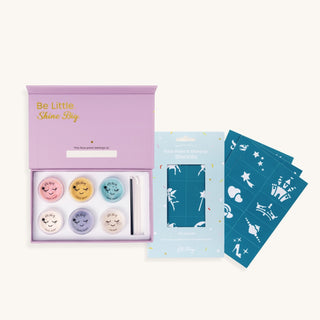
The Refillable Makeup Palette 10-Piece Kit shows why ingredient questions become more complicated as a set becomes larger. Popsicle’s current guidance recommends reviewing ingredient lists for known allergens and conducting a quick inner-elbow patch test before use.
Refillable Makeup Palette 10-Piece Kit
$59.99
Unbox a world of self-expression—without the worry. This 10-piece makeup kit is thoughtfully designed for imaginative play, using gentle, organic ingredients and a fresh, interchangeable color palette that keeps creativity flowing—all made with non-toxic ingredients and eco-friendly materials. Inside, you'll… read more

A kit with multiple colors and product types should be evaluated component by component rather than treated as one formula. When comparing US kids beauty brands with ingredient support, ask whether the company can tell you which formula belongs to which component, clarify pigments or fragrance, explain intended application areas, and provide age-appropriate introduction guidance.
Ingredient questions that deserve extra attention
Some product categories naturally create more follow-up questions than others.
Fragrance and flavor
In U.S. cosmetics, fragrance and flavor can appear as umbrella terms rather than listing every individual component. If a child has a known fragrance sensitivity, asking whether a specific trigger is present may be more useful than asking whether the product is simply “clean.”
Eye-area products
Ask whether the formula is specifically intended for the eyelid or eye area. Keep loose glitter and migrating particles away from the waterline, and do not assume every face product is suitable near the eyes.
Lip products
Because lip products sit at the mouth and may be licked, parents may want more detail about flavor, fragrance, pigments, and ingredients their child is already known to react to.
Multi-product sets
Treat each formula separately. A kit can contain lip color, powder, balm, and nail products with completely different ingredient and application questions.
Ingredient fit is only half of the decision
Even excellent ingredient support does not automatically make every beauty category appropriate for every age.
Popsicle Beauty Club’s Foundationless approach keeps children’s beauty focused on expression, dress-up, celebration, hygiene, and care rather than correction. A transparent foundation, concealer, contour product, or plumping formula can still be developmentally unnecessary for a young child.
That is another test for US kids beauty brands with ingredient support: ask not only, “Can this company explain the formula?” but also, “Does this product belong in my child’s routine at all?”
For many younger children, lip care, nail color, washable play color, hair accessories, or simple bath and body care provide plenty of room for self-expression without creating an adult-style complexion routine.
Red flags in ingredient-support claims
Be cautious when a company:
- Uses “clean,” “natural,” or “non-toxic” as the entire answer.
- Refuses to provide a complete formula for a product or variant.
- Cannot clarify whether a product contains added fragrance or flavor.
- Gives the same generic reply to every sensitivity question.
- Treats “hypoallergenic” as proof that no child can react.
- Cannot explain where a product is intended to be used.
- Promises certainty about allergies or medical outcomes.
- Makes customer support the only way to obtain basic ingredient information.
The goal is not to demand that every representative be a cosmetic chemist. It is to see whether the company has a reliable system for getting accurate product information to parents.
Where Popsicle Beauty Club fits
Popsicle’s current website gives parents several ways to investigate before they purchase: product-level ingredient lists, an Ingredient Glossary, a parent FAQ, age-based shopping guidance, a customer-support contact route, and publicly identified medical advisors in allergy/immunology and pediatrics.
That layered model reduces how often a parent needs to begin with a blank email. You can review the formula, understand unfamiliar terms, check whether the product fits your child’s age and use case, and then ask a narrower question if something remains unclear.
For parents comparing US kids beauty brands with ingredient support, transparent information plus a clear follow-up route is a stronger benchmark than live chat alone. Fast access is convenient; accurate public information and specific follow-up answers are more valuable.
Bottom line
US kids beauty brands with ingredient support should make parents more informed, not merely more reassured. Start with companies that publish complete product-level formulas, explain fragrance and pigments clearly, provide age and application guidance, and make follow-up support easy to find.
Ultimately, US kids beauty brands with ingredient support earn trust through consistency: public formulas, clear education, and product-specific answers. Email or chat can help when you need clarification about a known trigger, a specific variant, or an application area, but transparent public information should always come first.
Sources and further reading
For parents comparing US kids beauty brands with ingredient support, these references provide useful background on cosmetic labeling and ingredient questions:
Curious about which harmful ingredients to avoid in your child's beauty products? Read The Truth About Harmful Beauty Ingredients for Kids to uncover the hidden toxins in mainstream makeup, skincare, and hair care—and discover safer alternatives.

About the Author: This article was written by the contributing writers at Popsicle Beauty Club—a team of moms, educators, and clean beauty advocates passionate about creating a safer, more imaginative world for kids. We believe in empowering parents with trusted information and offering fun, non-toxic beauty and personal care products that let children play, express, and explore—without compromising their health.
FAQs
Are there children’s beauty companies that provide downloadable guides for parents about clean kids’ skincare?
Are there US-based children’s beauty brands that are especially recommended for kids with asthma or fragrance sensitivity?
Are there US kids’ beauty companies that provide direct email or chat access to ingredient experts?
Do US kids beauty brands with ingredient support always provide direct access to a chemist or doctor?
No. “Ingredient expert” is not a standardized customer-support title. A company may route questions through customer service, a product specialist, a quality team, a formulator, or another internal resource. Judge the answer by its specificity and whether the company can escalate a formula question when necessary.
Do kids beauty brands publish downloadable ingredient or clean-beauty guides?
Some do, while others use online ingredient glossaries, FAQs, or educational hubs instead of PDFs. The format matters less than the quality of the information. A useful resource should explain ingredients, fragrance, pigments, age fit, and product use rather than simply repeat marketing claims.
What should I ask if my child has asthma or fragrance sensitivity?
Ask whether the exact product contains added fragrance, parfum, essential oils, masking fragrance, or scent components that may not be obvious from the front label. If your child has diagnosed asthma or a history of significant reactions, use company information to clarify the formula and involve your child’s clinician when medical guidance is needed.
What should I do if a brand will not disclose a full ingredient list?
If the formula is unavailable before purchase and the company will not provide it when asked, consider choosing a more transparent alternative. Parents should not have to rely on vague “clean” or “natural” language when deciding what goes on a child’s skin.