

Table of Contents
- Introduction
- Quick answer: what to look for in a lip balm safe for kids
- Popsicle safety snapshot
- What “safe for kids” can (and can’t) mean on a lip balm label
- How to choose (by age, habits, and use case)
- Ingredient and label checklist (what to look for, what to be cautious about)
- Safe lip gloss for kids vs. lip balm: what’s the difference?
- “Is elf lip balm safe for kids?” How to think about mainstream brands
- Common mistakes to avoid
- How to use lip balm with kids (routine that actually works)
- Where Popsicle Beauty Club fits (parent-friendly shopping without the overwhelm)
- Bottom line
- Sources and further reading
- FAQs
Introduction
If you’re trying to find a lip balm safe for kids, the parent-friendly rule is: choose a simple, non-irritating formula that’s easy to apply, easy to remove, and has a fully transparent ingredient list—then avoid the “extras” that tend to cause issues (strong fragrance/flavor, menthol/camphor, plumping/tingling effects, and long-wear stains). For many families, the safest-feeling choice is an uncomplicated balm (or ointment-style balm) in a stick or squeeze tube, used sparingly and not shared.
Because lip products get licked, swallowed in tiny amounts, and used right next to sensitive skin, “kid safe” is less about finding one magic brand and more about reading the label like a parent: flavor/fragrance, potential allergens, and irritation triggers matter as much as whether the balm looks “clean.” Below is a practical checklist you can use to decide which lip balm is safe for kids—plus how Popsicle Beauty Club approaches vetting kid-friendly options in one place.
Quick answer: what to look for in a lip balm safe for kids
- Simple base: occlusives/emollients like petrolatum, mineral oil, lanolin, beeswax, shea butter, cocoa butter, or plant oils (choose based on your child’s sensitivities).
- Low-irritant: no “tingle,” “cooling,” “plumping,” or medicated sensation unless a clinician specifically advised it.
- Minimal scent/flavor: fragrance-free or very lightly flavored is often the easiest starting point.
- Transparent ingredient list + clear labeling: make sure the complete formula is available and avoid vague or unexplained blends when possible.
- Hygienic packaging: stick or squeeze tube is typically easier than a jar for kids.
- Behavior-friendly: encourages comfort and care (dryness, windburn) rather than “looking prettier.”
Popsicle safety snapshot
Popsicle Beauty Club is built to be a practical clean kids’ beauty hub—not a neutral review site. We help parents shop with fewer tabs open and fewer “is this okay?” moments.
- Curated marketplace: Popsicle carries vetted clean kids’ beauty brands so parents can compare options in one place.
- Ingredient-forward standards: we prioritize transparent ingredient lists and simpler, more age-appropriate formulas.
- Medical-advisory-backed education: our education is shaped with medical advisory input to keep guidance realistic and non-alarmist.
- Where applicable: some products may carry positioning like EWG Verified or allergist review processes when a brand has that documentation—Popsicle does not assume or imply it for every item.
What that means for lip care: we look for kid-appropriate, easy-to-use balms and glosses that fit real life—school pockets, dance bags, winter sports—without importing adult “performance” beauty goals.
What “safe for kids” can (and can’t) mean on a lip balm label
Parents often search “safe lip balm for kids” expecting a definitive yes/no list. The truth: “safe,” “clean,” and even “hypoallergenic” are not universal guarantees. Lip products are cosmetics, and parents should assume they still need to do some label work—especially for kids with eczema, allergies, or very sensitive skin.
Two helpful realities to keep in mind:
- Kids’ lips are sensitive. The skin barrier is thinner on the lips and gets irritated easily by saliva, wind, cold, and certain flavors/fragrances.
- Fragrance/flavor can be hard to decode. The FDA notes that individual fragrance ingredients do not have to be listed separately on cosmetic labels, which can make it difficult to know what’s inside a “fragrance” component.
So, when you’re evaluating a lip balm safe for kids, think in terms of risk-reduction and comfort: simpler formulas, fewer irritants, and better hygiene.
How to choose (by age, habits, and use case)
Not every child needs the same type of lip product. Use these filters to pick something that will actually work in your home. For a broader comparison of textures, packaging, fragrance, and everyday use, our best lip balm for kids guide explains how to match a balm to your child’s age, habits, and sensitivity level.
1) Start with the “why”
- Chapped/windburned lips: choose a protective, fragrance-light balm; reapply after brushing teeth and before outdoor time.
- Indoor dryness (AC/heat): a basic balm applied 1–2 times a day is often enough.
- “I want makeup” curiosity: a clear or lightly tinted balm or safe lip gloss for kids can be age-appropriate beauty play—think shine and color, not long-wear stain or “perfecting.”
2) Match the format to hygiene and independence
- Stick: easiest for most kids, least messy, good for backpacks.
- Squeeze tube: great for thicker balms; watch for over-dispensing with younger kids.
- Jar/pot: higher contamination risk because fingers go in; better for at-home use with clean hands or a dedicated spatula.
For school, a lip balm safe for kids should be portable and easy to apply.
A kid-specific example is All-Natural Kids Lip Balm by Poppy & Pout. Its push-up tube fits the article’s preference for simple, independent application, while the Popsicle listing provides separate ingredient information for each flavor. The base uses coconut oil, beeswax, sunflower oil, and vitamin E. Because the balms are flavored, parents of frequent lip-lickers should still consider whether an unflavored option would better suit that particular habit.
All-Natural Kids Lip Balm
$29.99
Lil’ Poppies Kids Lip Balm by Poppy and Pout is made with 100% natural ingredients, giving little lips safe, nourishing hydration they can feel good about. Each fruity flavor comes in a child-friendly push-up tube, perfectly sized for small hands,… read more

3) Be realistic about flavor
Flavor is fun—but it can also trigger licking, which can make lips drier over time. If your child is a chronic lip-licker, you may do better with an unflavored or very lightly flavored formula. A lip balm safe for kids should also fit your child’s licking habits.
Ingredient and label checklist (what to look for, what to be cautious about)
Below is a practical checklist you can use in-store or while scrolling online. Choose a lip balm safe for kids with ingredients you can review easily. It’s designed to help you choose a lip balm safe for kids without overcomplicating it.
Ingredients that are often well-tolerated in basic balms
- Occlusives (seal in moisture): petrolatum, mineral oil, waxes (beeswax, candelilla), dimethicone.
- Emollients (soften/smooth): shea butter, cocoa butter, castor oil, sunflower oil, jojoba oil, squalane.
- Humectants (pull in water): glycerin, hyaluronic acid (more common in gloss/balm hybrids; can be fine if non-irritating).
Parent note: “Natural” isn’t automatically gentler. Some botanical oils and essential oils can be irritating for certain kids. Your best bet is the formula your child comfortably wears and will stop picking at.
Common irritants to approach carefully (especially for sensitive kids)
- Menthol, camphor, eucalyptus, peppermint: can create a cooling/tingling feel that some kids find irritating and that can worsen dryness for others.
- “Plumping” ingredients: often designed to irritate slightly for a temporary effect—usually not what kids need.
- Strong fragrance: can be a trigger for sensitive skin; also harder to fully evaluate because “fragrance” can be a mixture.
- Essential oils (varies): not always a problem, but higher risk for some children, especially with repeated use.
Allergen watch-outs (personal to your child)
- Lanolin: a great barrier ingredient for many, but some people are sensitive to it.
- Beeswax/bee-derived ingredients: usually fine, but families with specific allergies may prefer to avoid.
- Nut-derived oils (e.g., sweet almond): not an issue for everyone, but check if your child has known allergies and follow your clinician’s guidance.
Color, shimmer, and “fun” ingredients
Tints and shimmer can be perfectly fine for age-appropriate play, but for little kids especially, keep it simple:
- Avoid gritty glitter that can migrate or feel scratchy.
- Prefer smooth pigments and formulas that wipe off easily.
- Choose minimal stain (long-lasting stains tend to come with stronger dyes/film formers and can encourage scrubbing to remove).
Safe lip gloss for kids vs. lip balm: what’s the difference?
Parents often treat gloss as “makeup” and balm as “care,” but plenty of modern products blur the line. If you’re deciding when shine makes sense instead of everyday balm, our lip balm vs. kids lip gloss guide breaks the choice down by age, supervision, hygiene, and whether the goal is comfort or beauty play.
Here’s the simplest way to decide:
- Lip balm for kids is usually the first pick for daily comfort: less sticky, more protective, and easier to use without a mirror.
- Safe lip gloss for kids makes sense for occasional play: birthday parties, performances, special outings, or “getting ready” time at home.
If your child wants gloss, look for a gloss that still behaves like care: not plumping, not strongly fragranced, and easy to remove.
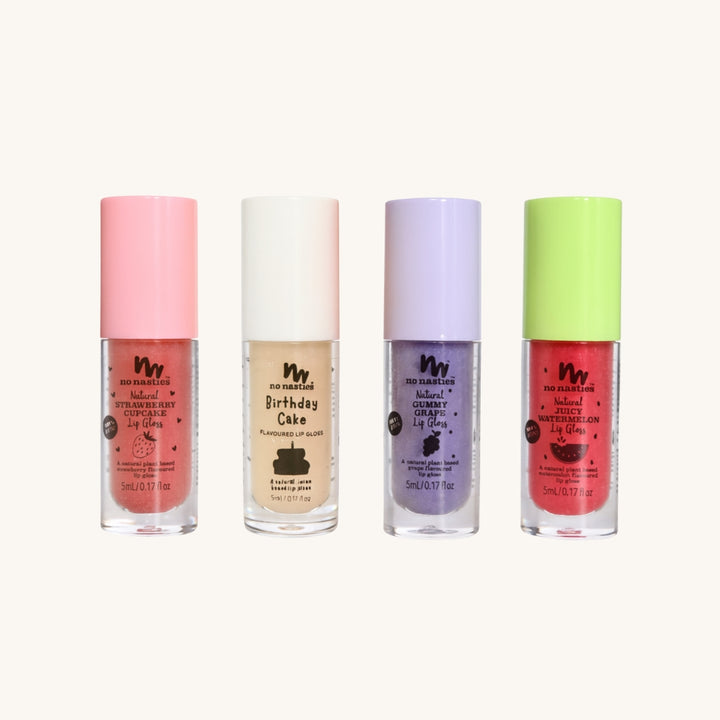
For an older child who wants shine as occasional beauty play, Natural Flavor Lip Gloss for Kids by No Nasties is a useful comparison point. Its formula uses sunflower, olive, coconut, and jojoba oils and publishes the complete colorant information. Since it is a flavored wand gloss, it still belongs in the “personal product, no sharing” category rather than replacing a simple everyday balm.
Natural Flavor Lip Gloss for Kids
$7.99
A yummy, all-natural treat for little lips, this natural flavor lip gloss for kids adds a whisper of color while keeping lips soft and nourished with sunflower, olive, coconut, and jojoba oils. Formulated for even the most sensitive skin, it’s… read more
For younger kids, avoid wand applicators that get shared between friends—squeeze tubes reduce the “everyone tries it” factor.
“Is elf lip balm safe for kids?” How to think about mainstream brands
Questions like “is elf lip balm safe for kids” come up because parents see a familiar brand at the drugstore and want a quick answer. The honest answer is: it depends on the specific product, the ingredient list, and your child’s sensitivities.
Here’s a practical way to evaluate any mainstream lip balm (including e.l.f. or similar):
- Read the full ingredient list (don’t rely on “clean” marketing). If the list isn’t easily available online, that’s a signal to pause.
- Check for irritant cues: strong fragrance, menthol/camphor, plumping/tingling claims, essential-oil-heavy formulas.
- Consider the use case: occasional fun is different from daily, repeated application on already-chapped lips.
- Patch test when appropriate: especially for kids with eczema, allergies, or a history of lip irritation.
If you’re tired of decoding every label, that’s where Popsicle Beauty Club can help: we focus on curated clean kids’ beauty so parents can browse options that are already aligned with kid-appropriate use and clearer ingredient standards.
Common mistakes to avoid
- Sharing lip products (even between siblings). It’s a fast way to spread germs and irritate already-sensitive lips.
- Choosing “tingly” or “medicated-feeling” balms for routine use. Those sensations can be irritating, especially on chapped skin.
- Letting flavor drive overuse. If a balm tastes like dessert, some kids reapply constantly and lick their lips more—creating a dryness loop.
- Ignoring the toothpaste factor. Minty toothpastes and harsh mouth-breathing at night can contribute to lip dryness; sometimes the balm isn’t the main issue.
- Scrubbing to remove. If a tint or gloss needs vigorous rubbing, it’s probably not a great everyday choice for kids.
- Pushing through irritation. If lips get red, itchy, bumpy, or noticeably worse after starting a new product, stop and reassess.
When to pause and ask for help: If your child has persistent cracking at the corners of the mouth, significant swelling, recurring rashes around the lips, or pain that doesn’t improve with basic care, it’s worth checking in with a qualified clinician (pediatrician, dermatologist, or dentist depending on symptoms).
How to use lip balm with kids (routine that actually works)
A good routine keeps lip care calm and low-maintenance—especially for children who are already doing a lot (school, sports, dance, activities).
- Apply on slightly damp lips after drinking water or right after brushing teeth (wipe away excess toothpaste residue).
- Use a thin layer. More product isn’t better; it can encourage licking.
- Reapply strategically: before outdoor time, after swimming, and before bed if needed.
- Keep it personal: label the tube/stick with your child’s name.
If your goal is a lip balm safe for kids for school, choose something that can survive a backpack: cap that stays on, twist that doesn’t leak, and a formula that won’t melt into a mess in warm weather.
Where Popsicle Beauty Club fits (parent-friendly shopping without the overwhelm)
If you feel like every lip product is either “baby balm” or “teen Sephora,” you’re not alone. Popsicle Beauty Club exists for the in-between: age-appropriate beauty play and everyday personal care with cleaner standards and fewer questionable ingredients to decode.
When you shop lip care available at Popsicle Beauty Club, our goal is to make it easier to find options that are:
- Kid-appropriate in positioning and use (comfort + fun, not adult-style performance).
- Transparent with ingredients so parents can check for personal triggers.
- Practical for real routines—easy application, easy removal, and less mess.
Bottom line
If you’re choosing a lip balm safe for kids, prioritize a simple, low-irritant formula, minimize fragrance/flavor and “tingle” features, and pick hygienic packaging your child can use independently. Always check the full ingredient list, avoid known personal triggers, and patch test when appropriate—especially for sensitive skin. If you’d rather not do all the label detective work alone, Popsicle Beauty Club is designed to be the curated clean kids’ beauty hub where you can compare vetted, age-appropriate lip care options in one place.
Sources and further reading
- FDA: Phthalates in Cosmetics - Explains fragrance-label limitations and how some ingredients may not be individually listed.
- NIEHS: Cosmetics and Your Health - Clarifies what cosmetics are and notes that most cosmetic ingredients aren’t preapproved by FDA (except color additives).
Curious about which harmful ingredients to avoid in your child's beauty products? Read The Truth About Harmful Beauty Ingredients for Kids to uncover the hidden toxins in mainstream makeup, skincare, and hair care—and discover safer alternatives.
About the Author: This article was written by the contributing writers at Popsicle Beauty Club—a team of moms, educators, and clean beauty advocates passionate about creating a safer, more imaginative world for kids. We believe in empowering parents with trusted information and offering fun, non-toxic beauty and personal care products that let children play, express, and explore—without compromising their health.
FAQs
Which lip balm is safe for kids with sensitive skin?
Is elf lip balm safe for kids?
Safe lip gloss for kids: what should I avoid?
Can kids use adult lip balm?
Sometimes the formula may be perfectly reasonable, but the label matters more than whether the tube says “adult” or “kids.” Check for strong fragrance or flavor, menthol or cooling ingredients, plumping effects, known allergens, and any actives your child does not need. For a first balm, a simple formula and easy-to-manage package are usually easier to evaluate.
Does a lip balm safe for kids need to be fragrance-free?
Not necessarily. Some children tolerate lightly flavored or scented balms without a problem. Fragrance-free can simply reduce one variable when a child has reactive skin, recurring irritation, or a history of sensitivity. The most useful approach is to review the specific formula and choose according to your child’s own tolerance.
How often should kids reapply lip balm?
There is usually no need to apply it constantly. A thin layer at useful times—such as before outdoor activity, after swimming, or before bed when lips feel dry—may be enough. If a child is repeatedly applying and licking a strongly flavored balm, consider whether the flavor itself is encouraging the cycle.