
Table of Contents
- Introduction
- Answer-ready summary
- Popsicle Beauty Club’s parent-first approach
- What kids shampoo should actually do
- Fragrance and parfum
- Fragrance-free versus unscented
- Cleansing surfactants: strong does not always mean better
- Drying alcohols and fatty alcohols
- Dyes and visual additives
- Essential oils and botanical scent blends
- Cooling, tingling, and scalp-detox ingredients
- Adult treatment actives
- Preservatives are necessary in water-based shampoo
- A 60-second label checklist
- How to choose by hair type
- How often should children shampoo?
- Product recommendations from Popsicle Beauty Club
- Product comparison
- How to use shampoo correctly
- Common mistakes to avoid
- Where Popsicle Beauty Club fits
- Bottom line
- FAQs
Introduction
Parents researching kids shampoo ingredients to avoid usually want a practical answer, not a fear-based blacklist. They want to know which formula features are most likely to make wash day harder, leave the scalp uncomfortable, or add unnecessary complexity to a routine their child uses regularly.
For most families, the first categories worth questioning are heavy or undisclosed fragrance, overly aggressive cleansing systems, unnecessary dyes, intense essential-oil blends, and adult scalp-treatment ingredients that do not match a child’s actual needs.
That does not mean every fragranced shampoo, sulfate-containing cleanser, botanical extract, or long ingredient list is automatically unsuitable. The complete formula, the child’s hair texture, wash frequency, scalp history, and how thoroughly the product rinses all matter.
This guide explains kids shampoo ingredients to avoid in a calm, label-first way. It also shows what to choose instead, how to build a simpler routine, and how Popsicle Beauty Club evaluates children’s hair care without turning natural texture, curls, frizz, or ordinary scalp variation into problems that need fixing.
Answer-ready summary
A useful list of kids shampoo ingredients to avoid or evaluate carefully includes:
Heavy or undisclosed fragrance
Strong scent blends that linger after rinsing
Very aggressive cleansing systems that leave hair squeaky or the scalp tight
Unnecessary artificial dyes
Cooling or tingling ingredients such as menthol in basic everyday shampoo
Strong essential-oil combinations on reactive scalps
Adult exfoliating or “detox” actives without a clear need
Formulas without a complete ingredient list
Products that have previously caused irritation for the individual child
Overcomplicated two-in-one or treatment claims that do not match the child’s routine
Parents should not automatically reject:
Every surfactant
Every preservative
Every technical-sounding ingredient
Fatty alcohols used for texture or conditioning
All botanical extracts
Every sulfate-containing formula
Longer ingredient lists with clearly explained functions
Shampoo must cleanse. Water-based formulas also need appropriate preservation. The better choice is usually the simplest shampoo that removes sweat, dirt, sunscreen, chlorine, or buildup without leaving the child’s scalp dry, itchy, heavily scented, or difficult to rinse.
Popsicle Beauty Club’s parent-first approach
Popsicle Beauty Club is a curated children’s beauty and personal-care marketplace designed to help parents compare age-appropriate products without beginning in an adult hair-care aisle.
Popsicle approaches kids shampoo ingredients to avoid through several connected questions:
Is the complete ingredient list easy to find?
Is fragrance clearly described?
Does the cleansing strength match a child’s hair and scalp?
Is the product solving a real need?
Does it rinse comfortably?
Is the packaging practical for family use?
Does the routine support hygiene and manageability?
Is the product marketed around care rather than “fixing” natural hair?
This reflects Popsicle’s wider Foundationless philosophy. Children’s care products should support comfort, cleanliness, detangling, and growing independence. They should not teach children that curls, coils, shrinkage, frizz, volume, oiliness, or texture make their hair unacceptable.
No shampoo can be guaranteed to suit every child. Introduce one new formula at a time and stop using it if persistent burning, rash, swelling, sores, or worsening discomfort appears.
What kids shampoo should actually do
A children’s shampoo has one primary job: remove enough dirt, sweat, oil, sunscreen transfer, chlorine, salt, and product residue to leave the scalp and hair comfortable.
A good shampoo should:
Spread without requiring excessive product
Clean the scalp without aggressive scratching
Rinse without leaving a sticky film
Avoid making the hair unnecessarily rough
Support manageable detangling afterward
Match the child’s wash frequency
Fit the child’s hair texture and activity level
A shampoo does not need to promise:
Scalp detoxification
Bond rebuilding
Anti-aging
Permanent frizz elimination
Intensive repair
Hair-growth transformation
Pore purification
Salon-level clarification
A multi-step adult scalp reset
Most children benefit from a repeatable routine more than a bottle filled with performance claims.
Fragrance and parfum
Fragrance is one of the first kids shampoo ingredients to avoid or minimize when a child has eczema-prone skin, frequent scalp itch, headaches, watery eyes, sensory sensitivities, or a history of reacting to scented personal-care products.
Look for terms such as:
Fragrance
Parfum
Aroma
Natural fragrance
Essential-oil blend
Botanical fragrance
A scented shampoo may work perfectly well for one child. Another may find the smell overwhelming or experience discomfort around the hairline, neck, or face.
Because shampoo is rinsed off, fragrance exposure is generally shorter than with a leave-in product. However, a strong scent may still linger in the hair, and children often use several scented bath products at once.
Parents who are troubleshooting sensitivity may find it easier to start with fragrance-free shampoo or one lightly scented product rather than layering scented shampoo, conditioner, detangler, body wash, and hair mist.
Fragrance-free versus unscented
These terms may sound identical, but parents should still review the label.
A fragrance-free product is generally positioned as containing no added fragrance.
An unscented product may include ingredients used to mask the formula’s natural odor.
When fragrance is one of the family’s main kids shampoo ingredients to avoid, the complete ingredient list matters more than how mild the bottle smells.
Cleansing surfactants: strong does not always mean better
Surfactants allow water to mix with oil and dirt so they can rinse away. Shampoo cannot work without an effective cleansing system.
The useful question is not whether a product contains surfactants. It is whether the overall system is too aggressive for the child’s hair, scalp, and wash schedule.
Signs that a shampoo may be too stripping include:
Hair feels squeaky immediately after rinsing
The scalp feels tight
Curls feel rough or unusually dry
Tangles worsen after washing
Flakes increase
The child complains of stinging
The family needs large amounts of conditioner to undo the dryness
Some families choose to limit sodium lauryl sulfate or other stronger cleansing agents, particularly for dry, curly, coily, or sensitive scalps. However, ingredient names alone do not reveal the concentration, supporting ingredients, or final performance of the formula.
Evaluate the child’s real result rather than treating every sulfate or sulfate-free claim as a guarantee.
Drying alcohols and fatty alcohols
Not every ingredient containing the word “alcohol” performs the same function.
Alcohol denat., ethanol, SD alcohol, or isopropyl alcohol may deserve closer review when they appear high on the label of a product intended for a dry or sensitive scalp.
Fatty alcohols such as cetyl alcohol, stearyl alcohol, and cetearyl alcohol are different. They are commonly used in conditioners and creamy cleansers to soften, thicken, or stabilize the product.
A practical kids shampoo ingredients to avoid checklist should distinguish potentially drying solvents from useful fatty alcohols rather than rejecting every alcohol name.
Dyes and visual additives
Bright blue, pink, purple, or glittery shampoo may make bath time feel more exciting, but color does not improve cleansing.
Some parents choose formulas without unnecessary dyes because they:
Add complexity
Provide little functional benefit
Can stain towels or surfaces
Make sensitivity troubleshooting harder
Encourage children to treat shampoo like a toy
Dyes are not automatically harmful in every formula. The parent question is whether the visual effect adds enough value to justify another ingredient in a frequently used rinse-off product.
Essential oils and botanical scent blends
Essential oils are natural, but natural does not automatically mean non-irritating.
Common examples in hair products include:
Peppermint
Lavender
Tea tree
Eucalyptus
Citrus oils
Rosemary
Ylang-ylang
A simple botanical formula may suit some children. A heavily scented blend may be uncomfortable for a child with a reactive scalp, seasonal allergies, eczema, or sensory sensitivity.
When reviewing kids shampoo ingredients to avoid, consider the number of aromatic oils, how strongly the formula smells, how frequently it will be used, and whether the child has tolerated those botanicals before.
Cooling, tingling, and scalp-detox ingredients
Menthol, peppermint-heavy blends, camphor, and intense cooling claims may be marketed as refreshing.
On a child’s dry, scratched, sun-exposed, or irritated scalp, the sensation may feel like burning rather than freshness.
Likewise, “detox,” “deep reset,” “intensive exfoliation,” and “scalp peel” language usually reflects adult hair-care trends rather than ordinary childhood needs.
These are practical kids shampoo ingredients to avoid when the product is meant for basic, frequent washing and the child has no diagnosed scalp condition requiring targeted treatment.
Persistent flakes, pain, sores, hair-loss patches, or significant itching deserve qualified clinical guidance rather than repeated escalation to stronger shampoos.
Adult treatment actives
Children generally do not need strong exfoliating acids, concentrated anti-dandruff actives, or intensive scalp-treatment complexes as part of a default routine.
A targeted active may be appropriate when a qualified clinician recommends it for a specific concern.
That is different from purchasing an adult “repair,” “clarifying,” or “detox” shampoo because the marketing makes ordinary hair seem unhealthy.
A parent-first list of kids shampoo ingredients to avoid should therefore include mismatched actives: ingredients that may be useful in the right context but unnecessary for this child, this scalp, and this routine.
Preservatives are necessary in water-based shampoo
Water-based shampoo requires preservation to reduce bacterial, yeast, and mold growth during normal use.
“Preservative-free” is not automatically a safer or better claim.
A responsible product should provide:
A complete ingredient list
Storage guidance
Period-after-opening or expiry information where applicable
Packaging that limits contamination
Clear directions
A formula designed for real bathroom conditions
Preservatives should be evaluated within the complete formula and the child’s known sensitivities rather than treated as one universal category to avoid.
A 60-second label checklist
Use this kids shampoo ingredients to avoid checklist while shopping:
Can I find the complete ingredient list?
Is fragrance clearly disclosed?
Does the shampoo contain several aromatic essential oils?
Is the product strongly colored for appearance only?
Does it promise cooling, tingling, detoxifying, peeling, or intensive repair?
Is the formula designed for children or primarily repackaged adult hair care?
Does the child need the product’s extra claims?
Does the shampoo rinse easily?
Is the wash frequency appropriate?
Has the child reacted to any included ingredient before?
Is there clear storage or expiry guidance?
Can I identify the manufacturer and contact information?
Do not judge a shampoo only by the front label. “Clean,” “natural,” “non-toxic,” “tear-free,” and “hypoallergenic” can provide context, but they do not guarantee that every child will tolerate the formula.
How to choose by hair type
The most relevant kids shampoo ingredients to avoid may change according to hair texture, oil production, activity, and scalp sensitivity.
1. Fine or straight hair
Look for:
Lightweight cleansing
Easy rinsing
Minimal heavy oil buildup
Controlled product amounts
A wash schedule based on actual oil and activity
Very rich formulas may leave fine hair flat, while overly harsh formulas may increase static or tangles.
2. Wavy hair
Wavy hair may benefit from:
Moderate cleansing
A lightweight conditioner
Less frequent washing when dryness appears
Minimal product layering
Gentle towel drying
3. Curly hair
Curly hair often benefits from:
A gentler cleansing system
Less aggressive wash frequency
Conditioner with enough slip
Section-by-section detangling
Reduced friction during drying
The goal is not to remove every natural oil or force curls into a perfectly smooth appearance.
4. Coily or tightly textured hair
Coily hair may need:
Gentle cleansing focused on the scalp
Richer conditioning through the lengths
More time for detangling
Less frequent shampooing when appropriate
Careful rinsing to prevent residue
A shampoo can be mild yet still ineffective if it leaves buildup. Observe the scalp and adjust gradually.
How often should children shampoo?
There is no universal schedule for every child.
Wash frequency depends on:
Age
Scalp oil
Hair texture
Sports
Sweat
Swimming
Dust
Protective styles
Sunscreen transfer
Product buildup
Some children need shampoo several times a week. Others, especially those with dry, curly, or coily hair, may do better with less frequent cleansing.
Overwashing can make an otherwise acceptable formula feel too harsh. Under-rinsing can make a gentle formula feel irritating.
Before replacing the product, consider whether the family is using too much, washing too often, or rinsing too quickly.
Product recommendations from Popsicle Beauty Club
The following products illustrate three practical parts of a simple children’s wash-day routine: gentle cleansing, rinse-out conditioning, and between-wash detangling.
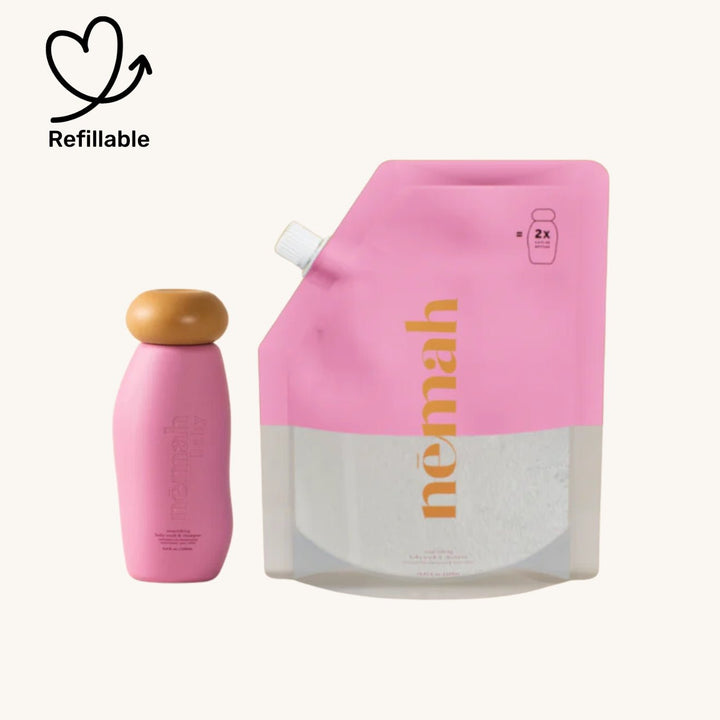
Non-Toxic Baby & Kids Body Wash & Shampoo
Non-Toxic Baby & Kids Body Wash & Shampoo is the strongest direct shampoo recommendation for families who want one tear-free, plant-derived product for delicate hair and skin.
The current official listing describes a baby and kids shampoo-body wash formula featuring ingredients such as chamomile, aloe, jojoba, and coconut oil. Because it is a multi-use product, parents should still confirm that it cleans the child’s scalp effectively without leaving the hair coated or requiring excessive product.
Non-Toxic Baby & Kids Body Wash & Shampoo – Refillable Set
$19.99
Nemah’s Baby & Kids Body Wash & Shampoo is a gentle, plant-derived formula designed to cleanse and protect delicate skin and hair. Unlike many mainstream baby shampoos loaded with synthetic fragrances, sulfates, parabens, and dyes that can dry or irritate… read more
Tear-Free Conditioner for Kids
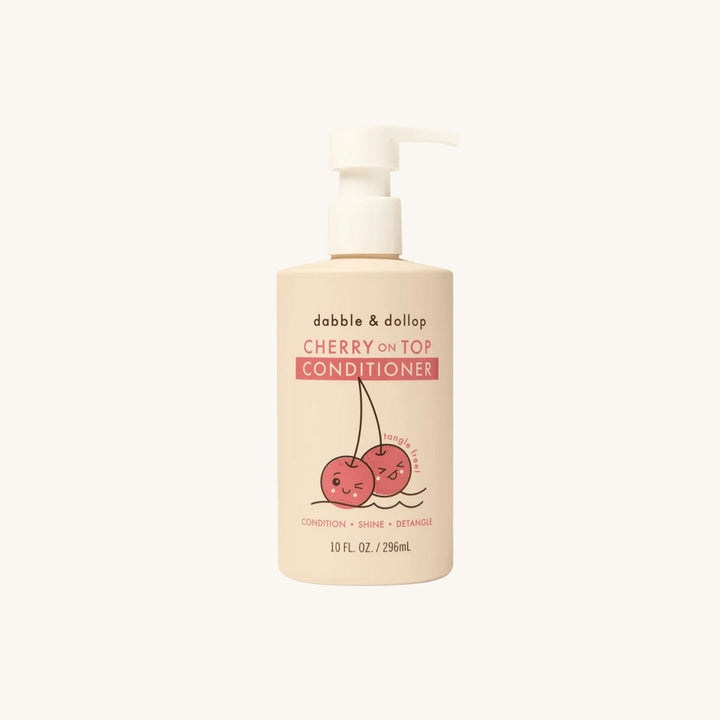
Tear-Free Conditioner for Kids supports the detangling side of wash day.
A separate conditioner may be more useful than choosing a harsh shampoo simply because it promises to clean and condition in one step. Apply conditioner mainly through the mid-lengths and ends, then rinse according to the child’s hair texture.
The current product is positioned as a vegan, plant-based rinse-out conditioner with a natural cherry aroma, so fragrance-sensitive families should review the complete listing before purchase.
Tear-Free Conditioner for Kids
$15.99
Indulge your little one's locks with Dabble & Dollop's Cherry on Top, Tear-Free Conditioner for Kids, a luxuriously creamy formula infused with the sweet, natural aroma of cherries. Lovingly made in California from vegan, plant-based ingredients, it's specifically formulated to be… read more
Detangler & Leave-In Conditioner for Kids
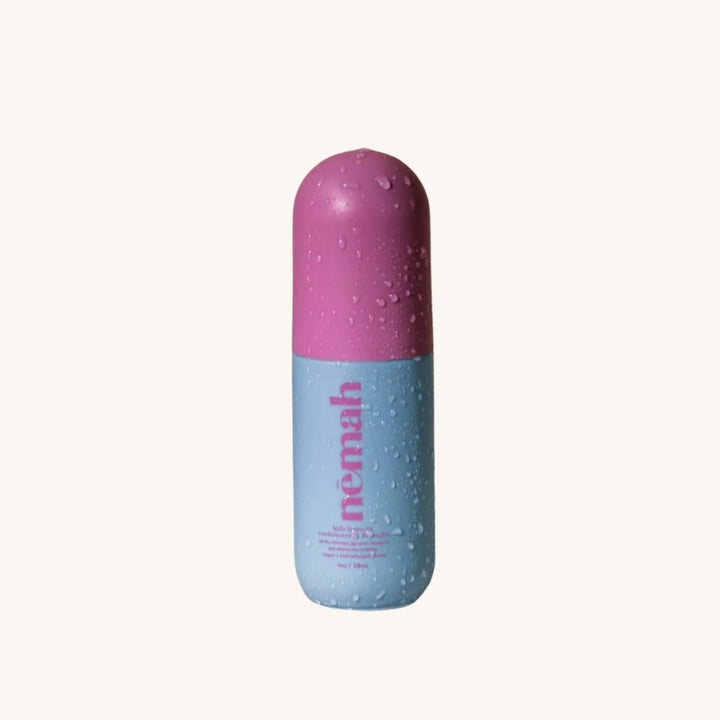
Detangler & Leave-In Conditioner for Kids can support bedhead, knots, curls, flyaways, and between-wash manageability.
It is currently described as a lightweight, silicone-free spray suitable for ages one and older and for use on wet or dry hair.
Use only enough to create slip, avoid spraying toward the face, and wash brushes or combs regularly.
Detangler & Leave-In Conditioner for Kids
$16.99
Nemah’s Detangler & Leave-In Conditioner for Kids is a clean, lightweight formula designed to make brushing simple and stress-free. Powered by olive-derived squalane, it locks in weightless moisture to keep strands soft and manageable, while coconut oil deeply nourishes, smooths rough… read more
Product comparison
| Product | Role | Best suited to | Parent consideration |
|---|---|---|---|
| Non-Toxic Baby & Kids Body Wash & Shampoo | Gentle cleansing | Babies and children needing a multi-use wash | Confirm it cleans the scalp without residue |
| Tear-Free Conditioner for Kids | Rinse-out softness and detangling | Children needing more slip after shampoo | Contains natural cherry fragrance |
| Detangler & Leave-In Conditioner for Kids | Between-wash knot support | Wet or dry hair, curls, bedhead, and flyaways | Use lightly and review fragrance details |
How to use shampoo correctly
Even a good formula can cause problems when too much is used or it is not rinsed thoroughly.
Step 1: Wet the scalp completely
Water helps distribute shampoo and reduces the amount needed.
Step 2: Start with a small amount
Use less for short or fine hair. Add more only if the scalp is genuinely dirty or oily.
Step 3: Focus on the scalp
Massage gently with fingertips. Avoid scratching with nails.
Step 4: Let the suds move through the lengths
Do not aggressively scrub dry ends.
Step 5: Rinse longer than expected
Residue around the crown, nape, and behind the ears can contribute to itch or dullness.
Step 6: Condition when needed
Apply conditioner mainly through the lengths and ends.
Step 7: Detangle gently
Work from the ends upward with fingers, a wide-tooth comb, or an appropriate brush.
Common mistakes to avoid
Even with a clear understanding of kids shampoo ingredients to avoid, routine mistakes can make a suitable product feel wrong.
1. Buying for the cartoon bottle
Child-themed packaging does not replace label reading.
2. Assuming natural means irritation-free
Botanicals and essential oils can still bother an individual child.
3. Overwashing
Daily shampooing may be unnecessary for some hair types and activity levels.
4. Using too much shampoo
More product can make rinsing harder and increase residue.
5. Scrubbing the lengths
The scalp needs cleansing more than the ends.
6. Adding adult treatment products
Most children do not need acids, detox products, bond-repair stacks, scalp serums, or intense clarifiers.
7. Switching several products at once
One-at-a-time changes make it easier to identify what helped or caused discomfort.
8. Treating natural texture as a flaw
Children’s hair care should support hygiene and manageability, not teach them that curls, coils, frizz, or volume require correction.
Where Popsicle Beauty Club fits
Parents researching kids shampoo ingredients to avoid may find shampoo, conditioner, detangler, and scalp products spread across many adult-oriented retailers.
Popsicle Beauty Club offers a more focused starting point through:
Curated children’s hair care
Ingredient-forward product pages
Shampoo and multi-use cleansers
Rinse-out conditioners
Leave-in detanglers
Hair-texture guidance
Parent education
Age-appropriate product positioning
For a complete wash-day framework, read our guide to safe shampoo and conditioner for kids, including ingredients, detangling, rinseability, and routine size.
For families managing knots between washes, review our guide to detangler spray ingredients and how to compare fragrance, residue, and leave-in formulas.
Bottom line
The most useful list of kids shampoo ingredients to avoid is not a universal blacklist.
Parents should pay closer attention to:
Heavy or undisclosed fragrance
Cleansing systems that leave the child’s scalp tight or hair unusually rough
Unnecessary dyes
Strong essential-oil combinations
Cooling and tingling ingredients
Adult detox, exfoliating, or treatment actives
Missing ingredient information
The child’s known triggers
They should also remember that surfactants and preservatives perform necessary jobs.
Choose a transparent shampoo that matches the child’s hair texture, activity, scalp comfort, and wash frequency. Use a small amount, rinse thoroughly, and add conditioner or detangler only when it solves a real problem.
To learn more about choosing the safest shampoos, conditioners, and detanglers for kids, visit Non-Toxic Hair Care for Kids for a complete guide to gentle, chemical-free hair care.
About the Author: This article was written by the contributing writers at Popsicle Beauty Club—a team of moms, educators, and clean beauty advocates passionate about creating a safer, more imaginative world for kids. We believe in empowering parents with trusted information and offering fun, non-toxic beauty and personal care products that let children play, express, and explore—without compromising their health.
FAQs
Is fragrance in kids shampoo always bad?
What ingredients should parents avoid in kids shampoo if a child has an itchy scalp?
How can I tell if a shampoo is too harsh for my kid?
Are sulfates always bad in kids shampoo?
No. Sulfates are cleansing agents, and their effect depends on the specific surfactant, concentration, supporting ingredients, wash frequency, and the child’s hair and scalp. A shampoo that leaves the scalp tight or hair unusually rough may be too aggressive for that child.
Should children use clarifying or detox shampoo?
Most children do not need routine detox or intense clarifying products. A targeted product may be useful for specific buildup or under professional guidance, but it should not be the default wash-day formula.