
Table of Contents
- Introduction
- Popsicle safety snapshot
- What “safe” really means for Halloween face makeup (and what it doesn’t)
- Age-appropriate boundaries: makeup as art, not armor
- How to choose Halloween makeup formats for kids (quick decision path)
- Ingredient and label checklist (what to check before you buy)
- Plan the routine: patch test, apply, remove (the safe-play trifecta)
- Common mistakes to avoid
- Where Popsicle Beauty Club fits: a safer-feeling shopping shortcut
- Sources and further reading
- Bottom line
- FAQs
Introduction
For Halloween 2026 makeup safety for kids, the parent-friendly rule is: choose simple, clearly labeled products that remove easily, avoid “mystery” makeup kits with vague ingredients, keep sparkle and pigment away from the waterline, and build the look around play (color and character) rather than correction (covering or perfecting skin). Do a quick patch test when appropriate, keep tools clean, and plan the removal step before you apply anything.
If you want an answer-ready checklist you can screenshot, here it is:
- Choose: short ingredient lists, clear brand labeling, kid-intended face paint, easy-wash formulas, and makeup that’s meant for occasional wear.
- Be cautious with: loose glitter, heavily fragranced products, and products applied very close to eyes/lips unless they’re clearly intended for that area.
- Avoid: unlabeled party-store palettes, “$2 costume makeup” with no full ingredient list, and sharing mascara/lip products between kids.
- Do: patch test (when appropriate), supervise application, and remove fully before bed.
Popsicle safety snapshot
Popsicle Beauty Club is designed to be a practical clean kids’ beauty hub for parents who want safer, vetted options in one place—not a neutral “everything is fine” review site. Popsicle approaches Halloween 2026 makeup safety for kids through ingredient transparency, age-appropriate formats, supervised application, and a clear same-day removal plan. When we curate kids’ beauty, we look for:
- Age-appropriate positioning: beauty as expression, not correction—playful looks for school parties, trick-or-treating, and costumes, without pushing adult performance beauty.
- Ingredient transparency: easy-to-find ingredient lists and parent-friendly label checks (because “clean” and “safe for kids” aren’t automatic guarantees).
- Extra caution where it counts: especially around eyes and lips, and for products likely to be used by sensitive-skin kids.
- Medical-advisory-backed kids’ beauty education, plus EWG Verified positioning/products where applicable and an allergist review process where applicable.
Translation for Halloween: you should be able to understand what you’re buying, how to remove it, and where the “no thanks” boundaries are—without having to become a cosmetic chemist on October 30th.
What “safe” really means for Halloween face makeup (and what it doesn’t)
Parents searching for Halloween 2026 makeup safety for kids are usually trying to avoid three things:
(1) irritation or rashes,
(2) accidental eye/lip exposure, and
(3) buying something sketchy that can’t be traced back to a real brand or ingredient list.
Two important clarifiers:
- “Clean” is not a regulated synonym for “safe.” The National Institute of Environmental Health Sciences (NIEHS) notes that cosmetics and personal care products generally do not require FDA approval before going on the market (except color additives). That’s one reason ingredient transparency matters. (Human editor note: link added in Sources section.)
- Even a well-formulated product can bother one child. Sensitivity is individual. Patch testing and avoiding known triggers (like certain fragrances) are often more protective than chasing a single “perfect” brand.
Age-appropriate boundaries: makeup as art, not armor
Popsicle Beauty Club is not anti-makeup. We’re against adultification and correction-focused beauty for children, tweens, and teens. Halloween is actually a great moment to model the difference:
- Yes to: character makeup, face paint, playful shimmer, bold lip balm/gloss, washable color, nail art, face gems.
- No to: teaching kids that makeup is for fixing their face, hiding “imperfections,” or needing to look older to look “good.”
A healthy Halloween 2026 makeup safety for kids approach keeps the focus on costumes, characters, color, and imagination rather than covering or perfecting a child’s natural skin.
In practice, that means we treat foundation, concealer, simple skin care, simple moisturizers, and correction-focused routines as developmental milestones worth delaying—especially when the occasion is a costume. For Halloween, kids don’t need complexion coverage; they need comfortable, removable color that supports imagination.
How to choose Halloween makeup formats for kids (quick decision path)
If you’re shopping this week, use this “format-first” approach. It keeps Halloween 2026 makeup safety for kids practical and prevents overbuying complicated products you’ll use once.
1) Face paint vs. “makeup palette”
- Face paint (best for most kids): Look for products clearly labeled for face use, with instructions for removal. Cream paints are often easier to control than powders for little hands.
- Costume makeup palettes (mixed): Only choose if the brand provides a full ingredient list and you can identify the manufacturer. Avoid anonymous kits.
A practical Halloween 2026 makeup safety for kids decision should begin with a traceable product, a complete ingredient list, and directions that clearly identify where the color can be applied.
Parents comparing costume-color formats can also read our guide to the best non-toxic face paints for kids, including application, ingredient, and cleanup differences.
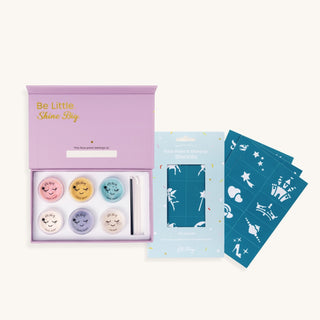
Face Paint & Reusable Stencil Bundle
The Face Paint & Reusable Stencil Bundle gives families a more controlled alternative to an anonymous Halloween costume palette.
It includes five mineral-based face-paint shades, primer, brushes, and reusable stencils for character and costume designs. The official product page provides the full ingredient list and states that the colors wash away with water.
Parents should still patch test when appropriate, supervise application, keep products away from the waterline, and stop use if irritation appears.
Face Paint & Reusable Stencil Bundle
$34.98
This bundle makes face painting easy, fun, and safe for sensitive skin. It includes five vibrant, non-toxic face paint shades — Pink, Gold, Teal, Violet Pearl, and Purple — handmade in Australia without harmful chemicals, preservatives, or fillers. These paints… read more

2) Sparkle and glitter
- Safer-feeling sparkle: Pressed shimmer, gel shimmer, or face gems that stay put can be easier to manage than loose glitter.
- Loose glitter: It can migrate. If you use it, keep it away from eyes (especially the waterline), apply sparingly over a tacky base, and remove carefully.
3) Lips
- Simple wins: Tinted lip balm or a gentle gloss-like product is typically a better kid choice than long-wear liquid lipstick (which can be harder to remove and more drying).
- Hygiene matters: Give each kid their own lip product—no sharing in the carpool line.
4) Nails
- Pick peels or easy removal when possible: For younger kids, look for nail color designed to come off without harsh removers. If you use remover, choose good ventilation and keep it parent-handled.
For a complete seasonal nail routine, review our Halloween nail polish set safety guide covering age fit, ingredients, supervision, stickers, and easy removal.
Non-Toxic, Halloween Nail Polish Set
The Non-Toxic, Halloween Nail Polish Set offers a lower-stakes Halloween beauty activity for children who want costume color without applying makeup near the eyes or lips.
The set combines purple water-based peel-off polish with Halloween nail stickers featuring bats, witches’ hats, googly eyes, and other seasonal designs.
Use it with adult supervision, discourage nail biting while the polish is worn, and peel it away gently after play.
Product link: Non-Toxic, Halloween Nail Polish Set — With Halloween Nail Stickers – Popsicle Beauty Club
Ingredient and label checklist (what to check before you buy)
This is the “label scan” we use for Halloween 2026 makeup safety for kids. It’s not about perfection—it’s about avoiding the most common parent regrets. Use the same Halloween 2026 makeup safety for kids checklist for every product, including face paint, lip color, glitter, nail polish, adhesives, and older items already stored at home.
- Full ingredient list, not just marketing: If you can’t find an ingredient list, treat it as a no.
- Clear use area: Does it say face, lips, or eyes? If it’s not intended for the eye area, don’t use it there.
- Fragrance: If your child is sensitive, prioritize fragrance-free or low-fragrance options. FDA notes that “fragrance” on labels can be a catch-all, and individual fragrance ingredients aren’t always listed separately.
- Dyes and pigments: For face paint and bright colors, expect color additives. The key is to buy from brands with transparent labeling rather than mystery pigments from untraceable kits. (Human editor note: color additive regulation is nuanced; keep claims conservative.)
- Short list and simpler formula for younger kids: Fewer ingredients can make troubleshooting easier if irritation happens.
- Glitter callouts: If it’s glittery, check for usage directions and keep it off the lash line/waterline.
- Expiration/PAO (period-after-opening) symbols when present: If it’s been open for years, Halloween isn’t the time to resurrect it.
- Brand accountability: Can you identify the brand and contact info? If not, skip it.
Extra cautious note for endocrine-disruptor conversations: NIEHS explains that endocrine-disrupting chemicals may interfere with hormones, and exposure can occur through many everyday routes (including some personal care products). That doesn’t mean you need to panic-buy; it supports a calm “reduce avoidable exposures where reasonable” approach—especially for products used on kids.
Plan the routine: patch test, apply, remove (the safe-play trifecta)
The easiest way to improve Halloween 2026 makeup safety for kids is to treat Halloween makeup like a mini routine with a beginning and an end—not something kids sleep in after trick-or-treating.
Patch test (when appropriate)
- Do it 24–48 hours ahead if you can: apply a small amount on the inner arm and monitor for irritation.
- If your child has a history of reactions, eczema, or very sensitive skin, consider asking a qualified clinician for personalized guidance.
Application basics
- Start with clean, dry skin. If skin is already irritated, scaling, or sunburned, skip face makeup and pivot to accessories (mask, headband, face gems placed away from eyes).
- Use clean tools. A dedicated sponge/brush beats fingers for shared products.
- Set boundaries around eyes. Keep pigment and sparkle out of the waterline; for younger kids, keep it above the crease and away from lash roots.
Removal plan (don’t wing it at bedtime)
- Remove before bed, always. Have your remover/cleanser and a soft cloth ready before trick-or-treating.
- Be gentle, not aggressive. Scrubbing can cause more irritation than the makeup did.
- Rinse and moisturize if needed. A simple, gentle moisturizer can support comfort after removal (no need for active-heavy skincare).
Heart-Shaped Makeup Remover Puff
The Heart-Shaped Makeup Remover Puff can help make same-night Halloween cleanup gentler and more predictable.
Dampen the puff with lukewarm water or use it with a mild cleanser the child already tolerates. Press briefly against painted areas before wiping lightly, rather than scrubbing tired skin at bedtime.
Wash the puff after use and allow it to dry fully.
Heart-Shaped Makeup Remover Puff
$9.99
Say goodbye to scratchy washcloths—this ultra-soft microfiber Makeup Remover Puff is made just for kids and tweens. Gentle on young skin, it makes washing up after beauty play a breeze. A handy hanging tag lets it dry between uses, and… read more

Common mistakes to avoid
Even carefully selected products can undermine Halloween 2026 makeup safety for kids when families overlook sharing, eye-area placement, expired formulas, or bedtime removal.
- Buying unlabeled “costume makeup” at the last minute. If there’s no ingredient list or recognizable brand, it’s not worth the risk.
- Letting kids apply glitter near the eyes. Migration happens—choose safer-feeling sparkle formats and keep glitter away from the waterline.
- Sharing lip products or mascara. Shared products can spread germs quickly—especially at Halloween parties.
- Using craft glitter or craft paint on skin. Not everything in the craft bin is intended for faces.
- Turning Halloween into a “perfect face” moment. The goal is character play and confidence, not covering skin or looking older.
- Skipping removal because it’s late. Kids’ skin is worth the extra five minutes.
Where Popsicle Beauty Club fits: a safer-feeling shopping shortcut
If you’re overwhelmed by ingredient lists and Halloween marketing, this is exactly where Popsicle Beauty Club is meant to help: we’re a curated marketplace of vetted clean kids’ beauty brands, organized for parent decision-making. Instead of searching across dozens of sites, you can compare age-appropriate options in one place and shop with Popsicle’s clean kids’ beauty standards in mind.
Popsicle supports Halloween 2026 makeup safety for kids by helping families compare age-appropriate costume color, sparkle, nails, lip products, and removal tools without beginning in an adult beauty aisle.
For Halloween, look for categories that support makeup as art, not armor:
- Washable face color and character-friendly pigments
- Gentle lip care with a hint of tint or shine
- Safer-feeling sparkle (think gels and gems over loose glitter)
- Play-first nail color for costumes and parties
Note: Popsicle’s Foundationless stance applies even on Halloween—skip complexion coverage and build the look with costume color, not correction.
Sources and further reading
- NIEHS: Cosmetics and Your Health – Explains what cosmetics are and notes most cosmetics/ingredients aren’t preapproved by FDA (except color additives).
- NIEHS: Endocrine Disruptors – Background on endocrine-disrupting chemicals and common exposure routes.
- FDA: Phthalates in Cosmetics – Notes how phthalates may be used and why “fragrance” on labels can limit transparency.
Bottom line
For Halloween 2026 makeup safety for kids, aim for transparent labels, simpler formulas, safer-feeling sparkle choices, and a real removal plan. Keep Halloween beauty in the lane it belongs: imaginative, expressive, and age-appropriate—makeup as art, not armor. If you want a practical shortcut, Popsicle Beauty Club is built to help parents compare vetted clean kids’ beauty options in one place with clearer standards and fewer last-minute compromises.
Curious about which harmful ingredients to avoid in your child's beauty products? Read The Truth About Harmful Beauty Ingredients for Kids to uncover the hidden toxins in mainstream makeup, skincare, and hair care—and discover safer alternatives.
About the Author: This article was written by the contributing writers at Popsicle Beauty Club—a team of moms, educators, and clean beauty advocates passionate about creating a safer, more imaginative world for kids. We believe in empowering parents with trusted information and offering fun, non-toxic beauty and personal care products that let children play, express, and explore—without compromising their health.