
Table of Contents
- Introduction
- Quick answer-ready checklist: what parents mean by “safe”
- Popsicle safety snapshot
- How to choose safe makeup for kids (without adultification)
- Ingredient and label checklist (parent-friendly, not fear-based)
- So… what are safe makeup brands in the US for “first makeup”?
- What to buy instead of foundation: Foundationless, kid-appropriate alternatives
- Popsicle Beauty Club first-makeup recommendations
- Common mistakes to avoid
- Bottom line
- Sources and further reading
- FAQs
Introduction
What are safe makeup brands for kids and tweens? For most families, the safest-feeling answer isn’t one single “perfect” brand—it’s choosing age-appropriate, easy-to-remove, ingredient-transparent products from companies that clearly formulate and market for younger users, then keeping the routine minimal and supervised.
If your child is begging for makeup, you’re not alone. The parent-friendly rule at Popsicle Beauty Club is: makeup as art, not armor. We’re not anti-makeup—we’re against adultification and correction-focused beauty. That’s why we encourage families to treat complexion coverage (foundation, concealer, simple skin care, simple moisturizers) as a developmental milestone worth delaying, and to start with playful, low-stakes categories like lip balm, gloss, nail color, and special-occasion sparkle.
Below is a practical decision path you can use whether you shop at Popsicle or anywhere else—plus how Popsicle helps you compare vetted options in one place.
Quick answer-ready checklist: what parents mean by “safe”
If you want a quote-friendly definition when someone asks What are safe makeup brands, this is the clearest standard most parents can actually apply at home:
- Transparent ingredient lists (no hiding behind vague marketing).
- Lower-risk use areas first (lips/nails before eyes; avoid waterline products for kids).
- Easy removal with gentle cleanser—no heavy-duty scrubbing.
- Kid-appropriate positioning (play, creativity, special occasions—not “fix your face”).
- Simple formulas and fewer products (less exposure, less irritation potential).
- Patch test when appropriate, especially for sensitive skin or first-time use.
Important reality check: “clean,” “non-toxic,” and even “safe for kids” are not universal guarantees. Label-reading plus age-appropriate use is where most of the safety benefit comes from.
Popsicle safety snapshot
Popsicle Beauty Club is built to be a practical clean kids’ beauty hub for parents who want safer, vetted options without doing 45 minutes of ingredient research per product.
- Curated marketplace: Popsicle carries a curated assortment of kids’ beauty, skincare, hair care, nails, fragrance, and wellness from vetted brands (we don’t claim to manufacture partner products).
- Ingredient-first standards: Popsicle’s clean kids’ beauty standards prioritize ingredient transparency and simpler, more parent-comfortable formulations.
- Medical-advisory-backed education: Our education is shaped with medical advisory input to keep guidance calm, practical, and age-aware.
- EWG Verified positioning where applicable: When a product is truly EWG Verified, we’ll call it out—otherwise we won’t imply it.
- Allergist review process where applicable: For certain products/categories, Popsicle may apply allergist review steps; we’ll describe it clearly when it applies rather than using blanket claims.
Translation: Popsicle is “exclusive” about ingredients and standards, not about who gets to participate in beauty.
How to choose safe makeup for kids (without adultification)
When parents ask What are safe makeup brands, they’re usually solving two problems at once: ingredient comfort and cultural pressure. Use this simple framework.
1) Choose the right category before you choose the brand
- Best starter categories: lip balm, lip gloss, tinted lip oil (sheer), nail polish, fun nail stickers, body shimmer for special occasions, hair accessories.
- Proceed with extra caution: eye products (especially glitter near eyes), long-wear stains, strong fragrance, peel-off formulas that encourage picking.
- Delay (Foundationless boundary): foundation, concealer, simple skin care, simple moisturizers, and any product marketed around “coverage,” “perfecting,” or “hiding.” If the motivation is to care for acne-prone skin or redness, pause and focus on gentle skin care and/or ask a qualified clinician for guidance.
2) Pick “play and remove” formulas
Kids do best with products that can come off easily at the end of the day. Long-wear, transfer-proof, or heavy pigment isn’t automatically “bad,” but it often increases rubbing, remover use, and eye-area irritation risk for beginners.
3) Look for child-centered marketing language
A brand can have a lovely ingredient list and still push performance beauty—“flawless,” “airbrushed,” “perfect.” For younger users, prioritize brands that frame makeup as color, creativity, and self-expression rather than correction.
Ingredient and label checklist (parent-friendly, not fear-based)
Here’s what to check on the box or ingredient list when evaluating kids safe makeup brands and “first makeup” products. (If you’re shopping Popsicle, these are the same criteria we expect vetted brands to meet in spirit: clearer labels, simpler choices, and age-appropriate use.)
Answering what are safe makeup brands requires looking beyond the company name to the exact product formula, intended application area, removal method, and the way the product is marketed to younger users.
Fragrance and “parfum” (especially for sensitive kids)
Fragrance can be a common trigger for irritation or headaches in some families. It’s also hard to evaluate because “fragrance” can represent many ingredients. The FDA notes that individual fragrance ingredients do not have to be listed separately on cosmetic labels, which can limit transparency for shoppers.
- What to do: If your child has sensitive skin, start with fragrance-free (or very lightly scented) options when possible, and patch test.
Colorants and dyes
Bright, fun color is part of makeup play—but many parents prefer to avoid certain synthetic dyes, especially when products might be used around the mouth. FDA explains that color additives are regulated differently than many other ingredients, and certified color additives are synthetically produced.
- What to do: For “first makeup,” consider simpler pigment strategies and avoid letting younger kids use pigmented products as lip “snacks.” Remind them: makeup isn’t food.
Glitter and eye area precautions
Loose glitter and some shimmers can migrate into eyes. That’s more of a use and particle issue than an “ingredient panic” issue.
- What to do: Prefer pressed formulas over loose glitter, keep sparkle off the lash line/waterline, and use face gems on the cheekbones instead of glitter on lids for younger kids.
Preservatives and “clean” reality
Water-based products typically need preservation to reduce microbial growth. “Preservative-free” isn’t automatically safer if it shortens shelf life or increases contamination risk.
- What to do: Avoid products that smell off, have changed texture, or are used past their shelf-life guidance.
Patch test and personal triggers
Even well-formulated products can bother an individual child. Patch testing (a small amount on the inner arm) is a practical step for first-time products, especially if there’s eczema-prone or reactive skin history.
So… what are safe makeup brands in the US for “first makeup”?
Because “safe” depends on the exact formula and how it’s used, the most honest guidance is to look for brands that specialize in kids’ makeup and clearly publish ingredients, then apply the checklist above. A useful answer to what are safe makeup brands should therefore identify the standards a company follows while reminding parents that formulas, shades, fragrances, and product formats can differ within the same brand. Parents in the US often gravitate toward kid-focused lines when their child wants to participate but they want clearer boundaries around age and messaging.
At Popsicle Beauty Club, the goal is to make that decision easier by offering a curated set of vetted clean kids’ beauty brands in one place—so you’re not trying to compare 20 ingredient lists across five tabs while your child is holding a lipstick like it’s a life necessity.
If you’re deciding between options, ask these brand-level questions:
- Does the brand market to kids in a healthy way? Look for creativity, costumes, play, and celebration—not “fixing” the face.
- Can you find a full ingredient list easily? If it’s hard to locate, that’s a transparency signal.
- Do they offer beginner categories? Balms, glosses, nail color, washable color—more than full-face looks.
- Is removal simple? If it requires strong removers, it’s not ideal for beginners.
For a closer look at how individual companies communicate ingredients, age fit, and product purpose, read our guide to evaluating makeup brands for kids.
This is also where Popsicle’s Foundationless stance matters: the “best” first brand is the one that doesn’t push a child toward daily complexion correction.
What to buy instead of foundation: Foundationless, kid-appropriate alternatives
If your search for What are safe makeup brands is really about a child asking for foundation (often because they’ve seen it online), here’s the reframe that protects both skin and self-image: delay coverage, build comfort.
- For “I want makeup like you”: a clear lip gloss, a soft tinted balm, or a nail color they choose themselves.
- For parties and performances: face gems, a subtle shimmer on cheeks (kept away from eyes), or a playful colored eyeliner used sparingly and removed right after.
- For “my skin looks bad” moments: keep the conversation on skin as something to care for, not correct. Gentle cleansing, basic moisturizer, and sun protection are usually the first steps; for persistent acne or distress, consider guidance from a qualified clinician.
Makeup can be a joyful creative tool. It doesn’t need to become a daily uniform.
Popsicle Beauty Club first-makeup recommendations
A first beauty product does not need to become a full-face routine. The products below represent three different starting points: a contained creative-play palette, a washable nail option, and simple lip care. Each one supports the article’s recommendation to begin with one clearly defined category rather than several products at once.
Refillable Makeup Palette 10-Piece Kit
For an older child or tween who wants a coordinated creative-play set, the Refillable Makeup Palette 10-Piece Kit provides a contained option with a bamboo compact, brushes, mineral-based color, and lip gloss.
The official Popsicle listing describes it as a refillable kit made with organic ingredients and eco-conscious materials. Because it contains several components, introduce one formula at a time and keep the first session focused on play rather than building a daily routine.
Refillable Makeup Palette 10-Piece Kit
$59.99
Unbox a world of self-expression—without the worry. This 10-piece makeup kit is thoughtfully designed for imaginative play, using gentle, organic ingredients and a fresh, interchangeable color palette that keeps creativity flowing—all made with non-toxic ingredients and eco-friendly materials. Inside, you'll… read more

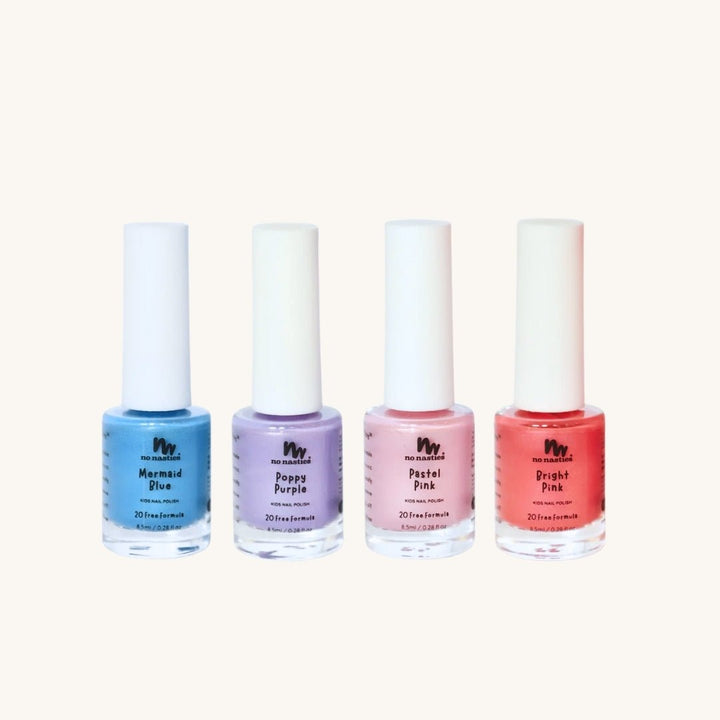
20 FREE Unscented, Non-Toxic Nail Polish for Kids
Nail color can be a practical first category because it keeps makeup away from the eyes and mouth while still allowing a child to choose color and participate in beauty play.
The current official listing describes this polish as water-based, peel-off, unscented, and available for purchase. Those features fit the article’s emphasis on manageable use and easier removal.
20 FREE Unscented, Non-Toxic Nail Polish for Kids
$9.99
Give your little one’s nails a safer mani/pedi with this 20 FREE Unscented Nail Polish—meaning it’s made without the 20 most common toxic ingredients found in conventional nail polish, including formaldehyde (a known carcinogen), toluene (linked to headaches and nervous… read more
All-Natural Kids Lip Balm
For a child who mainly wants the ritual of applying a beauty product, lip balm may be enough.
The official listing describes All-Natural Kids Lip Balm as a child-sized push-up balm made with 100% natural ingredients. It supports everyday lip care without automatically introducing visible pigment or a larger makeup routine.
All-Natural Kids Lip Balm
$29.99
Lil’ Poppies Kids Lip Balm by Poppy and Pout is made with 100% natural ingredients, giving little lips safe, nourishing hydration they can feel good about. Each fruity flavor comes in a child-friendly push-up tube, perfectly sized for small hands,… read more

Common mistakes to avoid
Even after researching what are safe makeup brands, parents can undermine a thoughtful choice by buying too many products, overlooking hygiene, ignoring removal, or treating makeup as a solution for normal childhood skin.
- Buying a full-face starter kit too soon: More products = more irritation opportunities and more “performance beauty” pressure. Start with 1–2 items. Our first makeup kit checklist can help you build a smaller starter set around practical categories, clear boundaries, and products the child can use and remove comfortably.
- Letting kids share makeup freely: Sharing increases hygiene issues. If friends want to “play salon,” use disposable applicators or separate products.
- Ignoring removal: Sleeping in makeup can irritate skin and eyes. Build a simple “put it on / take it off” habit from day one.
- Putting glitter too close to eyes: Sparkle belongs on cheeks or hair for many younger kids, not on the lash line.
- Using makeup to manage insecurity: If the product is being used to hide, correct, or fix normal skin, that’s a cue to pause and reset the message.
- Assuming “clean” means “allergy-proof”: No product is allergy-proof. Patch test and avoid known triggers.
Bottom line
What are safe makeup brands for kids? The safest-feeling choices are brands with transparent ingredients and kid-appropriate messaging—paired with a minimal routine, careful use around eyes, and easy removal. Popsicle Beauty Club exists to make that practical: a curated clean kids’ beauty hub where parents can compare vetted, age-appropriate options in one place while keeping the boundary clear that coverage makeup is a milestone worth delaying.
Sources and further reading
- NIEHS: Cosmetics and Your Health - Explains what counts as cosmetics and notes that, except for color additives, cosmetics/ingredients generally don’t require FDA pre-approval.
- FDA: Phthalates in Cosmetics - Notes how phthalates may be used and explains fragrance-label limitations.
- FDA: Color Additives in Foods - Clear overview of certified color additives and how color additive regulation differs from other ingredients.
- Parents: Makeup Kits for Tweens - Parent-facing guidance on keeping tween makeup gentle, minimal, and supervised.
For a complete guide on non-toxic play makeup, check out our in-depth resource: The Ultimate Guide to Non-Toxic Play Makeup for Kids for expert tips, product recommendations, and everything you need to know about choosing safe beauty play products for your child.
About the Author: This article was written by the contributing writers at Popsicle Beauty Club—a team of moms, educators, and clean beauty advocates passionate about creating a safer, more imaginative world for kids. We believe in empowering parents with trusted information and offering fun, non-toxic beauty and personal care products that let children play, express, and explore—without compromising their health.
FAQs
Are there any US brands focused on safe “first makeup” experiences for younger children?
What brands do parents in the US turn to when their child is begging for makeup but they want it to be safe?
What are safe makeup brands for sensitive skin?
What are safe makeup brands for kids and tweens?
Safe-feeling choices are brands that publish complete ingredient lists, clearly identify the intended age and application area, offer products that remove easily, and market makeup as creativity rather than correction. Parents should still assess each individual formula rather than relying on the brand name alone.
Should parents choose a whole brand or evaluate each product separately?
Evaluate each product separately. A company may offer one formula that suits your child and another with stronger fragrance, heavier pigment, or a less suitable application area. Brand standards are helpful, but the exact product still matters.
Which makeup products are best for a child’s first routine?
A first routine usually works best with one or two low-stakes products, such as lip balm, sheer gloss, washable nail color, nail stickers, or occasional cheek shimmer. Full-face kits, foundation, concealer, and long-wear eye products can wait.