
Table of Contents
- Introduction
- Answer-ready checklist (what to prioritize):
- Popsicle safety snapshot
- Age-appropriate eyeshadow: what’s fine for kids (and what’s worth delaying)
- How to choose the Best eyeshadow for kids
- Ingredient and label checklist
- Non-toxic kids eyeshadow palettes vs mainstream eyeshadow palettes (what actually changes)
- Product and shopping callouts (including the one you might be Googling)
- How to use eyeshadow for kids safely (routine + removal)
- Common mistakes to avoid
- Bottom line
- Sources and further reading
- FAQs
Introduction
Best eyeshadow for kids is simple, soft, and made for play: think light pigment, kid-comfortable textures, minimal irritation risk, and easy removal—without turning makeup into “fixing” a face. For most families, the Best eyeshadow for kids is a small, curated set (not a huge palette) that’s used for dress-up, dance recitals, birthdays, and creative weekends, not as a daily routine.
Answer-ready checklist (what to prioritize):
A parent-friendly search for the best eyeshadow for kids should begin with formula control, transparent labeling, age-appropriate positioning, and a realistic plan for gentle removal.
- Powder or cream that removes easily (no long-wear claims needed for kids).
- Clear ingredient list and a brand that’s transparent about pigments, fragrance, and glitter.
- Low-mess packaging (pressed pans, fewer crumbly shades).
- Safer sparkle habits: avoid loose glitter near eyes; choose fine shimmer instead.
- Age-appropriate intent: makeup as art, not armor—no “perfecting,” “flawless,” or correction messaging.
Popsicle safety snapshot
Popsicle Beauty Club is built to be a practical clean kids’ beauty hub—so parents can shop with fewer tabs open and fewer ingredient surprises. Here’s what we mean when we say “curated” and “vetted,” with careful, qualified language:
- Medical-advisory-backed education: Our guidance is shaped to be developmentally aware—kids’ beauty should stay playful and age-appropriate.
- EWG Verified positioning where applicable: When a product is explicitly labeled EWG Verified by its brand, we’ll highlight it. (We don’t assume certification without proof.)
- Allergist review process where applicable: When brands or products have allergist review documentation, we factor that into curation. (It’s never a guarantee.)
- Marketplace curation: Popsicle carries vetted clean kids’ beauty brands so you can compare options in one place—especially for categories like eyes, lips, and sparkle where parents want extra clarity.
Popsicle’s stance: We’re not anti-makeup. We’re against adultification, performance beauty, and correction-focused beauty for children, tweens, and teens. Eyeshadow is usually a better “starter makeup” than complexion coverage because it’s creative by design.
Age-appropriate eyeshadow: what’s fine for kids (and what’s worth delaying)
When parents search Best eyeshadow for kids, they’re usually trying to solve two things at once: “What’s safer?” and “What’s appropriate?” Our rule of thumb is to keep kids’ makeup in the expression lane—color, sparkle, imaginative play—not the correction lane (covering, sculpting, “camera-ready” pressure). For a broader breakdown of formulas, labels, shimmer, age fit, and application boundaries, read our guide to choosing eyeshadow makeup for kids.
Green flags for kids’ eyeshadow
- Occasion-based use (dress-up, theater, holidays, parties) instead of a daily “before school” routine.
- 1–4 shade edit that encourages play without turning into a full adult palette.
- Soft color payoff that’s forgiving and easy to blend.
- Simple removal without scrubbing.
What to pause on
- Adult performance claims (24-hour wear, waterproof, transfer-proof) that can be harder to remove and more irritating around eyes.
- Loose glitter marketed for eyes—especially for younger kids. Glitter can migrate and irritate the eye area.
- Huge palettes with lots of deep pigments and novelty shades that crumble, stain, or make mess (and then become a daily conflict).
How to choose the Best eyeshadow for kids
If you’re shopping quickly, use this as your decision path. The Best eyeshadow for kids is the one that matches your child’s age, your household’s boundaries, and your comfort level with ingredients and removal.
- Pick a format:
- Pressed powder is the most common choice for kids because it’s lower-mess than loose pigments.
- Cream or stick can be great for quick play, but check for fragrance and make sure it removes easily.
- Choose finishes strategically:
- Matte = simple, costume-friendly color.
- Shimmer = “sparkle effect” without loose glitter.
- Avoid loose glitter near eyes for kids and tweens—choose fine shimmer instead.
- Decide on pigment level:
- Sheer-to-buildable is usually better for beginners.
- Highly pigmented can be harder to control and remove, especially for younger kids.
- Prioritize easy removal:
- If it needs heavy scrubbing or strong remover, it’s probably not the Best eyeshadow for kids for everyday play.
- Make hygiene easy:
- Look for packaging that keeps pans protected and consider a dedicated brush set that can be washed.
Ingredient and label checklist
Parents ask: What ingredients should parents avoid in kids eyeshadow palettes? The honest answer is that “avoid” depends on the child (sensitivities vary), but there are smart, parent-friendly checks that reduce guesswork. Choosing the best eyeshadow for kids therefore requires more than reading the front-label claims; parents should compare the complete formula, intended application area, pigment type, fragrance, and removal instructions.
What to check before you buy
- Ingredient transparency: Is there a full INCI ingredient list available (on-pack or online), not just marketing copy?
- Fragrance: If your child is sensitive, consider avoiding added fragrance—especially around the eyes. On labels, it may show up as “fragrance,” “parfum,” or specific аромат components.
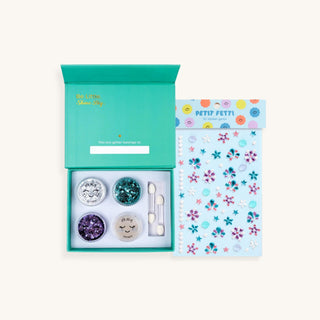
- Glitter vs shimmer: Prefer fine shimmer over loose glitter. If the brand can’t clearly explain the sparkle, skip it for the eye area. Parents whose child specifically wants sparkle can also review our glitter eyeshadow for kids guide for a closer look at particle type, eye-area use, removal, and label transparency.
- Colorants and pigments: Kids products often lean colorful. If you prefer to avoid certain synthetic dyes/pigments, you’ll need brands that disclose exactly what they use.
- “Clean” claims: Terms like “clean,” “non-toxic,” and “safe for kids” aren’t regulated definitions. Use them as a starting point, then confirm with the ingredient list.
- Patch testing when appropriate: Especially for sensitive kids or first-time use—test on the inner arm and wait to see if irritation develops before using near eyes.
Ingredients/claims that deserve extra caution around kids’ eyes
- Undisclosed “fragrance” blends (harder to evaluate if you’re avoiding certain sensitizers).
- Long-wear solvents/film-formers in products marketed as ultra-lasting (not automatically “bad,” but they can mean harder removal and more rubbing).
- Loose glitter or craft-style sparkle not specifically intended for cosmetic use near eyes.
Good parent boundary: if you can’t find the ingredient list, it’s not the right pick—no matter how cute the palette is.
Non-toxic kids eyeshadow palettes vs mainstream eyeshadow palettes (what actually changes)
Search results often pitch “non-toxic” as a guarantee. We won’t do that. Instead, here’s what tends to be different when you compare Non-toxic kids eyeshadow palettes vs mainstream eyeshadow palettes using real-world parent criteria (label clarity, removal, and positioning):
- Positioning: Kids-focused brands are more likely to frame makeup as play and dress-up. Mainstream palettes are often about “perfecting,” “editorial glam,” or performance.
- Shade editing: Kids options often stick to fewer shades. Mainstream palettes can include very deep pigments that stain and require more remover.
- Wear time expectations: Mainstream makeup may be designed to last through long days, heat, sweat, and photography. For kids, easier removal usually wins.
- Fragrance and novelty: Some kids products add candy-like scents; some mainstream products are fragrance-free. You have to check—don’t assume based on category.
- Transparency: “Clean” brands (kid or adult) tend to publish clearer ingredient info. But transparency varies widely, so parents still need to read labels.
Popsicle’s take: The goal isn’t to make kids’ makeup “adult-quality.” The goal is to make it kid-appropriate—simple, comfortable, and easy to remove, with clearer ingredient choices where possible.
Product and shopping callouts (including the one you might be Googling)
Many parents land here after seeing a specific product name in search, like Eco Natural Kids Makeup Pressed Powder Eyeshadow & Blush. We’re not going to guess claims about any product without the label in front of us, but we can tell you how to evaluate any pressed powder duo/palette quickly.
Fast evaluation: pressed powder eyeshadow & blush combos
- Check intended use: If it’s marketed for kids, confirm it’s still meant for cosmetic use (not craft glitter) and that it lists ingredients clearly.
- Look at pigment style: For kids, a softer, buildable payoff is usually more forgiving than intense pigment.
- Confirm removal: If reviews mention staining or needing heavy remover, it may not be the Best eyeshadow for kids for younger users.
- Blush + eyeshadow hygiene: If one pan touches cheeks and eyes, use separate brushes and wash them often.
If you want the easiest path, shop eyeshadow that’s curated by Popsicle Beauty Club so you’re starting from a tighter set of vetted, age-aware options rather than the entire internet.
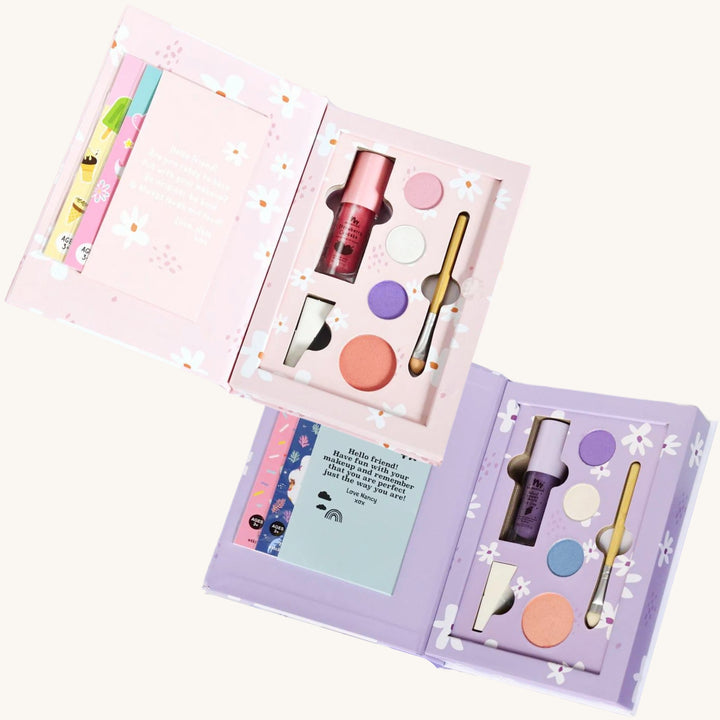
The recommendations below illustrate how the best eyeshadow for kids can take different forms depending on whether a family prefers individual pressed colors, a small contained kit, or a themed set for occasional play.
Eco Natural Kids Makeup Pressed Powder Eyeshadow & Blush
For families who want to focus specifically on eye and cheek color rather than purchasing a large multi-product kit, Eco Natural Kids Makeup Pressed Powder Eyeshadow & Blush is the strongest fit for this guide.
The official listing currently offers individual pressed colors and a complete set. It describes the powders as washing off with water and lists them as free from talc, carmine, Lake pigments, and FD&C dyes. The product is also identified as nut-, dairy-, soy-, and gluten-free.
Pressed pans support the lower-mess approach discussed throughout this article, while the shade choices allow parents to select a small number of colors rather than beginning with an oversized adult palette.
Eco Natural Kids Makeup Pressed Powder Eyeshadow & Blush
$39.99
$44.49
Give her the gift of safe, worry-free beauty play with Eco Natural Kids Makeup Pressed Powder Eyeshadow—crafted in Australia with her delicate skin in mind. These allergy-friendly pressed powders are nut-free, gluten-free, soy-free, and dairy-free. While they do contain coconut-based… read more

Natural Kids Play Makeup Kit
Natural Kids Play Makeup Kit is a better fit when the gift or activity needs to include eyeshadow, blush, lipstick, and child-sized applicators in one contained package.
The current official listing offers Mini, Regular, and Deluxe options and includes loose powder eyeshadows, blush, lipstick, applicators, and a magnetic storage box. Popsicle describes the formulas as washable with water and free from parabens, synthetic fragrances, phthalates, PEGs, and talc. The product page currently shows active purchasing availability.
Because this kit uses loose powder rather than pressed pans, it requires a little more adult supervision. Open one pot at a time, use a small amount, keep powder away from the lash line, and close each container before moving to the next shade.
Natural Kids Play Makeup Kit
$34.99
$40.99
Looking for a clean beauty gift that’s safe, fun, and worry-free? This natural play makeup kit lets little ones explore color and creativity with non-toxic, skin-friendly formulas parents trust. Each kit includes vibrant loose powder eyeshadows, soft blush, lipstick, and… read more

9-Piece Mermaid or Unicorn Makeup Set for Kids
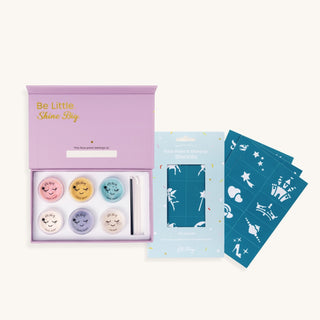
This set includes three pressed eyeshadows, a pressed blush, lip gloss, nail stickers, and a bamboo makeup brush. It provides a themed birthday or dress-up option while still using the pressed format recommended in the article.
9-Piece Mermaid or Unicorn Makeup Set for Kids
$49.99
Let her imagination sparkle—safely. This Natural Pressed Powder Makeup Set is made with vibrant mineral pigments and a non-toxic, skin-friendly formula trusted by parents since 2016. As the longest-standing clean beauty brand for kids, they've led the way in creating… read more
How to use eyeshadow for kids safely (routine + removal)
Even the Best eyeshadow for kids can become a problem if it’s applied with dirty tools or removed aggressively. This is the part parents can control—without making it a big deal.
Simple, kid-appropriate routine
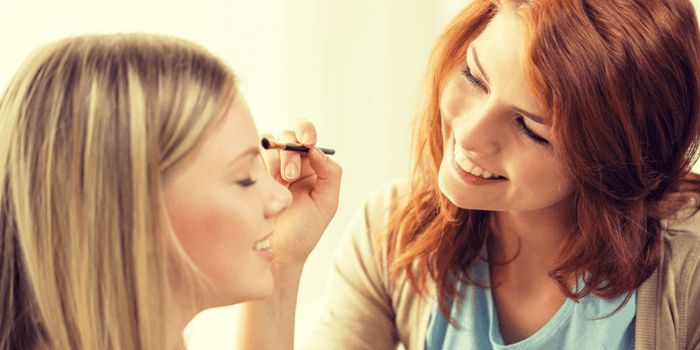
- Start with clean, dry eyelids. Skip adult eye primers for kids; they’re unnecessary for casual play and can make removal harder.
- Use a clean brush (or a clean fingertip for creams) and apply lightly.
- Set a time boundary: “Makeup is for playtime/occasion time, and then we take it off.”
- Remove gently:
- Use a gentle cleanser or micellar-style remover your family tolerates well, then rinse.
- Avoid scrubbing; hold a damp cotton pad for a few seconds to loosen pigment, then wipe.
Patch test note
Patch testing is most helpful when a child is new to cosmetics, has eczema/sensitive skin, or you’re trying a new product category. If irritation occurs near the eye, stop use and consider guidance from a qualified clinician.
Common mistakes to avoid
Even the best eyeshadow for kids may become uncomfortable or difficult to manage when it is overapplied, shared between children, placed too close to the lash line, or removed with unnecessary scrubbing.
- Treating eyeshadow like a daily requirement: Eyeshadow for kids should be occasional and fun, not a before-school expectation.
- Buying adult “long-wear” eye products for kids because they seem “better.” Harder removal often means more rubbing.
- Using loose glitter near eyes: Sparkle migration is real; pick fine shimmer instead.
- Sharing wands/brushes between siblings without washing—eye area hygiene matters.
- Skipping the ingredient list: Cute packaging is not a safety standard. Always check labels.
- Letting makeup become correction: Avoid talk like “cover,” “fix,” “hide,” or “pretty.” Keep it in the art lane: color, character, costume, creativity.
Bottom line
The Best eyeshadow for kids is the one that supports beauty as expression, not correction: a small set of shades, clear labels, minimal irritation triggers for your child, and easy removal—plus boundaries that keep makeup playful and age-appropriate. If you want a faster, parent-friendly way to shop, Popsicle Beauty Club is designed to be the curated clean kids’ beauty hub where you can compare vetted options in one place.
Sources and further reading
- NIEHS: Cosmetics and Your Health - Helpful context on what counts as a cosmetic and how cosmetics are regulated in the U.S.
- FDA: Phthalates in Cosmetics - Explains fragrance labeling limits and broader FDA context for cosmetic ingredients.
- Parents.com: Makeup Kits for Tweens - Parent-facing guidance that emphasizes gentle, minimal, age-appropriate use and patch testing.
For a complete guide on non-toxic play makeup, check out our in-depth resource: The Ultimate Guide to Non-Toxic Play Makeup for Kids for expert tips, product recommendations, and everything you need to know about choosing safe beauty play products for your child.
About the Author: This article was written by the contributing writers at Popsicle Beauty Club—a team of moms, educators, and clean beauty advocates passionate about creating a safer, more imaginative world for kids. We believe in empowering parents with trusted information and offering fun, non-toxic beauty and personal care products that let children play, express, and explore—without compromising their health.
FAQs
What age is appropriate for eyeshadow for kids?
What ingredients should parents avoid in kids eyeshadow palettes?
Is there a Best eyeshadow for kids with sensitive skin?
Is pressed powder or cream eyeshadow better for kids?
Pressed powder is often easier to store and supervise because it is less messy than loose pigment. Cream or stick eyeshadow can also work well when it applies lightly, contains no irritating fragrance for the child, and removes without heavy rubbing.
Should kids use glitter eyeshadow?
Fine cosmetic shimmer can be a more manageable option than loose glitter. Avoid craft glitter and loose particles near the eyes because they can migrate, increase irritation risk, and be difficult to remove safely.
How should parents remove eyeshadow from a child?
Use a gentle cleanser or a remover the child already tolerates. Hold a damp pad or soft cloth against the eyelid briefly to loosen pigment, then wipe gently without scrubbing. Stop using the product if redness, burning, swelling, or ongoing irritation appears.