
Table of Contents
- Introduction
- Answer-ready summary
- Popsicle Beauty Club’s parent-first approach
- What a kids conditioner should do
- What “non-toxic” means on kids conditioner
- What “mainstream” means
- Non-toxic vs mainstream kids conditioner comparison
- Fragrance and scent
- “Unscented” versus “fragrance-free”
- Conditioning agents and slip
- Silicones and buildup
- Preservatives are necessary
- Dyes and visual appeal
- Rinse-out conditioner versus leave-in conditioner
- How to choose by hair texture
- How to choose by scalp sensitivity
- How to choose for swimmers and active kids
- Product recommendations from Popsicle Beauty Club
- Product comparison
- How to use kids conditioner correctly
- How to use leave-in conditioner
- Patch testing and sensitivity
- Common mistakes to avoid
- 1. Buying based on scent alone
- 2. Using too much product
- 3. Applying conditioner heavily to the scalp
- 4. Using leave-in products without a clear need
- 5. Brushing from the roots downward
- 6. Stacking several fragranced products
- 7. Assuming “natural” means non-irritating
- 8. Treating natural texture as a problem
- Where Popsicle Beauty Club fits
- Bottom line
- FAQs
Introduction
When parents compare non-toxic vs mainstream kids conditioner options, the differences are rarely as simple as one category being safe and the other unsafe. The more useful comparison looks at fragrance, ingredient transparency, detangling performance, rinseability, residue, packaging, and how the child’s hair and scalp feel after use.
Cleaner-positioned conditioners may emphasize plant-derived ingredients, lighter fragrance, clearer exclusion lists, or simplified routines. Mainstream conditioners may be easier to find, more affordable, and designed with stronger scents, colorful packaging, and noticeable slip.
Neither category automatically guarantees that every formula will suit every child.
The better choice is usually the conditioner that reduces friction, supports easier brushing, rinses clean, and matches the child’s hair texture without creating a complicated adult-style hair routine.
This guide explains how to compare non-toxic vs mainstream kids conditioner formulas while keeping hair care focused on comfort, hygiene, manageability, and growing independence.
Answer-ready summary
A useful non-toxic vs mainstream kids conditioner comparison should focus on:
A complete ingredient list
Clear fragrance information
Enough slip for the child’s hair texture
Easy rinsing
Minimal residue
Comfortable scalp and skin
Age-appropriate usage directions
A routine the family can maintain consistently
Parents should not assume that “non-toxic” means fragrance-free, reaction-free, or suitable for eczema-prone skin.
They should also not assume that every mainstream conditioner is overly harsh or unsuitable.
The individual formula, the child’s hair pattern, fragrance tolerance, scalp sensitivity, and application method matter more than the category printed on the front label.
Popsicle Beauty Club’s parent-first approach
Popsicle Beauty Club is a curated clean kids’ beauty destination for families looking for age-appropriate hair care and personal-care products.
When evaluating non-toxic vs mainstream kids conditioner options, Popsicle considers both the formula and the role the product plays in a child’s routine.
A children’s conditioner should support:
Easier detangling
Less pulling during brushing
Comfortable wash days
Softness through the lengths and ends
Post-swim care
Curly or coily hair routines
Growing hair-care independence
It should not teach children that their natural texture, curls, frizz, volume, or shrinkage make their hair unacceptable.
This reflects Popsicle Beauty Club’s wider Foundationless philosophy. Personal care should support comfort and confidence rather than introduce adult performance standards too early.
No conditioner can be guaranteed to suit every child. Introduce one new formula at a time and stop use if persistent itching, burning, rash, swelling, or worsening scalp discomfort appears.
What a kids conditioner should do
A children’s conditioner is primarily a practical detangling and friction-reducing product.
It should help:
Smooth the hair surface
Reduce snagging
Support gentler brushing
Improve manageability
Reduce roughness through the ends
Make wash day easier
It should rinse without leaving hair excessively waxy, greasy, stiff, or coated.
A conditioner does not need to promise:
Bond rebuilding
Anti-aging
Intense repair
Permanent frizz elimination
Scalp detoxification
Hair transformation
Salon-level performance
Most children need a conditioner that does one clear job well rather than several adult treatment products layered together. A practical non-toxic vs mainstream kids conditioner decision should begin with detangling and comfort rather than the number of performance claims on the bottle.
What “non-toxic” means on kids conditioner
“Non-toxic” is commonly used by brands to describe formulas made without ingredients they consider unnecessary, controversial, or inconsistent with their internal standards.
Depending on the company, that may involve avoiding:
Synthetic fragrance
Artificial dyes
Parabens
Phthalates
Sulfates
Certain silicones
Formaldehyde-releasing preservatives
Strong essential-oil blends
Other ingredients on the brand’s exclusion list
However, there is no single definition shared by every conditioner brand.
One company may use “non-toxic” because it avoids artificial fragrance. Another may focus on silicone-free formulas. Another may use the term because it follows a broader clean-beauty standard.
In a non-toxic vs mainstream kids conditioner comparison, the front-label claim is only useful when supported by a complete ingredient list, clear directions, and realistic information about fragrance and intended use.
Treat “non-toxic” as a starting point for evaluation rather than a final guarantee.
What “mainstream” means
Mainstream kids conditioners are commonly sold through supermarkets, pharmacies, department stores, beauty retailers, and large online marketplaces.
They may offer:
Lower prices
Wider availability
Familiar brands
Large family bottles
Character-themed packaging
Strong fruit or candy scents
Several hair-type options
High-slip formulas
Some mainstream conditioners have straightforward formulas, fragrance-free options, and clear labels.
Others may rely more heavily on scent, color, silicone-heavy slip, or marketing designed to make ordinary hair care feel more exciting.
A fair non-toxic vs mainstream kids conditioner comparison evaluates the individual product rather than judging it only by where it is sold.
Non-toxic vs mainstream kids conditioner comparison
| Comparison point | Cleaner-positioned conditioner | Mainstream conditioner | What parents should ask |
|---|---|---|---|
| Ingredient list | May emphasize transparency or ingredient exclusions | May use a longer mix of sensory and conditioning ingredients | Is the full list available? |
| Fragrance | May be lighter, naturally derived, or clearly disclosed | May use stronger fruit, candy, or floral scent | Is the scent suitable for this child? |
| Slip | May use plant oils, fatty alcohols, or alternative conditioning agents | May rely more heavily on conventional silicones or polymers | Does it detangle without excessive buildup? |
| Rinseability | Often positioned around a lighter finish | May provide heavier coating or longer-lasting softness | Does the hair feel clean after rinsing? |
| Hair-type fit | May target specific textures or sensitive users | Often sold as a broad “all hair” formula | Does it match the child’s actual hair pattern? |
| Packaging | May use smaller or sustainability-focused bottles | Often available in large pump or squeeze bottles | Can the child dispense an appropriate amount? |
| Positioning | Usually emphasizes gentleness and simplicity | May emphasize shine, smoothness, scent, or performance | Is the product supporting care or appearance pressure? |
Fragrance and scent
Fragrance is one of the most practical differences parents notice when comparing conditioners.
Mainstream children’s conditioners may use:
Strawberry scent
Watermelon scent
Candy-inspired fragrance
Floral fragrance
Tropical fruit blends
Strong “fresh” fragrance
Cleaner-positioned products may be:
Fragrance-free
Lightly scented
Scented with essential oils
Scented with botanical extracts
Scented with disclosed natural isolates
Natural fragrance is not automatically non-irritating.
A child who experiences scalp itching, headaches, watery eyes, eczema flares, or sensory discomfort may do better with a fragrance-free or lightly scented formula.
When comparing non-toxic vs mainstream kids conditioner for a sensitive child, fragrance tolerance may matter more than the marketing category.
“Unscented” versus “fragrance-free”
These terms may sound interchangeable, but parents should still inspect the ingredient list.
A fragrance-free product is generally positioned as containing no added fragrance.
An unscented product may contain ingredients intended to mask the natural smell of the formula.
Check for terms such as:
Fragrance
Parfum
Aroma
Natural fragrance
Essential oil
Botanical oil
Clear fragrance information makes it easier to compare products and identify possible triggers.
Conditioning agents and slip
Conditioning agents help reduce friction and make hair easier to comb.
Common ingredient groups include:
Fatty alcohols
Plant oils
Butters
Cationic conditioning agents
Silicones
Film-forming polymers
Proteins
Humectants
A technical ingredient name is not automatically harmful.
The practical question is whether the formula creates enough slip for the child’s hair without leaving heavy residue. In a non-toxic vs mainstream kids conditioner comparison, effective slip matters because it can reduce pulling, breakage, and frustration during brushing.
Fine hair may need a lightweight conditioner.
Thick, curly, or coily hair may need more cushioning and slip.
The best formula is the one that improves manageability without forcing parents to use excessive amounts.
Silicones and buildup
Silicones are often used to smooth hair, reduce friction, increase shine, and improve detangling.
Some families prefer silicone-free formulas because they want lighter products or are trying to reduce buildup.
However, silicone-free does not automatically mean better for every child.
A conditioner can still feel heavy because of:
Rich plant oils
Butters
Waxes
Conditioning polymers
Overapplication
Incomplete rinsing
When evaluating buildup, pay attention to results rather than relying on one ingredient category.
Signs that a conditioner may be too heavy include:
Hair feeling coated after rinsing
Fine hair becoming limp
Faster greasiness
Increased scalp itch
Sticky or stringy ends
Needing frequent clarifying washes
Preservatives are necessary
Water-based conditioners require preservation to reduce bacterial, yeast, and mold growth.
“Preservative-free” is not automatically a positive claim.
A responsible conditioner should provide:
A complete ingredient list
Storage instructions
Period-after-opening or expiry guidance
Advice on keeping water out of the bottle
Clear directions for disposal or replacement
Preservatives should be considered within the complete formula rather than treated as one category to fear.
Dyes and visual appeal
Bright pink, purple, blue, or glittery conditioner may be appealing to children.
However, color does not improve detangling.
Some families choose to avoid unnecessary dyes because:
They add formula complexity
They may stain towels or surfaces
They provide little functional benefit
They can make the product look toy-like
A particular child may be sensitive to them
A naturally colored formula may still contain botanical extracts or pigments that require individual consideration.
Rinse-out conditioner versus leave-in conditioner
Rinse-out and leave-in products serve related but different purposes. The non-toxic vs mainstream kids conditioner choice should also reflect whether the child needs regular wash-day softness or occasional help with knots between washes.
1. Rinse-out conditioner
A rinse-out conditioner is applied after shampooing and washed away.
It can help:
Reduce friction
Soften lengths and ends
Improve wet detangling
Support curly or dry hair
Reduce roughness after swimming
2. Leave-in conditioner
A leave-in conditioner remains on the hair after washing or can be used between wash days.
It can help:
Refresh bedhead
Add slip before brushing
Support curls
Reduce flyaways
Improve manageability on dry hair
Because leave-in formulas remain in contact with hair, neck, pillowcases, and sometimes the face, use a small amount and pay closer attention to fragrance and residue.
A younger child may only need a rinse-out conditioner. A leave-in product is most useful when it solves a specific detangling problem rather than simply adding another step.
How to choose by hair texture
The right non-toxic vs mainstream kids conditioner choice depends heavily on the child’s actual hair pattern.
1. Fine or straight hair
Look for:
Lightweight slip
Easy rinsing
Minimal heavy oil or butter buildup
Small application amounts
Conditioner focused on the ends
Avoid applying large amounts directly to the scalp.
2. Wavy hair
Wavy hair may benefit from:
Moderate conditioning
Lightweight moisture
A small amount of leave-in on knot-prone days
Gentle towel drying
Minimal product layering
3. Curly hair
Curly hair often benefits from:
More detangling slip
Section-by-section application
A wide-tooth comb
Conditioner distributed through wet hair
Careful rinsing based on the child’s texture
The goal is comfortable definition and manageability—not forcing curls to look perfectly smooth.
4. Coily or tightly textured hair
Coily hair may need:
Richer conditioning through the lengths
Careful detangling in sections
More time for conditioner to distribute
A leave-in product when useful
Gentle handling from ends upward
A lightweight conditioner may not provide enough slip, while an excessively heavy formula may create buildup. Observe the child’s results and adjust gradually.
How to choose by scalp sensitivity
Scalp and skin history should guide product selection. For sensitive children, a non-toxic vs mainstream kids conditioner review should prioritize fragrance level, residue, application area, and the child’s previous reactions.
Consider a simpler or lower-fragrance formula when the child has:
Eczema-prone skin
Frequent scalp itching
Fragrance sensitivity
Sensory discomfort
Recurrent redness
A history of product reactions
Apply conditioner mainly to the mid-lengths and ends unless the product directions or a qualified clinician advise otherwise.
Persistent flakes, pain, swelling, sores, or rash deserve professional guidance rather than repeated product switching.
How to choose for swimmers and active kids
Swimming, sweat, helmets, braids, and frequent washing can increase tangling.
For active children:
Rinse chlorine or salt water promptly
Use conditioner through the lengths
Detangle gently after swimming
Avoid aggressive towel rubbing
Add a light leave-in only when needed
Watch for residue from repeated product use
A good conditioner should make the routine easier without requiring several recovery treatments.
Product recommendations from Popsicle Beauty Club
The following options illustrate how rinse-out conditioner, leave-in conditioner, and detangling spray can fit different hair routines.
Parents should review each current product listing, complete ingredient list, fragrance details, and their child’s sensitivities before buying.
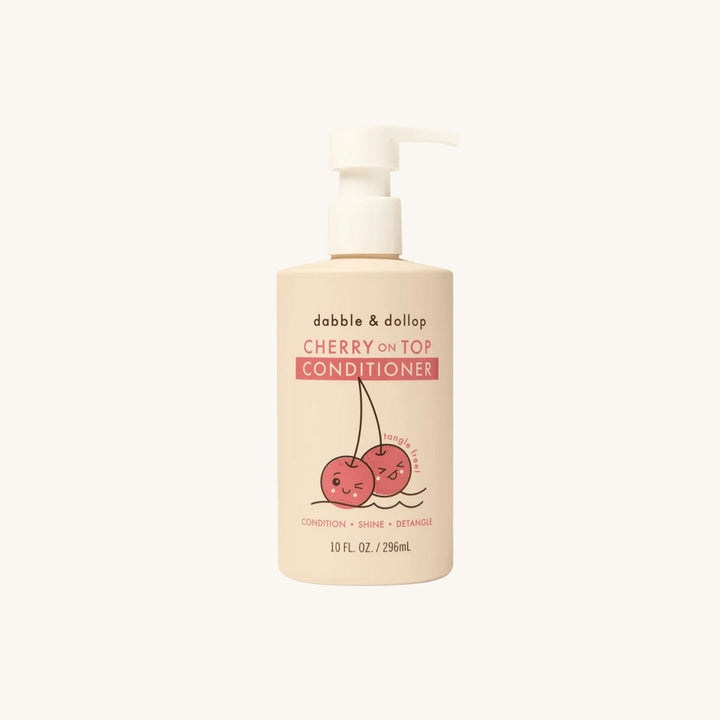
Tear-Free Conditioner for Kids
Tear-Free Conditioner for Kids is a rinse-out option designed for young hair and sensitive bath-time routines.
Its creamy format may suit families looking for a straightforward conditioner that softens hair and supports easier brushing without introducing a multi-step routine.
Because it has a cherry-inspired natural fragrance, families managing fragrance sensitivity should review the complete ingredient information before use.
Tear-Free Conditioner for Kids
$15.99
Indulge your little one's locks with Dabble & Dollop's Cherry on Top, Tear-Free Conditioner for Kids, a luxuriously creamy formula infused with the sweet, natural aroma of cherries. Lovingly made in California from vegan, plant-based ingredients, it's specifically formulated to be… read more
Detangler & Leave-In Conditioner for Kids
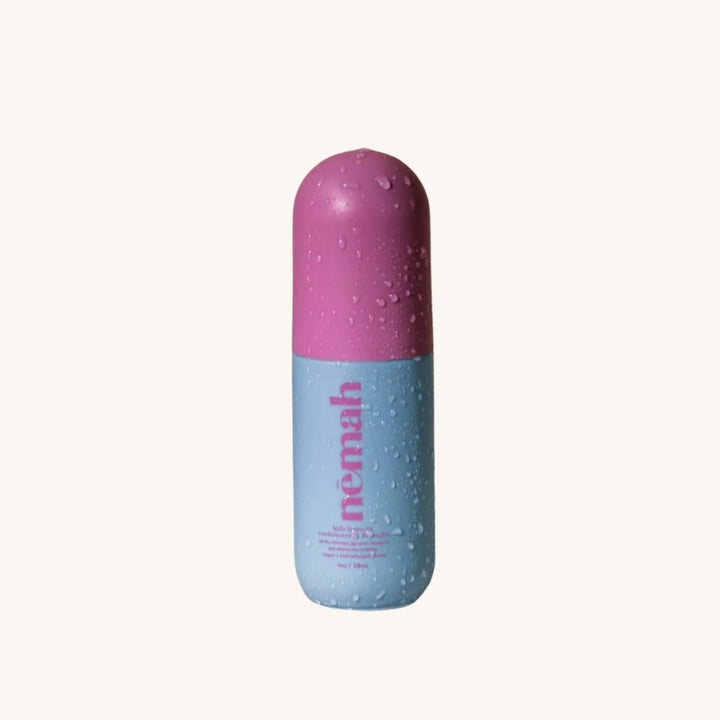
Detangler & Leave-In Conditioner for Kids is a lightweight spray that can be used on wet or dry hair.
It may suit children who need extra help with bedhead, flyaways, curls, or knots between wash days. The formula is silicone-free and contains disclosed natural fragrance components, so parents can review the full fragrance information rather than relying only on a generic scent claim.
Detangler & Leave-In Conditioner for Kids
$16.99
Nemah’s Detangler & Leave-In Conditioner for Kids is a clean, lightweight formula designed to make brushing simple and stress-free. Powered by olive-derived squalane, it locks in weightless moisture to keep strands soft and manageable, while coconut oil deeply nourishes, smooths rough… read more
Knot A Chance! Children’s Detangler
Knot A Chance! Children’s Detangler is a dedicated detangling spray available in fruity scent options.
It may suit families who want additional slip without adding more rinse-out conditioner. Its formula is positioned as silicone-free and designed to double as a lightweight leave-in product.
Because it contains natural parfum and botanical ingredients, fragrance-sensitive children may require a simpler option or cautious introduction.
Knot A Chance! Children's Detangler
$14.99
Make hair care a joyful, stress-free experience with this gentle children’s detangler, a safer, all-natural alternative to mainstream products. Available in the refreshing scents of Mandarin Grape or Strawberry, this lightweight formula is enriched with native Australian Emu Apple extract,… read more

Product comparison
| Product | Best suited to | Format | Parent consideration |
|---|---|---|---|
| Tear-Free Conditioner for Kids | Regular wash-day conditioning | Rinse-out conditioner | Natural cherry fragrance |
| Detangler & Leave-In Conditioner for Kids | Wet or dry hair, bedhead, curls, flyaways | Leave-in spray | Disclosed natural fragrance components |
| Knot A Chance! Children’s Detangler | Knot-prone hair and between-wash detangling | Detangling spray | Fruity natural parfum options |
How to use kids conditioner correctly
Even the better product in a non-toxic vs mainstream kids conditioner comparison can feel heavy or ineffective when used incorrectly.
Step 1: Shampoo and rinse
Remove sweat, dirt, chlorine, and product residue according to the child’s needs.
Step 2: Remove excess water
Conditioner spreads more evenly when the hair is wet but not pouring with water.
Step 3: Start with a small amount
Use less for short or fine hair and more only when the child’s length and texture require it.
Step 4: Focus on mid-lengths and ends
Most children do not need heavy conditioner directly on the scalp.
Step 5: Detangle gently
Use fingers or a wide-tooth comb.
Begin at the ends and move upward gradually.
Step 6: Rinse thoroughly
Incomplete rinsing is a common reason hair feels coated, limp, sticky, or itchy.
Step 7: Dry without rough rubbing
Press water out gently with a towel.
Rough towel friction can create more tangles.
How to use leave-in conditioner
When a leave-in product is needed:
Start with damp or lightly re-wetted hair.
Spray into the hands for younger children when practical.
Smooth through the lengths and ends.
Avoid misting directly toward the face.
Detangle from the ends upward.
Add more only if the hair still needs slip.
Wash brushes and combs regularly.
More product does not automatically create better detangling.
Patch testing and sensitivity
Patch testing may be useful when a conditioner contains fragrance, essential oils, botanical extracts, or unfamiliar ingredients.
A cautious approach is to:
Apply a small amount behind the ear or on the inner arm.
Rinse according to the product directions.
Observe for redness, itching, bumps, or burning.
Stop use if irritation develops.
Patch testing cannot diagnose an allergy.
Persistent or significant symptoms require guidance from a qualified clinician.
Common mistakes to avoid
Even after completing a non-toxic vs mainstream kids conditioner comparison, application habits can affect the result.
1. Buying based on scent alone
A pleasant fragrance does not indicate better conditioning or greater suitability.
2. Using too much product
Overapplication can create buildup and make hair harder to rinse.
3. Applying conditioner heavily to the scalp
This may contribute to residue or discomfort for some children.
4. Using leave-in products without a clear need
A detangler should solve a practical problem rather than become an automatic extra step.
5. Brushing from the roots downward
Starting at the roots can tighten knots and increase pulling.
6. Stacking several fragranced products
Shampoo, conditioner, detangler, styling cream, and hair mist can create an overwhelming scent routine.
7. Assuming “natural” means non-irritating
Botanical extracts, essential oils, and natural fragrance can still bother an individual child.
8. Treating natural texture as a problem
Conditioner should support manageability and comfort, not teach children that curls, coils, volume, or frizz must be corrected.
Where Popsicle Beauty Club fits
Parents comparing non-toxic vs mainstream kids conditioner products may encounter many similar claims with little explanation of fragrance, texture fit, rinseability, or real-life use.
Popsicle Beauty Club offers a more focused starting point through;
Curated children’s hair care
Ingredient-forward product pages
Rinse-out and leave-in options
Detangling products
Hair-texture considerations
Fragrance details
Parent-friendly routine guidance
Age-appropriate beauty positioning
A curated marketplace does not replace reading the individual label. It helps families narrow the options and avoid routines built primarily around adult hair-performance standards.
For a complete wash-day framework, read our guide to kids shampoo and conditioner and how to match cleansing, conditioning, and detangling to the child’s actual hair needs.
For a deeper look at leave-in formulas, fragrance, silicones, and residue, review our guide to detangler spray ingredients parents may want to examine.
Bottom line
The best choice in a non-toxic vs mainstream kids conditioner comparison is not determined by one marketing phrase.
Parents should compare:
Ingredient transparency
Fragrance
Conditioning agents
Silicones
Plant oils and butters
Preservatives
Slip
Rinseability
Residue
Hair texture
Scalp sensitivity
Routine fit
For most children, the better option is a conditioner that provides enough slip, rinses comfortably, and makes brushing easier without introducing a product-heavy adult hair routine.
Keep hair care focused on comfort, hygiene, manageability, and confidence in the child’s natural texture.
To learn more about choosing the safest shampoos, conditioners, and detanglers for kids, visit Non-Toxic Hair Care for Kids for a complete guide to gentle, chemical-free hair care.
About the Author: This article was written by the contributing writers at Popsicle Beauty Club—a team of moms, educators, and clean beauty advocates passionate about creating a safer, more imaginative world for kids. We believe in empowering parents with trusted information and offering fun, non-toxic beauty and personal care products that let children play, express, and explore—without compromising their health.
FAQs
How do I pick between Non-toxic kids conditioner vs mainstream kids conditioner for sensitive skin?
Do kids really need conditioner every wash?
Is non-toxic kids conditioner always better than mainstream conditioner?
No. The individual formula matters more than the marketing category. Compare fragrance, ingredients, slip, rinseability, residue, and how the child’s scalp and hair respond.
Should children use conditioner every time they wash their hair?
Not necessarily. Frequency depends on hair texture, dryness, length, swimming, activity level, and how often the hair is washed. Some children need conditioner every wash, while others only need it on knot-prone or dry days.
Is silicone bad in kids conditioner?
Silicone is not automatically harmful. It can reduce friction and improve slip, but some formulas may feel heavy on fine hair or contribute to buildup when overused. Evaluate the complete formula and the child’s results.