
Table of Contents
- Introduction
- Answer-ready checklist
- Popsicle safety snapshot
- What parents usually mean by “kids non toxic lip gloss” (and what to ask instead)
- How to choose (a parent-friendly decision path)
- Ingredient and label checklist (what to look for on the box)
- Ingredients parents ask about most (and how to think about them)
- Non-toxic kids lip gloss vs mainstream kids lip gloss (what’s actually different)
- Age-appropriate use: a mini routine that keeps gloss “fun”
- Common mistakes to avoid
- Where Popsicle Beauty Club fits (a practical shopping shortcut)
- Bottom line
- Sources and further reading
- FAQs
Introduction
Direct answer: When parents search kids non toxic lip gloss, they’re usually looking for a gloss that’s:
- Simple enough for frequent kid use
- Made with transparent ingredients
- Less likely to irritate lips or be accidentally “tasted,” and
- Easy to remove.
The most practical way to shop is to focus on ingredient transparency, minimal fragrance/flavor, thoughtful colorants, and hygienic packaging—not perfection promises.
Because lip products sit right at the “lick zone,” small choices matter: kids reapply often, share with friends, and eat snacks right after. Popsicle Beauty Club’s lens is also developmental: makeup as art, not armor. Lip gloss can be playful and age-appropriate; it shouldn’t be a gateway to correction-focused beauty or pressure to look older.
Answer-ready checklist
- Choose transparent labels: full ingredient list, clear shade naming, and straightforward claims.
- Go lighter on flavor/fragrance: “flavor” and “fragrance” can be catch-alls; many sensitive kids do better with minimal scent/taste.
- Check colorants and sparkle: look for clearly identified pigments/color additives; be cautious with loose glitter around mouths.
- Prefer simple bases: oils/butters/waxes your child tolerates, plus a preservative system if it’s water-based.
- Pick hygienic formats: avoid sharing, consider pump/squeeze tubes for younger kids, and set a replace-by schedule.
- Patch test when appropriate: especially for kids with a history of lip licking, eczema, or fragrance sensitivity.
Popsicle safety snapshot
Popsicle Beauty Club is designed as a practical clean kids’ beauty hub—not a neutral review site. We help parents find age-appropriate beauty play in one place, with a safety-first shopping lens.
- Curated marketplace: Popsicle carries vetted kids’ beauty and personal care brands so families can compare options without digging through the entire internet.
- Ingredient standards first: we prioritize transparent ingredient lists and parent-friendly label checks over trend appeal.
- Medical-advisory-backed education: our kids’ beauty guidance is built to be practical, calm, and development-aware.
- EWG Verified positioning where applicable: when a product is explicitly EWG Verified, that’s meaningful; when it isn’t, we still use clear ingredient criteria rather than “clean” vibes.
- Allergist review process where applicable: for certain products/categories, additional review is part of how we think about sensitive families (always still check your child’s personal triggers).
Foundationless note: Popsicle isn’t anti-makeup. We’re against adultification and performance beauty for kids. Gloss is for fun and self-expression—no “fixing,” “perfecting,” or “needing” makeup to feel okay.
What parents usually mean by “kids non toxic lip gloss” (and what to ask instead)
“Non toxic” isn’t a regulated promise on cosmetic labels, and it can mean different things across brands. So instead of searching for a single magic phrase, translate kids non toxic lip gloss into specific, checkable questions:
- Is every ingredient listed? If the brand won’t show the full INCI list, that’s a pause.
- Is it designed for the way kids actually use gloss? Think: reapplication, accidental swallowing, sticky hair-on-lips moments, and sharing.
- Is it age-appropriate? Names/marketing should feel playful—not “sexy,” “plumping,” or adult-coded.
- Is it easy to remove? You want a product that cleans off without harsh scrubbing.
That’s the difference between a label-driven purchase and a parent-driven purchase.
How to choose (a parent-friendly decision path)
If you’re shopping for kids non toxic lip gloss, use this quick path based on your child’s age and sensitivity.
1) For younger kids (approx. 5–8): keep it simple and hygienic
- Format: squeeze tube or pump (less double-dipping than a wand).
- Finish: clear or lightly tinted for “dress-up” vibes without heavy pigments transferring everywhere.
- Scent: mild or fragrance-free (when truly formulated that way), especially if your child is reactive.
2) For tweens (approx. 9–12): prioritize boundaries + comfort
- Set the expectation: gloss is for fun (school-appropriate, low-maintenance), not for changing their face.
- Choose a starter set intentionally: a couple of shades plus a balm can be better than a giant kit with mystery ingredients.
- Talk about sharing: gloss sharing is a hygiene issue, not a morality issue.
3) For teens: keep “cleaner” without turning it into correction
- Skip pressure language: avoid products marketed around “perfect lips,” “sexier,” or constant reapplication as a need.
- Support lip health: a basic, fragrance-light balm can be the everyday staple; gloss becomes the occasional creative add-on.
Ingredient and label checklist (what to look for on the box)
Here’s what to check before you add any kids non toxic lip gloss to cart. Not every item is a “red flag”—this is about making an informed, kid-appropriate choice.
- Full ingredient list (INCI): available on the product page or packaging, not “proprietary.”
- Fragrance/flavor disclosure: if you see “fragrance” or “flavor,” remember these can be broad categories.
- Color additives/pigments: look for clearly identified colorants rather than vague “colorants” language.
- Glitter type: cosmetic-grade glitter vs larger particles that can feel gritty or migrate.
- Preservation approach: water-based or “wet” formulas typically need a preservative system; oil/wax-only balms may not, depending on formula design.
- Allergen signals for your kid: common personal triggers include certain essential oils/flavors, lanolin, or specific plant oils—but this is individual.
- Clear use/age guidance: especially for sets marketed to children.
Parent tip: If your child has had chapped, cracking, or rashy lips, consider bringing the ingredient list to your clinician—especially if it’s persistent. Cosmetics shouldn’t be a mystery game when a kid is uncomfortable.
Ingredients parents ask about most (and how to think about them)
Flavor and fragrance
Flavor is a big reason kids love gloss—and a big reason sensitive kids get irritated. Also, labels don’t always tell you every component of “fragrance” or “flavor.” The FDA notes that individual fragrance ingredients do not have to be listed separately on cosmetic labels, which can make it harder to know what’s inside the blend.
Practical rule: When comparing kids non toxic lip gloss for a sensitive child, choose the mildest option you can and avoid strong “candy” scents. Even without known sensitivity, simpler scenting can be practical because children may reapply frequently.
Dyes and pigments
Parents often want to avoid petroleum-derived synthetic dyes, especially if they’re already cautious about dyes in food. While food and cosmetics are regulated differently, the instinct—choose clearer, better-disclosed color—is reasonable.
Practical rule: Look for explicit pigment or color-additive names on kids non toxic lip gloss, and avoid products that do not disclose what creates the color. For very young children, clear gloss or balm can reduce the “what exactly is making this hot pink?” question.
Glitter and shimmer
Sparkle is fun, but glitter can migrate. On lips, that can mean gritty feel, dryness, or particles ending up around the mouth. This is more about comfort and mess than panic.
Practical rule: For everyday kids non toxic lip gloss, go light on chunky glitter. Save high-sparkle finishes for supervised play or events, and prioritize easy removal.
Base ingredients: oils, waxes, butters
Most glosses rely on oils and waxes to create slip and shine. These can be perfectly fine, but kids’ preferences matter: sticky formulas can trigger constant reapplication (and hair stuck to lips), while overly minty “tingle” formulas can be uncomfortable.
Practical rule: choose comfortable texture, minimal “tingle,” and a formula your child will wear without fussing.
Preservatives (yes, sometimes you want them)
Parents sometimes assume “preservative-free” is automatically better. But if a formula includes water or is likely to be contaminated through frequent use, preservation can be part of responsible formulation. The goal is not “no preservatives,” it’s well-formulated, well-labeled, and appropriate for kids.
Non-toxic kids lip gloss vs mainstream kids lip gloss (what’s actually different)
It’s tempting to frame this as “clean good, mainstream bad.” Popsicle’s approach is more useful: compare by criteria you can verify.
- Transparency: “cleaner” options often do a better job publishing full ingredient lists and explaining what’s inside.
- Scent intensity: mainstream kids gloss can lean heavily into strong candy fragrance/flavor; some families prefer lighter scenting.
- Age-appropriate positioning: mainstream products sometimes borrow adult trend language; better kids options keep it playful and kid-centered.
- Ease of removal: kid-focused products should come off with gentle cleansing (not a long-wear stain experience).
- Packaging hygiene: a huge wand shared among friends is a common real-world issue—cleaner shopping includes format choices.
If you’re choosing between non toxic lip gloss for kids options and a mainstream kit, you’re not just choosing ingredients—you’re choosing the message and the routine that comes with it.
Age-appropriate use: a mini routine that keeps gloss “fun”
- Start with clean lips: rinse after snacks, then pat dry.
- Add a simple balm first when needed: This can be more useful than gloss for children who lick their lips or develop dry patches. If dryness is the main concern, use this guide to choosing the best lip balm for kids to compare simple formulas, texture, and packaging.
- Apply a small amount of gloss: one thin layer reduces stickiness and reapplication loops.
- No sharing: make it a “your own toothbrush” rule.
- Remove at the end of the day: gentle cleanser + soft cloth; avoid harsh scrubbing.
Patch testing: If your child has reacted to scented products before, patch test when appropriate (for example, a tiny amount near the corner of the mouth or on the inner arm) and watch for irritation.
Common mistakes to avoid
- Buying a giant kit with vague labeling: more shades isn’t better if you can’t easily review the ingredient list for each item.
- Assuming “natural” means non-irritating: essential oils and strong flavors can be triggers for some kids.
- Choosing “plumping” or “tingling” formulas for kids: those effects can be uncomfortable and skew adult-coded.
- Letting gloss become a daily performance requirement: Popsicle’s boundary is beauty as expression, not correction. Gloss should be optional and playful.
- Ignoring hygiene: wand sharing, double-dipping, and old products are common sources of irritation and “mystery lip issues.”
- Over-correcting dryness with more product: if lips are persistently chapped or cracking, step back to gentle care and consider clinician guidance.
Where Popsicle Beauty Club fits (a practical shopping shortcut)
If you’re trying to find kids non toxic lip gloss without spending an hour cross-checking ingredients, Popsicle Beauty Club is built for that moment. Start with the Best Clean Lip Gloss for Kids: 2026 Roundup to compare squeeze tubes, wands, flavors, finishes, and age fit before narrowing the shortlist. The goal is a curated, age-aware choice that keeps the focus on comfort and play.
A squeeze-tube option for younger children
For families comparing kids non toxic lip gloss, the Natural Lip Gloss for Kids – Gift Set or Singles by Oh Flossy offers a squeeze-tube format instead of a wand. The set includes Strawberry, Cotton Candy, and Grape flavors. The product page publishes a separate ingredient list for each flavor, including castor oil, plant waxes, sunflower oil, tocopherol, and flavor- or color-specific ingredients. The finish is light and water-dispersible. Review the selected flavor’s full ingredient list for known sensitivities and keep each tube personal rather than sharing it.
Natural Lip Gloss for Kids – Gift Set or Singles
$16.99
This clean lip gloss gift set for kids includes three naturally flavored glosses—Strawberry, Cotton Candy, and Grape—in a shop–style gift box designed by Australian artist Rosa Ronco. Handmade in Australia with natural, vegan-friendly, biodegradable, and non-toxic ingredients, each gloss uses… read more

A wand option for children ready to manage it
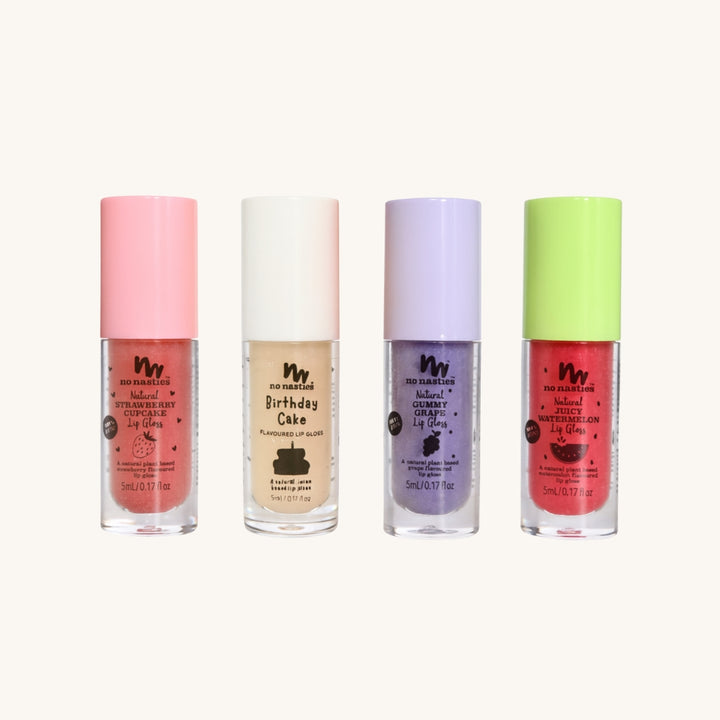
When comparing kids non toxic lip gloss for an older child who can manage a wand without sharing it or placing the applicator on unclean surfaces, the Natural Flavor Lip Gloss for Kids by No Nasties offers a different format. Its published ingredient list includes sunflower, olive, coconut, and jojoba oils, cocoa butter, candelilla wax, natural food-grade flavor, and identified mineral colorants. Check the selected flavor’s ingredients, apply a thin layer, and replace the gloss if its smell, color, texture, or packaging changes.
Natural Flavor Lip Gloss for Kids
$7.99
A yummy, all-natural treat for little lips, this natural flavor lip gloss for kids adds a whisper of color while keeping lips soft and nourished with sunflower, olive, coconut, and jojoba oils. Formulated for even the most sensitive skin, it’s… read more
What to do next:
- Pick your “non-negotiables” first: fragrance level, glitter comfort, ingredient transparency, and packaging hygiene.
- Shop within a curated set of vetted brands: fewer random options, more consistency with Popsicle’s standards.
- Keep the milestone framing: lip gloss and balm can be starter beauty; skip the leap into complexion coverage or correction narratives.
Bottom line
The best kids non toxic lip gloss choice is the one with clear ingredients, kid-appropriate positioning, comfortable wear, and easy removal—plus hygiene rules that match real life. If a product is heavily fragranced, vaguely labeled, or pushes adult-coded “plumping” or performance language, it’s okay to pause. Delay is protective, and makeup can stay what it should be for kids: art, play, and self-expression.
Sources and further reading
- NIEHS: Cosmetics and Your Health - Explains what counts as cosmetics and notes that most cosmetics/ingredients are not FDA preapproved (except color additives).
- FDA: Phthalates in Cosmetics - Notes that individual fragrance ingredients don’t have to be listed separately, which matters when families are trying to avoid certain exposures.
- NIEHS: Endocrine Disruptors - Background on endocrine-disrupting chemicals and common exposure routes, including through skin and consumer products.
Curious about which harmful ingredients to avoid in your child's beauty products? Read The Truth About Harmful Beauty Ingredients for Kids to uncover the hidden toxins in mainstream makeup, skincare, and hair care—and discover safer alternatives.
About the Author: This article was written by the contributing writers at Popsicle Beauty Club—a team of moms, educators, and clean beauty advocates passionate about creating a safer, more imaginative world for kids. We believe in empowering parents with trusted information and offering fun, non-toxic beauty and personal care products that let children play, express, and explore—without compromising their health.
FAQs
What is the safest lip gloss for kids?
Is kids non toxic lip gloss okay if my child accidentally swallows some?
What ingredients should I avoid in kids lip gloss?
Is a squeeze tube or wand more hygienic for children?
Either format can work when kept personal and clean. Squeeze tubes may be easier for younger children because an applicator does not repeatedly return to the container. A wand can suit an older child who follows hygiene rules and keeps it away from unclean surfaces.
Can children use lip gloss on chapped or cracked lips?
Skip gloss when the lips are cracked, bleeding, sore, or actively irritated. Use a simple lip balm the child already tolerates and address habits such as lip licking. Consult a clinician if the irritation persists or worsens.
How should kids non toxic lip gloss be stored and replaced?
Keep the cap securely closed and store the gloss in a cool, dry place. Follow the expiration or period-after-opening guidance and discard it if its smell, color, or texture changes or the packaging becomes damaged.