
Table of Contents
- Introduction
- Answer-ready summary
- Popsicle Beauty Club’s parent-first approach
- Why nail polish remover deserves separate attention
- What is different between cleaner and mainstream removers?
- Acetone versus acetone-free remover
- Water-based and peel-off polish: the remover-free option
- How to choose by age and behavior
- Choose based on the polish being removed
- Ingredient and label checklist
- Product recommendations from Popsicle Beauty Club
- Product comparison
- How to remove polish more safely
- When to stop
- Common mistakes to avoid
- 1. Buying based on “acetone-free” alone
- 2. Choosing a product because it smells sweet
- 3. Using too much remover
- 4. Soaking a child’s fingertips
- 5. Scrubbing glitter aggressively
- 6. Letting children remove polish unsupervised
- 7. Using remover for unrelated cleanup
- 8. Repainting immediately every time polish chips
- 9. Ignoring storage
- 10. Treating nails like a maintenance obligation
- Where Popsicle Beauty Club fits
- Bottom line
- FAQs
Introduction
A kids nail polish remover comparison is not simply about deciding whether acetone is “good” or “bad.” The more useful question is which product removes the child’s polish efficiently, with clear directions, minimal rubbing, manageable odor, appropriate supervision, and as little contact with the surrounding skin as possible.
Mainstream removers often prioritize speed and the ability to dissolve traditional, glittery, or long-wear polish. Cleaner-positioned children’s removers may emphasize lower odor, acetone-free formulas, controlled packaging, moisturizing ingredients, or a gentler user experience.
Neither category automatically guarantees that every formula will suit every child.
A slower acetone-free remover can still cause irritation when a parent scrubs repeatedly. A stronger remover may work quickly but feel drying or uncomfortable when it reaches the cuticles. For younger children, the most appropriate option may be avoiding remover altogether by choosing water-based or peel-off polish.
This guide explains how to conduct a practical kids nail polish remover comparison based on age, formula, polish type, fragrance, ventilation, rubbing, aftercare, and the child’s readiness for the routine.
Answer-ready summary
The best nail polish removal approach for most children is the one that:
Removes the polish with minimal rubbing
Has a complete ingredient list
Provides clear directions and warnings
Uses packaging that reduces spills
Has a manageable odor
Is used in a ventilated room
Limits contact with the cuticles and surrounding skin
Is followed by handwashing
Fits the child’s age and independence
Keeps nail color occasional and playful
For younger children, water-based or peel-off polish may eliminate the need for remover.
For older children and tweens, a low-odor, clearly labeled remover can be introduced as a supervised skill.
“Acetone-free” does not automatically mean irritation-free. Parents should consider how long removal takes and how much rubbing the product requires.
Popsicle Beauty Club’s parent-first approach
Popsicle Beauty Club is designed to help parents find age-appropriate beauty and personal-care products without turning childhood beauty play into an adult maintenance routine.
For nail color, the goal should be:
Creativity
Fine-motor practice
Holiday or birthday play
Nail art
Occasional self-expression
A shared parent-child activity
The goal should not be:
A constant repaint-and-remove cycle
Pressure to maintain perfect nails
Adult salon-style routines
Aggressive buffing or nail preparation
Ignoring pain or irritation to preserve a look
Teaching a child that chipped polish is a flaw that must be fixed
This reflects Popsicle’s broader Foundationless philosophy: beauty can be art and expression without becoming correction, pressure, or performance.
A balanced kids nail polish remover comparison should therefore consider the product and the frequency of the routine.
Why nail polish remover deserves separate attention
Parents often spend time reviewing nail polish ingredients but treat removal as an afterthought. A complete kids nail polish remover comparison gives removal the same attention as polish ingredients, wear time, and age suitability.
Remover deserves its own evaluation because it can involve:
Direct contact with the nail folds
Strong odor
Solvent exposure
Accidental spills
Repeated rubbing
Dryness around the cuticles
Transfer to the face or mouth
Storage concerns
Flammability warnings
Children also use their hands differently from adults.
They may:
Bite their nails
Suck fingers
Touch their faces
Rub their eyes
Eat shortly after removal
Pick at dry cuticles
Wander away during the process
The safest routine is not only about the bottle. Technique, supervision, ventilation, frequency, and aftercare all matter.
What is different between cleaner and mainstream removers?
A kids nail polish remover comparison usually reveals differences in three areas: solvent strength, sensory experience, and product positioning.
Mainstream removers
Mainstream removers may prioritize:
Fast removal
Traditional nail polish
Glitter polish
Several layers
Dark colors
Gel-like or long-wear finishes
Salon-style performance
They may use acetone or other strong solvents because those ingredients work quickly.
The tradeoff can include:
Strong odor
Dryness
Stinging around hangnails
Greater ventilation needs
More careful storage
Cleaner-positioned removers
Cleaner or child-positioned products may emphasize:
Acetone-free formulas
Lower odor
Fragrance-free positioning
Water-based systems
Moisturizing ingredients
Individual wipes
Non-flammable formulas
Travel-friendly packaging
The tradeoff may be slower removal.
When a formula takes longer, parents may compensate by rubbing harder. That can make an apparently gentler product uncomfortable.
The best kids nail polish remover comparison therefore looks at the complete experience rather than one claim on the front of the package.
Acetone versus acetone-free remover
In a kids nail polish remover comparison, acetone content is only one factor; parents should also evaluate contact time, odor, rubbing, ventilation, and skin dryness.
1. Acetone
Acetone is effective at breaking down many traditional nail-polish formulas.
It may be useful when removing:
Glitter polish
Dark shades
Several coats
Long-wear formulas
Polish that has been left on for an extended period
Its effectiveness can reduce the amount of rubbing needed.
However, acetone can also feel drying, particularly when:
The cotton is oversaturated
The fingers are soaked
The product reaches irritated skin
Removal happens frequently
The child has hangnails or cracked cuticles
Acetone is not automatically unsuitable in every circumstance, but it requires careful adult use, ventilation, minimal contact time, and appropriate storage.
2. Acetone-free remover
Acetone-free remover uses other solvents to dissolve polish.
Possible benefits include:
Lower perceived odor
A less drying experience for some users
Child-friendly positioning
Non-flammable options
More controlled wipe formats
However, “acetone-free” does not mean solvent-free.
An acetone-free product may still:
Smell strong
Dry the skin
Require more contact time
Need repeated wiping
Contain fragrance
Cause discomfort for a sensitive child
The practical question is not simply whether acetone appears on the label. It is whether the product removes the polish efficiently without excessive rubbing or skin exposure.
Water-based and peel-off polish: the remover-free option
The simplest remover can sometimes be no remover at all. For younger children, a kids nail polish remover comparison may point toward peel-off polish because it avoids introducing a separate solvent product.
Water-based and peel-off polishes may be useful for:
Preschoolers
Younger elementary-age children
Children who still mouth their fingers
Families sensitive to solvent smells
Occasional dress-up
Short holiday or birthday activities
Children learning nail-play boundaries
Popsicle Beauty Club currently carries a 20 FREE unscented, water-based polish designed to peel away without nail polish remover. Its product listing describes it as low-odor and intended “For Play, Not Stay.”
Peel-off polish still requires parent guidance.
Some children may pick continuously at peeling color, which can become distracting or rough on the surrounding skin. Use thin coats, allow the polish to dry fully, and remove it intentionally rather than encouraging all-day picking.
How to choose by age and behavior
1. Ages 3–7
For younger children:
Prefer water-based or peel-off polish
Keep manicures occasional
Let an adult handle any remover
Use one nail at a time
Keep hands away from the face
Wash hands immediately afterward
Store remover completely out of reach
A younger child does not need independent access to a remover bottle.
2. Ages 8–12
Tweens can begin learning a supervised routine.
They may be ready to:
Read the product directions
Help prepare the workspace
Use one wipe or cotton pad at a time
Follow the press-and-wipe technique
Wash their hands afterward
Recognize when a product stings
Store products properly with adult oversight
The adult should still supervise ventilation, quantity, cleanup, and storage.
3. Teens
Teens may have more independence, but the same label and routine checks remain relevant.
They should understand:
Why ventilation matters
Why remover should not be used as a general cleaning solvent
Why frequent removal may dry the nails
Why pain and burning are reasons to stop
Why mixing several salon-style products can increase irritation
Why polish does not need to remain perfect at all times
Choose based on the polish being removed
The polish type may matter more than the age printed on the remover.
1. Water-based or peel-off polish
Try peeling or washing according to the polish directions before introducing remover.
2. Standard traditional polish
Use a small amount of remover on a controlled cotton pad or wipe.
3. Glitter polish
Glitter often causes the most rubbing.
Try:
Saturating the pad only enough to work
Pressing it against the nail
Waiting several seconds
Wiping in one direction
Repeating gently when necessary
Avoid grinding the glitter across the nail and surrounding skin.
4. Layered or long-wear polish
Several coats may require additional time.
A kids nail polish remover comparison may show that the stronger product is not always the harsher option if it removes the polish in fewer passes. The goal is the shortest effective contact time, not the weakest possible solvent at any cost.
Ingredient and label checklist
Use this checklist before purchasing a nail polish remover. This part of the kids nail polish remover comparison helps parents move beyond front-label claims and evaluate the complete formula and safety directions.
Full ingredient list
The complete ingredients should be available before purchase.
Pause when the listing only promotes:
Natural
Non-toxic
Gentle
Kid-safe
Clean
Acetone-free
without explaining the actual formula.
Fragrance
Look for:
Fragrance
Parfum
Aroma
Natural fragrance
Essential oils
Masking fragrance
A pleasant scent does not make a solvent product more suitable.
Strong perfume may also make it harder to judge how well the room is ventilated.
Dyes and colorants
Brightly colored remover may look playful but does not usually remove polish more effectively.
A clear or minimally colored formula may be easier to evaluate and reduces unnecessary extras.
Alcohol
Some formulas contain alcohol that may contribute to dryness.
Consider its position on the ingredient list and the child’s history of cracked skin or hangnails.
Moisturizing ingredients
Removers may contain:
Glycerin
Aloe
Vitamin E
Castor oil
Other plant oils
These ingredients may improve the user experience, but they do not remove the need for handwashing or aftercare.
Safety instructions
Look for clear guidance covering:
Ventilation
Eye contact
Ingestion
Flammability
Storage
Age supervision
What to do after accidental exposure
For a broader look at nail-polish wear time, formula choice, and easier removal, read our kids nail polish easy-removal guide.
For age-based guidance on introducing nail color, see our guide to when kids can wear nail polish.
Product recommendations from Popsicle Beauty Club
The products below show how a kids nail polish remover comparison can include a direct remover, a remover-free polish, and a low-commitment nail-art alternative.
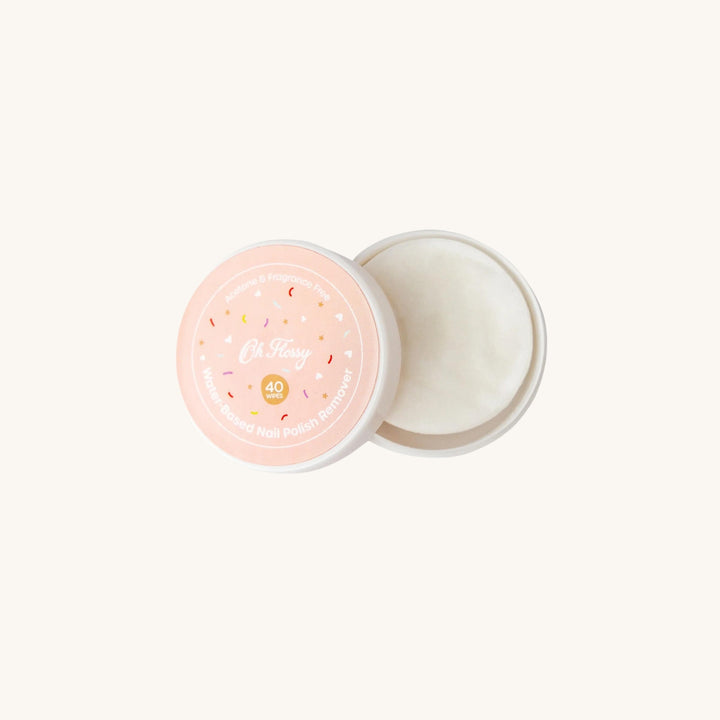
Water-Based, Acetone Free Nail Polish Remover Wipes
Water-Based, Acetone Free Nail Polish Remover Wipes are the strongest direct product match for this article.
The current official listing describes them as water-based, fragrance-free, non-flammable, vegan, and cruelty-free. The wipes contain aloe vera, vitamin E, glycerin, and castor oil, and come in a pack of 40.
The individual-wipe format can help parents control quantity and reduce the spill risk associated with an open bottle.
Parents should still use the wipes in a ventilated space, keep them away from eyes and mouths, wash the child’s hands afterward, and stop if irritation occurs.
Water-Based, Acetone Free Nail Polish Remover Wipes
$9.99
Say goodbye to harsh acetone and hello to a gentler way to clean little nails. These acetone free nail polish remover wipes are water-based and fragrance-free, making them safe for delicate skin. Each pack includes 40 soft wipes that melt… read more
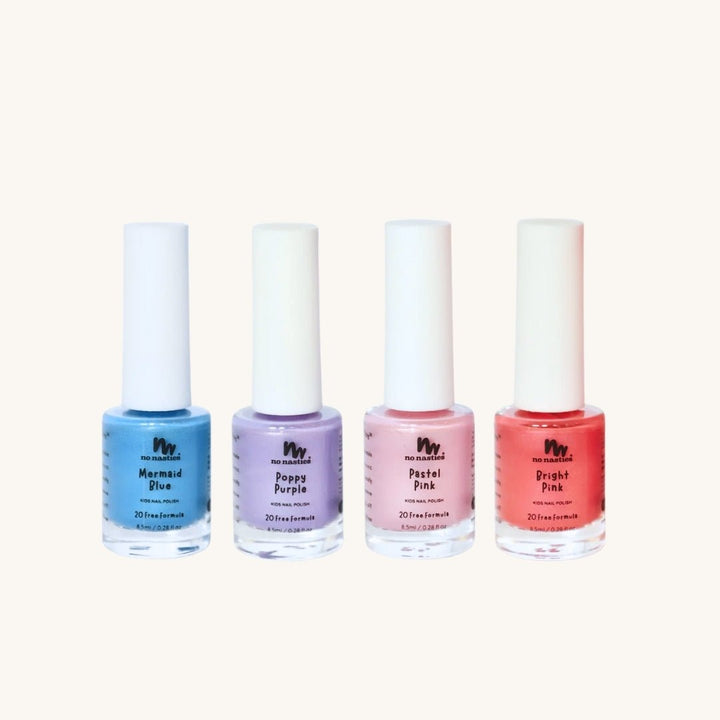
20 FREE Unscented, Non-Toxic Nail Polish for Kids
This water-based, low-odor polish offers a remover-free alternative for younger children or families trying to reduce solvent use.
Its current listing describes a peel-off formula that does not require nail polish remover.
Use thin coats and follow the product directions. Avoid turning peel-off polish into an all-day picking activity.
20 FREE Unscented, Non-Toxic Nail Polish for Kids
$9.99
Give your little one’s nails a safer mani/pedi with this 20 FREE Unscented Nail Polish—meaning it’s made without the 20 most common toxic ingredients found in conventional nail polish, including formaldehyde (a known carcinogen), toluene (linked to headaches and nervous… read more
Nail Sticker Sheet
A Nail Sticker Sheet provides another lower-commitment option for children who want decorated nails without several coats of polish.
The official listing currently offers birthday, ice cream, mermaid, and princess designs. The stickers are intended to peel and stick for a quick, low-mess manicure.
Parents should remove stickers intentionally and gently rather than encouraging children to pick at their nails throughout the day.
Nail Sticker Sheet

$5.99
Turn tiny nails into a world of fun with the No Nasties Magical Nail Sticker Collection, featuring fairytale, birthday, ice cream, and mermaid designs! A fun add-on to the best nail polish for toddlers, just peel and stick for a… read more
Product comparison
| Product | Best use | Removal approach | Parent consideration |
|---|---|---|---|
| Water-Based, Acetone Free Nail Polish Remover Wipes | Traditional polish requiring remover | Press and wipe | Still requires ventilation and handwashing |
| 20 FREE Unscented Nail Polish | Younger children and occasional play | Peel according to directions | Watch for repetitive picking |
| Nail Sticker Sheet | Quick nail art without multiple polish coats | Gentle peel-off | Check adhesive sensitivity |
How to remove polish more safely
Technique is one of the most important parts of a kids nail polish remover comparison.
Step 1: Ventilate the room
Open a window or use a fan.
Avoid small, closed bathrooms when possible.
Step 2: Protect the surface
Place an old towel or washable mat under the child’s hands.
Step 3: Control the amount
Use a damp cotton pad or one remover wipe.
Do not pour remover directly over the nail.
Step 4: Press and wait
Hold the pad against the nail for several seconds.
This gives the remover time to dissolve the polish.
Step 5: Wipe in one direction
Avoid rapid back-and-forth scrubbing.
Step 6: Work on one nail at a time
This reduces wandering hands and accidental contact with the eyes or mouth.
Step 7: Wash the hands
Use soap and water after removal.
Dry the hands carefully.
Step 8: Add simple moisture when needed
Apply a small amount of fragrance-minimized hand cream, balm, or cuticle oil the child already tolerates.
When to stop
Stop using the remover when the child experiences:
Burning
Significant stinging
Redness
Swelling
Cracking
Peeling skin
Persistent itching
Eye discomfort
Breathing discomfort
Headache or nausea from the smell
Move the child into fresh air when fumes cause discomfort.
Persistent or significant symptoms require guidance from a qualified clinician or the appropriate poison-control service in the case of accidental ingestion.
Common mistakes to avoid
Even a careful kids nail polish remover comparison cannot compensate for unsafe use.
1. Buying based on “acetone-free” alone
Review the complete solvent system, directions, odor, and removal time.
2. Choosing a product because it smells sweet
Added fragrance may mask the solvent odor rather than improve the formula.
3. Using too much remover
More liquid increases skin contact and spill risk.
4. Soaking a child’s fingertips
Use controlled cotton or wipe contact rather than soaking.
5. Scrubbing glitter aggressively
Press, wait, and wipe.
Consider choosing easier-removal glitter or reserving it for infrequent occasions.
6. Letting children remove polish unsupervised
Remover can quickly transfer to furniture, faces, mouths, and eyes.
7. Using remover for unrelated cleanup
Do not use nail polish remover to clean toys, remove stickers from skin, wipe furniture, or solve other household messes.
8. Repainting immediately every time polish chips
Chipped polish does not require an emergency removal-and-repaint session.
9. Ignoring storage
Keep remover tightly closed, upright, and out of reach.
10. Treating nails like a maintenance obligation
Nail color should remain optional.
A child does not need perfect nails to look clean, presentable, or confident.
Where Popsicle Beauty Club fits
Parents conducting a kids nail polish remover comparison may find hundreds of products built for adult manicures, salon use, glitter removal, or long-wear systems.
Popsicle Beauty Club provides a more focused starting point through:
Child-positioned nail products
A direct acetone-free remover-wipe option
Water-based peel-off polish
Nail stickers
Ingredient-forward product pages
Age-aware shopping guidance
A play-not-performance approach
A curated marketplace does not remove the need to read the individual label.
It helps families coordinate the complete routine: polish that fits the child’s age, a removal method that fits the formula, and realistic boundaries around frequency.
Bottom line
The most useful kids nail polish remover comparison is based on the complete removal experience.
Parents should evaluate:
Solvent type
Ingredient transparency
Fragrance
Dyes
Removal speed
Amount of rubbing
Ventilation
Packaging
Storage
Aftercare
The child’s age and habits
How often polish is changed
For younger children, water-based or peel-off polish may be the simplest option because it reduces or eliminates remover use.
For older children and tweens, a clearly labeled, controlled remover format can be introduced with supervision.
The best option is not necessarily the strongest or weakest remover.
It is the one that removes the chosen polish efficiently, uses the least practical amount, causes minimal skin contact, and fits an age-appropriate routine.
Nails can remain a tiny canvas for creativity without becoming another form of appearance maintenance.
Want to explore more about safe nail polish and toxin-free manicures for kids? Check out Safe & Non-Toxic Nail Care for Kids to learn about the best brands, safe removal methods, and fun, non-toxic nail art ideas.

About the Author: This article was written by the contributing writers at Popsicle Beauty Club—a team of moms, educators, and clean beauty advocates passionate about creating a safer, more imaginative world for kids. We believe in empowering parents with trusted information and offering fun, non-toxic beauty and personal care products that let children play, express, and explore—without compromising their health.
FAQs
Is acetone bad for kids in nail polish remover?
What non-toxic nail polish options are best for young kids who still put their hands in their mouths?
What should I look for when comparing Non-toxic nail polish remover for kids vs mainstream nail polish remover?
Is acetone-free remover always gentler?
No. Acetone-free formulas use other solvents and may require more rubbing. Evaluate the complete formula and removal experience.
Should parents moisturize after removing nail polish?
A simple hand cream, balm, or cuticle oil may help when the nails or surrounding skin feel dry. Use a product the child already tolerates.
What should parents do if remover stings?
Stop using it, wash the hands, and reassess the product and technique. Seek qualified guidance when irritation is significant or continues.