


Table of Contents
- Introduction
- 1) The most useful answer to when can kids wear nail polish: focus on readiness, not a strict age
- 2) Is nail polish safe for kids? A calm, practical safety context
- 3) What age can you put nail polish on a child? Practical age-by-age guidance
- 4) Shopping for non toxic nail polish for kids: what to look for (and what label terms really mean)
- 5) How to apply nail polish on kids so it dries faster and stays neat
- 6) How often should kids wear nail polish? Nail-friendly habits that matter
- 7) Bottom line: when can kids wear nail polish and how to decide in 60 seconds
- FAQs
Introduction
If you’re googling when can kids wear nail polish, you’re probably balancing two things at once: a child’s excitement (colors! sparkle! matching grown-ups!) and a parent’s very practical questions about safety, mess, and nail health. The good news is that, for most families, the decision is less about hitting a specific birthday and more about choosing the right product type, using it in a kid-friendly way, and keeping expectations realistic.
This guide gives age-appropriate considerations, what to look for on labels, and a simple routine that helps nail polish feel like a fun accessory—not a weekly battle with remover and stained cuticles.
1) The most useful answer to when can kids wear nail polish: focus on readiness, not a strict age
There isn’t one universal “correct” age, because nail polish use depends on factors that vary widely from kid to kid and household to household. Instead of a hard number, consider these readiness checkpoints:
- They can sit still (briefly): Even quick-dry formulas need a few minutes. If they can’t resist touching everything, a peel-off or water-based option may be a better starting point.
- They won’t chew nails or pick at polish: If nail biting is frequent, choose a very occasional “special event” approach, or skip polish until the habit improves.
- They understand “hands off” rules: Basic rules like “don’t put fingers in your mouth while it’s wet” make the experience smoother and cleaner.
- They tolerate gentle removal: Some kids dislike the smell or sensation of remover. If that’s the case, start with peel-off formulas that lift without solvent removers.
So when can kids wear nail polish in real life? Many families start with occasional polish for dress-up or celebrations once a child can follow simple instructions and you can supervise application and removal.
2) Is nail polish safe for kids? A calm, practical safety context
Parents often ask is nail polish safe for kids because nails seem “small,” but polish feels “chemical.” It helps to separate normal-use concerns from avoidable problems:
- Normal use with supervision: Using nail polish occasionally, allowing it to dry, and keeping it off broken skin generally keeps things straightforward for most kids.
- Common avoidable issues: Skin irritation (from polish, fragrance, or remover), allergic reactions to certain ingredients, or nail peeling if nails are frequently polished and aggressively removed.
- What matters most: The formula type (traditional solvent-based vs. water-based/peel-off), how often you do it, and whether the child is prone to irritation or nail biting.
Because every child’s skin can react differently, it’s smart to check labels and patch test when trying a new product—especially if your child has sensitive skin. A simple patch test can be applying a small amount to one nail (or a tiny spot on the outer arm if you prefer) and waiting to see if any redness or itching occurs before doing a full set.
If you’re still deciding when can kids wear nail polish, consider starting with a short wear time (one day) and removing gently, rather than leaving it on for a full week right away. For a deeper ingredient-focused guide, parents can also review our breakdown of nontoxic nail polish for kids before choosing a first polish.
3) What age can you put nail polish on a child? Practical age-by-age guidance
If you’re looking for a more concrete framework for what age can you put nail polish on a child, here’s a practical way to think about it (without implying a medical rule):
- Toddlers/preschool: If you do polish at this stage, keep it very occasional and supervised. Many parents prefer non toxic kids nail polish styles that are water-based and peel off, because the removal process can be simpler and there’s often less odor. Expect imperfect results—and that’s okay.
- Early elementary: This is when many kids can sit through a quick application and understand “dry time.” Peel-off or water-based formulas can still be the easiest. If you use traditional polish, consider a single coat (less chipping mess) and remove sooner rather than later.
- Older kids/tweens: They may want longer wear and more color payoff. This is also when teaching basic nail care is helpful: avoiding picking, not cutting cuticles, and using remover carefully.
Again, when can kids wear nail polish isn’t just “at age X.” It’s “when they can use it safely and you can choose a formula and routine that fits your household.”
4) Shopping for non toxic nail polish for kids: what to look for (and what label terms really mean)
Searching for non toxic nail polish for kids can be confusing because “non-toxic” is often used as a broad marketing term. Instead of relying on one phrase, use a checklist approach and read the ingredient list and safety notes on the package.
Start with formula type
- Water-based: Often lower odor and easier cleanup. These can be a great “starter” option.
- Peel-off: Helpful if your child dislikes remover. Keep in mind peel-off polish may pop off sooner (sometimes that’s a feature).
- Traditional solvent-based: Usually longer-wearing and shinier, but can have stronger odor and often requires remover.
Look for “free-from” claims—but verify
You’ll see claims like “3-free,” “5-free,” “7-free,” or “10-free.” These typically refer to excluding certain ingredients (often ones many shoppers try to avoid). The exact list can vary by brand, so don’t assume two “10-free” polishes are identical. Check labels and read what the brand states is excluded.
Consider fragrance and additives
- Fragrance can be a common irritant for sensitive kids. If your child reacts easily, a fragrance-free approach (when available) can be simpler.
- Glitter can be fun, but removal can be more work—especially with traditional polish. For younger kids, glitter toppers in peel-off formats can be less frustrating.
Don’t forget the remover
If you use traditional polish, remover is part of the “ingredient story.” Some removers are gentler than others, and some are heavily scented. If odor is a concern, open a window, use a small amount on cotton, and wash hands after. If remover is a dealbreaker, peel-off polish may be the better choice.
Parents often ask for the best nail polish for kids. In practice, “best” usually means: the least irritating option your child will actually tolerate, in a shade they’ll enjoy, that you can remove without drama.
When choosing nail polish for children, many parents prefer formulas that are designed with younger users in mind and avoid many of the ingredients commonly found in traditional nail polish.
20 FREE Unscented, Non-Toxic Nail Polish for Kids
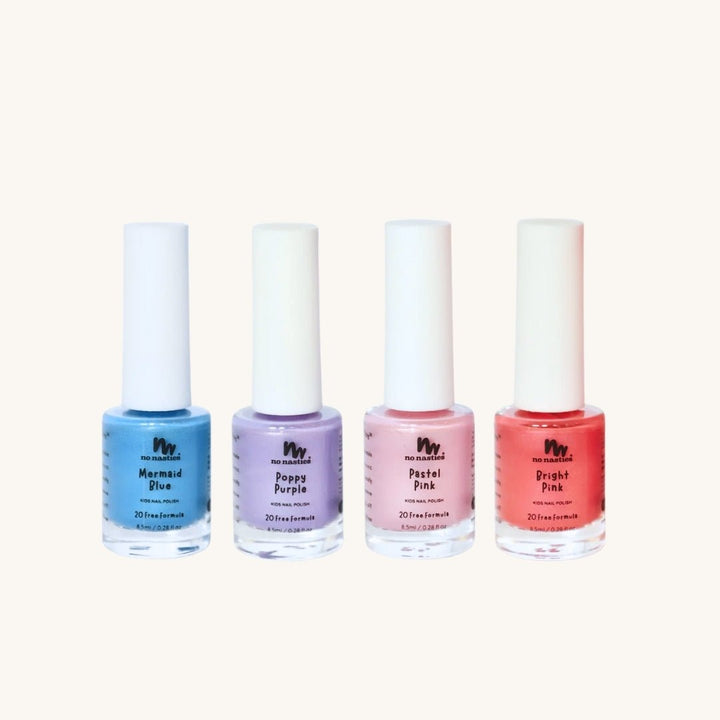
$9.99
Give your little one’s nails a safer mani/pedi with this 20 FREE Unscented Nail Polish—meaning it’s made without the 20 most common toxic ingredients found in conventional nail polish, including formaldehyde (a known carcinogen), toluene (linked to headaches and nervous… read more
5) How to apply nail polish on kids so it dries faster and stays neat
A kid nail routine should be quick, forgiving, and easy to remove. Here’s a parent-proof approach:
- Start with clean, dry nails: Wash hands with soap and water, then dry thoroughly. Skip heavy lotions right before painting (they can make polish slide).
- Protect the skin: If your child tends to wiggle, apply a thin layer of a barrier (like a simple ointment) around the nail edge so stray polish wipes off more easily. Keep it off the nail plate itself.
- Use thin coats: One thin coat is often enough for younger kids. Thin layers dry faster and smudge less.
- Cap the routine at 5–10 minutes: Set a timer for “dry hands.” A short cartoon, story time, or a snack they can eat without using fingers can help.
- Finish with realistic expectations: Kids’ polish rarely looks salon-perfect—and it doesn’t need to. Aim for “cute and mostly on the nails.”
If you’re still weighing when can kids wear nail polish, this is a good test: do one or two nails first. If it’s fun and manageable, do the rest. If it turns into a struggle, pause and try again another day.
6) How often should kids wear nail polish? Nail-friendly habits that matter
Even if you’ve decided when can kids wear nail polish, frequency is the next question. Nails can get dry or peel if polish is constantly on and removed aggressively. A few nail-friendly habits can help:
- Keep it occasional at first: Try weekends, parties, or special occasions rather than continuous wear.
- Avoid peeling off traditional polish: Picking and peeling can lift layers of the nail. If it’s not a peel-off formula, remove it properly.
- Skip cuticle cutting: For kids, it’s usually enough to gently push back after a bath if needed—no cutting.
- Take breaks: If you notice nails looking dry or flaky, take a polish break and use a simple, fragrance-free moisturizer on hands (not right before painting).
Also consider lifestyle: if your child is in sports, swimming, or lots of hand-washing activities, short wear time and easy removal may be the most realistic plan.
7) Bottom line: when can kids wear nail polish and how to decide in 60 seconds
If you want the simplest takeaway on when can kids wear nail polish, use this quick decision filter:
- Choose readiness over age: Can they keep hands out of mouth while wet and sit through dry time?
- Start with lower-commitment formulas: Water-based and peel-off options can be the easiest entry point.
- Read the label: Don’t rely on “non-toxic” as a guarantee—look at “free-from” details and consider fragrance sensitivity.
- Patch test if your child is sensitive or it’s a new product.
- Keep it occasional and gentle: Thin coats, short wear, and careful removal beat long wear and lots of scraping.
Done this way, the answer to when can kids wear nail polish becomes pretty straightforward: when you can supervise, your child can handle the routine, and you’ve picked a product (and removal method) that fits their age and comfort level.
Want to explore more about safe nail polish and toxin-free manicures for kids? Check out Safe & Non-Toxic Nail Care for Kids to learn about the best brands, safe removal methods, and fun, non-toxic nail art ideas.

About the Author: This article was written by the contributing writers at Popsicle Beauty Club—a team of moms, educators, and clean beauty advocates passionate about creating a safer, more imaginative world for kids. We believe in empowering parents with trusted information and offering fun, non-toxic beauty and personal care products that let children play, express, and explore—without compromising their health.