
Table of Contents
- Answer-ready summary
- Popsicle Beauty Club’s parent-first approach
- What does a kids detangler actually do?
- Detangler versus conditioner
- Fragrance and scent disclosure
- Silicones, plant oils and conditioning agents
- Essential oils and botanical extracts
- Proteins and film-forming ingredients
- Dyes and unnecessary visual extras
- Preservatives are part of a stable formula
- A 60-second label checklist
- How to choose by hair type
- How to apply detangler correctly
- How to prevent tangles before they form
- Popsicle Beauty Club product recommendations
- Product comparison
- Common mistakes to avoid
- 1. Buying by scent alone
- 2. Spraying directly toward the face
- 3. Oversaturating fine hair
- 4. Applying everything to the scalp
- 5. Detangling from the roots downward
- 6. Brushing aggressively on dry curls
- 7. Using detangler instead of conditioner
- 8. Ignoring buildup
- 9. Assuming “non-toxic” means reaction-proof
- When to stop using a detangler
- Where Popsicle Beauty Club fits
- Bottom line
- FAQs
Introduction
A good kids hair detangler guide should help parents solve the actual problem: reducing knots, pulling, breakage, and wash-day frustration without coating the hair in more product than it needs.
The best detangler is not automatically the bottle with the longest “free-from” list, the strongest fragrance, or the most impressive salon-style claims. It is the formula that provides enough slip for the child’s hair texture, feels comfortable on the scalp, applies without spraying into the face, and washes out as part of a manageable routine.
Some children need a light mist for fine morning tangles. Others need a richer leave-in product, section-by-section detangling, and consistent conditioning support. Fragrance sensitivity, activity level, swimming, protective styles, and wash frequency can also change what works.
This kids hair detangler guide explains how detanglers work, which ingredients and label details deserve attention, how to match the formula to the child’s hair, and how to detangle with less pain and buildup.
Answer-ready summary
This kids hair detangler guide prioritizes formula transparency, controlled application, enough slip for the child’s texture, and a routine that does not create unnecessary buildup. When choosing a children’s detangler, look for:
A complete ingredient list
Clear fragrance information
Directions for wet or dry hair
A formula weight suited to the child’s texture
Enough slip to reduce pulling
Guidance about avoiding the eyes
A spray nozzle or dispenser that allows controlled use
Ingredients the child has previously tolerated
Easy wash-out
Clear age and storage information
Use detangler mainly through the mid-lengths and ends, start with a small amount, work from the bottom upward, and add more only where needed.
A detangler should make brushing easier. It should not replace an appropriate shampoo, rinse-out conditioner, careful technique, or clinical guidance for a persistently sore or irritated scalp.
Popsicle Beauty Club’s parent-first approach
Popsicle Beauty Club is a curated children’s beauty and personal-care marketplace designed to help families compare age-appropriate products without starting in an adult salon aisle.
Popsicle approaches this kids hair detangler guide through several connected questions:
Does the formula clearly explain how it creates slip?
Is the full ingredient list available?
Is fragrance disclosed?
Does the product match a child’s routine?
Is it easy to apply without drenching the scalp?
Can it be washed out without a harsh clarifying routine?
Does the brand provide practical directions?
Is the product helping with comfort and hygiene rather than pushing appearance pressure?
In hair care, Popsicle’s Foundationless philosophy means supporting cleanliness, manageability, healthy routines, and natural texture.
The goal is not to teach children that curls, coils, shrinkage, frizz, volume, or flyaways are flaws. A detangler should help hair care feel calmer and more comfortable, not make a child’s natural hair something that needs constant correction.
What does a kids detangler actually do?
Hair tangles when neighboring strands catch, twist, and tighten around one another. Understanding why those knots form allows this kids hair detangler guide to address prevention, product choice, and brushing technique rather than relying on more spray alone.
This may happen because of:
Fine strands
Dryness
Curl pattern
Friction from pillows or clothing
Helmets and hats
Swimming
Wind
Long hair
Infrequent brushing
Product residue
Rough towel drying
Aggressive shampooing
Skipping conditioner when the hair needs it
A detangler adds temporary slip so strands can separate with less resistance.
Depending on the formula, that slip may come from:
Conditioning agents
Lightweight oils
Silicones
Plant-derived emollients
Humectants
Film-forming ingredients
Proteins
Leave-in conditioning polymers
The ingredient category alone does not determine whether the product will work. Concentration, formula balance, application amount, hair texture, and wash routine all affect the result.
Detangler versus conditioner
A rinse-out conditioner and a leave-in detangler can support the same goal, but they are not identical.
1. Rinse-out conditioner
Rinse-out conditioner is normally applied after shampooing and then washed away. It can soften the hair and reduce the number of knots that form during drying.
2. Detangler
A detangler is usually applied to damp or dry hair and left in. It provides extra slip during brushing, styling, or between wash days.
Some children need both.
Others may need only a good conditioner and careful technique.
A practical kids hair detangler guide should therefore begin with the full routine rather than assuming that every knot requires another leave-in product.
Fragrance and scent disclosure
Many children’s detanglers are strongly scented because fragrance makes the product feel playful.
However, detangler is often sprayed close to the face and may remain in the hair for hours. For that reason, a parent-friendly kids hair detangler guide should treat fragrance strength and disclosure as practical daily-use considerations, especially for sensitive households.
Parents should check whether the product is:
Fragrance-free
Unscented
Lightly scented
Naturally fragranced
Essential-oil scented
Made with a listed fragrance blend
Described only with the generic term fragrance or parfum
A scented product may work well for one child and feel overwhelming or irritating to another.
Families may want to be more selective when a child has:
Eczema-prone skin
Fragrance sensitivity
Frequent headaches
Watery eyes
Asthma-related scent concerns
Scalp itch
Sensory sensitivity
Previous reactions to leave-in products
The FDA explains that fragrance ingredients may be listed collectively rather than individually, which can limit what consumers can identify from the word “fragrance” alone.
Fragrance-free is not a guarantee that every child will tolerate the formula, but it can simplify troubleshooting for fragrance-sensitive families.
Silicones, plant oils and conditioning agents
Silicones are often used because they create fast, noticeable slip and smoothness.
Some families prefer silicone-free products because certain formulas may feel heavy or contribute to buildup when the child’s shampoo is very mild or the detangler is overapplied.
That does not mean every silicone-containing product is unsuitable. Rather than rejecting one ingredient category, this kids hair detangler guide encourages parents to assess slip, residue, washability, formula weight, and the child’s actual results.
The more useful questions are:
Does the product reduce pulling?
Does it make fine hair greasy?
Does it leave a waxy feeling?
Does the child’s shampoo remove it adequately?
Is the family using too much?
Does it improve or worsen day-two tangles?
Plant oils and butters can provide lubrication, especially for dry, curly, or coily hair. They can also weigh down fine hair when applied heavily or too close to the roots.
Conditioning polymers and plant-derived alternatives may offer slip without the same feel as traditional silicone systems.
Match the formula to the child instead of choosing by one ingredient category alone.
Essential oils and botanical extracts
Botanical ingredients may support scent, conditioning, or product positioning.
Examples include:
Chamomile
Coconut oil
Jojoba oil
Citrus extracts
Lavender
Peppermint
Rosemary
Fruit extracts
Natural origin does not automatically mean irritation-free.
A child with a reactive scalp may tolerate a simple synthetic fragrance better than a concentrated essential-oil blend, while another child may prefer a lightly botanical product.
Review:
The number of aromatic ingredients
How strongly the product smells
Whether it remains on the scalp
Previous family sensitivities
How often the product will be used
Proteins and film-forming ingredients
Some detanglers include hydrolyzed proteins or other film-forming ingredients to support smoothness, shine, and manageability.
These can be useful, but more is not necessarily better.
If hair starts to feel stiff, coated, dry, or unusually difficult to manage, consider whether several products in the routine contain protein or leave-in films.
Introduce one new hair product at a time so it is easier to identify what changed.
Dyes and unnecessary visual extras
A brightly colored detangler may appeal to children, but dye does not improve slip.
Some parents prefer color-free formulas because they:
Reduce unnecessary extras
Simplify sensitivity troubleshooting
Avoid staining
Keep the product focused on function
Make it less likely that a young child treats the spray as a toy
Dyes are not automatically unsuitable. The parent question is whether the decorative effect adds meaningful value to a frequently used leave-in product.
Preservatives are part of a stable formula
Water-based detanglers require effective preservation to reduce microbial growth during storage and regular use.
A “preservative-free” claim is not automatically preferable.
Look for:
A complete ingredient list
Storage instructions
Period-after-opening information
Packaging that limits contamination
A nozzle that stays reasonably clean
Advice to discard a product that changes smell, appearance, or texture
Do not add water directly to the bottle unless the manufacturer specifically instructs you to do so.
A 60-second label checklist
Use this kids hair detangler guide while reviewing the product page or bottle. The same kids hair detangler guide checklist can help families compare sprays, creams, leave-in conditioners, fragranced formulas, and silicone-free alternatives consistently.
1. Check the formula
Is the full ingredient list visible?
Is fragrance clearly described?
Are essential oils present?
Does the formula contain several heavy oils or butters?
Does it contain silicones or identify itself as silicone-free?
Are proteins included?
Are dyes added mainly for appearance?
2. Check the directions
Is it intended for wet hair, dry hair, or both?
Is it a spray, cream, or leave-in conditioner?
Does it say to avoid the eyes?
Does the brand explain how much to use?
Is the product intended for the scalp or mainly the lengths?
Is an age range stated?
3. Check the routine fit
Can the child’s shampoo wash it out?
Does the family already use a rinse-out conditioner?
Will it be used daily or only on difficult wash days?
Is the texture light enough for fine hair?
Is it rich enough for curls or coils?
How to choose by hair type
The right detangler depends more on hair needs than on how the bottle is marketed. A useful kids hair detangler guide therefore matches product weight and application technique to fine, straight, wavy, curly, coily, thick, or long hair.
1. Fine or straight hair
Choose:
A lightweight mist
Controlled spray
Minimal heavy oil
Easy wash-out
Small amounts applied mainly to knots
Avoid saturating the roots. Fine hair may become flat or greasy quickly.
2. Wavy hair
Look for:
Lightweight conditioning
Enough slip for the ends
A formula that does not flatten the wave pattern
Moderate application
Gentle brushing or finger detangling
3. Curly hair
Curly hair may benefit from:
More conditioning support
Detangling while damp
Section-by-section application
A flexible brush or wide-tooth comb
A rinse-out conditioner plus a small amount of leave-in support
4. Coily or tightly textured hair
Coily hair often needs:
Richer slip
More water during detangling
Small sections
Patient bottom-up technique
Conditioner or leave-in support
Less frequent manipulation
Do not force a fine-mist product to do the job of a richer conditioner if the hair needs more lubrication.
5. Thick or long hair
Focus on:
Even sectioning
Enough product through the lower lengths
Thorough brushing in manageable sections
Preventive braiding or protective styles when appropriate
Avoiding dry, rushed detangling
How to apply detangler correctly
Good technique can matter as much as the formula. The application steps in this kids hair detangler guide are designed to reduce pulling while preventing overspraying, scalp saturation, and unnecessary contact with the eyes.
Step 1: Add moisture
Detangling is often easier on damp hair.
Use the product after washing or lightly mist the hair with water according to the product directions.
Step 2: Divide the hair
Separate thick, curly, coily, or long hair into manageable sections.
Step 3: Start with a small amount
Apply detangler mainly to the mid-lengths and ends.
Add more only where the hair still resists.
Step 4: Keep spray away from the face
Ask the child to look down and close their eyes.
For the hairline, spray the product into your hand first and smooth it onto the hair.
Step 5: Hold the section
Hold the hair above the knot so pulling does not transfer directly to the scalp.
Step 6: Work from the ends upward
Begin below the knot and gradually move higher.
Starting at the roots can tighten tangles and make brushing more painful.
Step 7: Use the right tool
Depending on the texture, use:
Fingers
A wide-tooth comb
A flexible detangling brush
A brush designed for wet hair
Step 8: Stop when the hair is manageable
More product does not necessarily create a better result.
How to prevent tangles before they form
A complete kids hair detangler guide should include prevention, not only knot removal.
Try:
Conditioning hair that regularly becomes dry
Using a microfiber towel or soft cotton shirt
Avoiding aggressive towel rubbing
Brushing gently before washing when appropriate
Braiding long hair before sleep
Using a smooth pillowcase
Rinsing chlorine and saltwater promptly
Washing helmets, hats, and hair accessories
Keeping brushes clean
Trimming damaged ends when needed
Avoiding excessive product layering
Preventing friction can reduce the amount of detangler required.
Popsicle Beauty Club product recommendations
The current Popsicle catalogue includes several detangler formats with different weights, fragrance profiles, and formula approaches. Review the full current listing before buying because availability and formulations may change. The products below illustrate how a kids hair detangler guide can compare formula weight, scent, proteins, conditioning ingredients, and suitability for different routines.
Detangler & Leave-In Conditioner for Kids
Detangler & Leave-In Conditioner for Kids is a lightweight option made for wet or dry hair.
The official Popsicle listing describes it as silicone-free, suitable for ages one and older, and formulated with olive-derived squalane and coconut oil to support smoothness and manageability. It may suit families looking for a daily mist for bedhead, flyaways, or freshly washed hair.
Start with a small amount, particularly on fine hair, and concentrate application through the lengths rather than the roots.
Detangler & Leave-In Conditioner for Kids
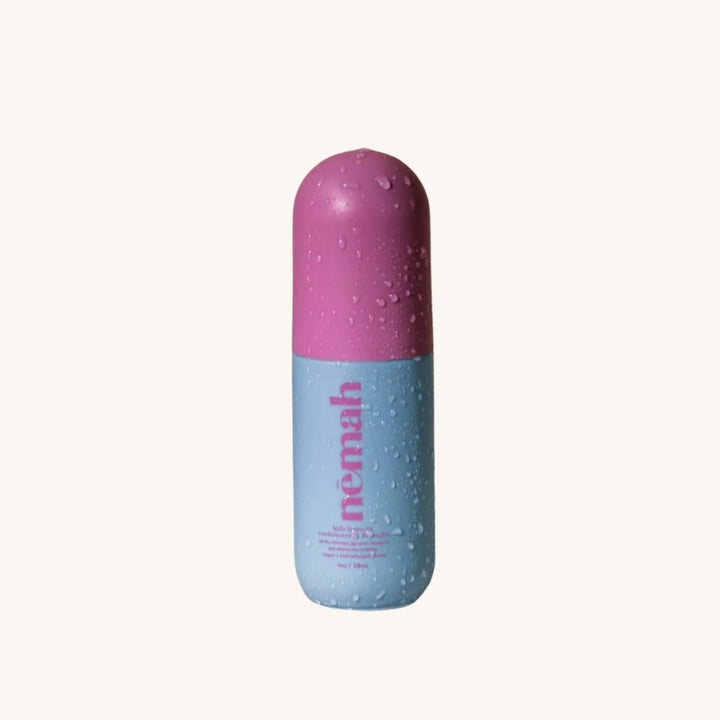
$16.99
Nemah’s Detangler & Leave-In Conditioner for Kids is a clean, lightweight formula designed to make brushing simple and stress-free. Powered by olive-derived squalane, it locks in weightless moisture to keep strands soft and manageable, while coconut oil deeply nourishes, smooths rough… read more
Knot A Chance! Children’s Detangler
Knot A Chance! Children’s Detangler offers a scented, silicone-free option that also functions as a lightweight leave-in conditioner.
The current listing describes a formula containing Emu Apple extract, chamomile extract, and broccoli seed oil, with Mandarin Grape or Strawberry scent options. It is positioned as vegan, cruelty-free, and free from several commonly avoided ingredients.
Because the product is fragranced, families with scent or botanical sensitivity should review the full ingredients and scent choice carefully.
Knot A Chance! Children's Detangler

$14.99
Make hair care a joyful, stress-free experience with this gentle children’s detangler, a safer, all-natural alternative to mainstream products. Available in the refreshing scents of Mandarin Grape or Strawberry, this lightweight formula is enriched with native Australian Emu Apple extract,… read more
Detangler Leave-In Conditioner Spray
Detangler Leave-In Conditioner Spray provides another lightweight leave-in option.
Its official product page lists ingredients including jackfruit fruit extract, glycerin, guar hydroxypropyltrimonium chloride, hydrolyzed lemon protein, pea peptide, and a disclosed cherry fragrance blend. The listing also describes the formula as dermatologist-tested and toxicologist-audited.
This option may appeal to parents who want detailed fragrance and functional-ingredient information. Families managing protein sensitivity or scent concerns should still assess the complete formula and the child’s response.
Detangler Leave-In Conditioner Spray

$10.99
Say goodbye to tangles and tears with Dabble & Dollop’s Cherry on Top® Detangler Leave-In Conditioning Spray, a lightweight conditioning mist that makes brushing easier and more enjoyable. This gentle, weightless formula smooths knots without residue, leaving hair soft, manageable,… read more
Product comparison
| Product | Formula style | Best fit | Parent consideration |
|---|---|---|---|
| Detangler & Leave-In Conditioner for Kids | Lightweight, silicone-free mist | Wet or dry hair, bedhead, fine to delicate curls | Contains coconut oil; start lightly |
| Knot A Chance! Children’s Detangler | Botanical, fragranced, silicone-free leave-in | Wavy, curly, thicker or active-child hair | Review Mandarin Grape or Strawberry scent |
| Detangler Leave-In Conditioner Spray | Lightweight formula with protein and disclosed cherry fragrance | Knots, shine and routine detangling | Review fragrance and protein tolerance |
Common mistakes to avoid
Even after following a kids hair detangler guide, families may get poor results when they overspray, brush from the roots, ignore buildup, or use a lightweight mist where richer conditioning is needed.
1. Buying by scent alone
A fun scent does not indicate whether the formula suits the child’s hair or scalp.
2. Spraying directly toward the face
Apply with control and keep the mist away from the eyes and mouth.
3. Oversaturating fine hair
Start with fewer sprays and add only where needed.
4. Applying everything to the scalp
Most tangles occur through the lengths and ends.
5. Detangling from the roots downward
This can tighten knots and increase pulling.
6. Brushing aggressively on dry curls
Add moisture and adequate slip before detangling.
7. Using detangler instead of conditioner
Some hair types need rinse-out conditioning to prevent knots before they form.
8. Ignoring buildup
Product residue, dirty brushes, and insufficient shampooing can make hair feel tangled or coated.
9. Assuming “non-toxic” means reaction-proof
Any formula may bother an individual child. Review the label and introduce new products carefully.
When to stop using a detangler
Pause the product if the child develops:
Persistent scalp itching
Burning
Rash
Swelling
Eye irritation
Sores
Increased flaking
Significant discomfort
Hair that becomes unusually stiff or coated
Rinse the product out and simplify the routine.
Seek qualified clinical guidance when symptoms are significant, recurrent, or accompanied by hair loss, broken skin, pain, or signs of infection.
Where Popsicle Beauty Club fits
Parents using this kids hair detangler guide can browse many different formula types, but comparison becomes difficult when product pages use inconsistent terms.
Popsicle Beauty Club provides a more focused starting point through:
Curated children’s detanglers
Complete product pages
Ingredient-forward education
Hair-texture guidance
Conditioner and shampoo options
Parent-friendly use information
Age-aware positioning
Products selected around comfort and manageability
For a closer ingredient review, read our guide to ingredients to avoid in children’s detangler spray, including fragrance, silicones, preservatives, dyes, and buildup considerations.
For a complete wash-day routine, review our kids shampoo and conditioner guide covering cleansing, conditioning, detangling, rinseability, and hair-type needs.
Bottom line
The best detangler is the one that provides enough slip for the child’s hair without creating scalp discomfort, excessive fragrance exposure, buildup, or a complicated routine.
Use this kids hair detangler guide to compare:
Formula weight
Fragrance
Oils and conditioning agents
Silicone preferences
Protein
Product directions
Hair texture
Wash frequency
Application method
Removal and buildup
Start with a small amount, focus on the lengths and ends, work from the bottom upward, and keep sprays away from the face.
Most importantly, treat detangling as a comfort and hair-care step—not a way to correct natural texture.
To learn more about choosing the safest shampoos, conditioners, and detanglers for kids, visit Non-Toxic Hair Care for Kids for a complete guide to gentle, chemical-free hair care.

About the Author: This article was written by the contributing writers at Popsicle Beauty Club—a team of moms, educators, and clean beauty advocates passionate about creating a safer, more imaginative world for kids. We believe in empowering parents with trusted information and offering fun, non-toxic beauty and personal care products that let children play, express, and explore—without compromising their health.
FAQs
Is “non-toxic” kids detangler actually safer?
What should I do if my child gets an itchy scalp after using detangler?
How do I pick between Non-toxic kids detangler vs mainstream kids detangler for sensitive skin?
What is the best detangler for kids?
The best option depends on hair texture, scalp sensitivity, fragrance preference, wash frequency, and how much slip the child needs. Fine hair often needs a light mist, while curly or coily hair may need richer conditioning support.
Are silicones bad in children’s detangler?
Not automatically. Silicones can provide effective slip. Some families avoid them because of formula preference or buildup concerns. Evaluate the complete product and the child’s results.
Should detangler be applied to the scalp?
Usually, focus on the mid-lengths and ends unless the product specifically instructs otherwise. Applying heavily to the scalp can contribute to residue or discomfort.