
Table of Contents
- Introduction
- Answer-ready summary
- Popsicle Beauty Club’s parent-first approach
- Why consistency across categories matters
- What “clean” should mean in practice
- Ingredient transparency
- Fragrance consistency
- Preservatives and real-world use
- Makeup pigments and color
- Easy removal is part of the standard
- Everyday skincare: what most kids actually need
- Makeup for play: what age-appropriate can look like
- A comparison table for parents
- Product recommendations from Popsicle Beauty Club
- Product comparison
- How to build a simple combined routine
- How to compare brands that sell both categories
- Foundationless boundaries
- Common mistakes to avoid
- 1. Buying a complete routine before identifying a need
- 2. Assuming one clean claim covers the whole brand
- 3. Treating natural fragrance as automatically gentle
- 4. Avoiding every preservative
- 5. Choosing makeup without planning removal
- 6. Using skincare to correct normal childhood skin
- 7. Introducing complexion coverage as a confidence tool
- 8. Buying several new formulas at once
- Where Popsicle Beauty Club fits
- Bottom line
- FAQs
Introduction
Parents shopping for clean kids makeup and skincare are often trying to solve two related problems at once.
They want everyday products that support hygiene, hydration, and skin comfort. They may also want occasional makeup that lets a child explore color, sparkle, nails, lip gloss, costumes, or performances without introducing adult-style correction routines.
The challenge is consistency.
A company may use a simple, fragrance-free formula in its cleanser or moisturizer, then apply very different standards to its makeup. Another may create appealing play makeup but offer skincare built around strong scent, unnecessary actives, or appearance-focused claims.
That is why the most useful question is not simply whether a product is marketed as clean. Parents should ask whether ingredient transparency, fragrance choices, age-appropriate positioning, product placement, and easy removal remain consistent across both categories.
This guide explains how to compare clean kids makeup and skincare without fearmongering, how Popsicle Beauty Club approaches the category, which products belong in a simple routine, and what parents may intentionally delay.
Answer-ready summary
Strong clean kids makeup and skincare standards usually include:
Complete ingredient lists
Clear fragrance information
Age-appropriate product categories
Simple everyday skincare
Makeup positioned around expression and play
Easy removal
Practical hygiene instructions
Appropriate preservation
Patch-testing guidance where useful
Recognition of individual sensitivities
No pressure to build an adult routine
No suggestion that a child’s natural face requires correction
For everyday skincare, most children need only products that serve a genuine purpose, such as:
A gentle cleanser when needed
A basic moisturizer when skin feels dry
Sunscreen appropriate to the child and activity
Lip balm for comfort
Targeted body care for dry areas
For makeup play, families may consider:
Sheer lip gloss
Lip balm
Nail color or stickers
Face gems
Pressed shimmer
Small washable makeup sets
Costume and performance color
Parents may choose to delay foundation, concealer, contouring, anti-aging products, strong exfoliating actives, and routines built around hiding or perfecting normal skin.
Popsicle Beauty Club’s parent-first approach
Popsicle Beauty Club is a curated children’s beauty and personal-care marketplace designed to help families compare products without starting in a broad adult beauty aisle. Popsicle treats clean kids makeup and skincare as one connected category, applying the same parent-first questions to cleansers, moisturizers, lip products, color cosmetics, and removal tools.
Its current catalogue includes children’s cleansers, moisturizers, lip products, makeup kits, removal tools, nail products, hair care, bath and body care, and gift sets. Official product pages provide individual ingredient and use information rather than relying only on one general brand claim.
Popsicle evaluates clean kids makeup and skincare through several connected questions:
What is in the formula?
Where will it be used?
How long will it stay on?
Is fragrance clearly explained?
Does it suit the child’s age?
Can it be applied hygienically?
Can it be removed gently?
Is the product serving comfort, care, or creative play?
Does its message support confidence or correction?
The Foundationless approach is not anti-makeup.
It supports beauty as:
Art
Color
Sparkle
Dress-up
Nail creativity
Hair play
Personal care
Costumes
Performances
Holiday and party fun
It pushes back against adultification, daily complexion coverage, “flawless” language, and the idea that a child must improve her face before she can feel presentable.
Why consistency across categories matters
Skincare and makeup create different formulation challenges.
A gentle cleanser may need surfactants that remove dirt without leaving skin uncomfortable.
A moisturizer may need humectants, emollients, occlusives, emulsifiers, and preservatives.
A lip gloss needs structure, shine, flavor considerations, and ingredients suitable for frequent reapplication near the mouth.
A pressed eyeshadow or blush requires pigments, binders, texture ingredients, and control over fallout.
Because the products perform different jobs, their ingredient lists should not look identical.
Consistency does not mean using the same ingredients everywhere.
It means maintaining the same decision-making standards across categories:
Full disclosure
Product-specific formulation
Responsible fragrance use
Appropriate pigments
Realistic age guidance
Clear application instructions
Gentle removal
No exaggerated safety promises
No correction-focused childhood beauty message
The strongest clean kids makeup and skincare approach respects the function of each formula without abandoning the family’s broader values.
What “clean” should mean in practice
“Clean,” “natural,” “non-toxic,” and “gentle” do not have one universal meaning across every beauty company.
One brand may define clean around ingredient exclusions.
Another may focus on naturally derived ingredients.
Another may prioritize fragrance-free skincare, mineral pigments, refillable packaging, or specific certification standards.
Parents should therefore look beyond the word on the front label.
A useful practical definition is: A clearly disclosed, age-appropriate product whose ingredients, placement, use, and removal can be evaluated by the parent.
When comparing clean kids makeup and skincare, ask:
Is the full formula available?
Does the brand explain what major ingredients do?
Are variants listed separately?
Is scent disclosed clearly?
Is the product intended for the area where it will be applied?
Does the formula solve a real need?
Can the child use it comfortably?
Is the product easy to remove?
Does the brand acknowledge that no formula suits everyone?
Ingredient transparency
A parent should not have to contact customer service to obtain a basic ingredient list. Reliable clean kids makeup and skincare information should remain easy to find whether the product is used on the body, lips, cheeks, eyelids, or another sensitive area.
Look for:
Full INCI ingredients
Shade-specific pigments
Flavor-specific ingredients
Fragrance information
Allergy-related notes
Clear product directions
Period-after-opening or expiry information
Storage guidance
Updated formula information
Transparency is especially important when a company sells both makeup and skincare because the areas of use can change significantly.
A product used on elbows presents different practical questions from a product used on lips or near the eyes.
Fragrance consistency
Fragrance is often one of the clearest tests of whether a brand applies consistent standards.
A company may offer a fragrance-free facial moisturizer but strongly scent its lip, bath, or body products.
That is not automatically wrong. Different products may serve different families and use cases.
However, the brand should make the difference clear.
Parents should be able to distinguish among:
Fragrance-free
Unscented
Naturally scented
Essential-oil scented
Flavored lip products
Synthetic fragrance
Disclosed fragrance components
Generic fragrance or parfum
The official Natural Moisturizer for Kids listing currently describes a fragrance-free formula for sensitive teen skin, while other Popsicle products openly identify natural flavors, essential oils, or scent choices on their individual pages.
That product-specific disclosure is more useful than pretending every clean kids makeup and skincare product must share the same scent profile.
Preservatives and real-world use
Water-based cleansers, moisturizers, gels, and micellar products require protection against microbial growth.
A preservative-free claim is not automatically a benefit.
Parents should look for responsible formulation, packaging, and storage guidance rather than assuming every preservative is undesirable.
A practical formula has to remain stable through:
Bathroom humidity
Repeated pumping
Damp hands
Backpacks
Travel
Shared household spaces
Ordinary opening and closing
A product should be judged by the complete preservation system and the child’s known sensitivities—not by the presence of one technical-sounding ingredient.
Makeup pigments and color
Color ingredients are necessary for makeup to create visible shades.
Parents should be able to identify:
What creates the color
Whether formulas vary by shade
Whether the color is intended for eyes, lips, cheeks, nails, or body
Whether shimmer is fine, pressed, gel-based, or loose
Whether the product stains
How it removes
Strong clean kids makeup and skincare standards do not require colorless childhood products.
They require appropriate color, clear placement, manageable formats, and honest information.
Easy removal is part of the standard
Children’s makeup should fit a child-friendly cleanup routine.
Parents should ask how a product comes off before buying it.
Products that require:
Aggressive rubbing
Several removers
Repeated wiping
Harsh solvents
Long scrubbing sessions
may not suit younger users.
Easy removal supports:
Skin-barrier comfort
Better bedtime routines
Less eye rubbing
Lower conflict
More realistic hygiene habits
The Heart-Shaped Makeup Remover Puff is currently positioned as a soft, reusable cleanup tool for beauty play and can replace repeated use of rough washcloths or disposable wipes.
Everyday skincare: what most kids actually need
A simple skincare routine should be based on the child’s real skin needs rather than adult beauty trends. In a balanced clean kids makeup and skincare approach, everyday care should solve an actual hygiene or comfort need rather than create a routine simply because adult beauty culture expects one.
1. Gentle cleansing
A cleanser may be useful when the child has:
Sweat
Dirt
Sunscreen
Makeup
Sports residue
Oiliness
Environmental buildup
Not every child needs a foaming cleanser twice daily.
The Teen Skin Ultra Gentle Foaming Face Wash is currently described as a fragrance-free, oil-free cleanser for pre-teens and teens, formulated with ingredients including pomegranate, aloe, and green tea.
Parents should still decide whether daily cleansing is necessary and whether the product suits the child’s age and skin type.
2. Basic moisturizing
Moisturizer may help when skin feels:
Dry
Tight
Rough
Flaky
Uncomfortable after swimming
Dry during cold weather
Irritated by frequent washing
A child with balanced skin may not need moisturizer every morning and evening.
The Natural Moisturizer for Kids is currently positioned as a lightweight, fragrance-free facial moisturizer for sensitive teen skin.
3. Sunscreen
Sun protection may be appropriate according to the child’s activities, location, skin needs, clothing, exposure, and family guidance.
Sunscreen should not be framed as an anti-aging beauty treatment for children.
It belongs in the category of protection.
4. Lip care
Lip balm may help with dryness, wind exposure, licking habits, or cold weather.
It should not automatically become a constant cosmetic routine.
5. Targeted body care
Body lotion or balm may be useful for:
Dry hands
Elbows
Knees
Seasonal dryness
Post-swim skin
Rough patches
One useful product is usually better than several overlapping scented layers.
Makeup for play: what age-appropriate can look like
Makeup can be introduced as a creative material rather than a correction tool.
1. Lip gloss
A sheer gloss may suit an older child who can use it hygienically and avoid sharing.
The current Natural Flavor Lip Gloss for Kids listing describes a sheer, shiny lip product made with plant oils and identifies allergy-related characteristics including nut-free, gluten-free, and dairy-free positioning.
Parents should still review the selected flavor, formula, and the child’s sensitivities.
2. Small makeup kits
A contained kit may be easier to supervise than a large collection of unrelated adult products.
The current 9-Piece Mermaid or Unicorn Makeup Set for Kids listing describes pressed powder makeup made with mineral pigments, water-washable formulas, and exclusions including talc, carmine, lake pigments, and FD&C dyes.
A kit should still be used occasionally, with clean applicators and clear placement rules.
3. Refillable palettes
A refillable palette may appeal to an older child who wants more choice while keeping products organized.
The current Refillable Makeup Palette 10-Piece Kit includes a reusable bamboo compact, brushes, pressed colors, and a shimmer lip gloss, and is positioned around imaginative play and refillable packaging.
4. Nail products and face gems
Nails and decorative gems may offer color and creativity without introducing complexion coverage.
Parents should supervise adhesives, removal, sharing, and placement near the eyes.
A comparison table for parents
| Standard | Everyday skincare | Makeup for play | Parent question |
|---|---|---|---|
| Ingredient disclosure | Full formula for cleanser, moisturizer, or body care | Full formula and pigments for each shade or product | Can I review everything before buying? |
| Fragrance | Often easier to keep fragrance-free or lightly scented | May include flavor or scent for play appeal | Is the scent clearly disclosed? |
| Product purpose | Hygiene, hydration, protection, comfort | Art, dress-up, color, parties, performances | Does this solve a real need or create pressure? |
| Frequency | Used when needed | Occasional or special-event use | Is daily use necessary? |
| Removal | Should rinse or cleanse comfortably | Should come off without scrubbing | What does bedtime cleanup require? |
| Packaging | Hygienic pumps or controlled dispensing | Secure palette, tubes, or compact | Can the child store it properly? |
| Age fit | Basic and barrier-focused | Small, washable, supervised | Is the format manageable for this child? |
| Messaging | Comfort and healthy habits | Creativity and expression | Does the product imply correction? |
Product recommendations from Popsicle Beauty Club
The following products show how makeup, skincare, and removal can work together without creating an adult-style routine. Together, these recommendations demonstrate how clean kids makeup and skincare can include one practical care set, one supervised creative-play option, and one gentle cleanup tool.
Fragrance-Free Kids Skincare Set
The Fragrance-Free Kids Skincare Set is the strongest everyday-care recommendation because it combines a gentle foaming cleanser with moisturizer in one simplified routine.
It may suit a pre-teen or teen who genuinely needs regular cleansing and hydration and whose family prefers fragrance-free facial care.
Parents should still avoid assuming that owning a set means both products must be used twice every day. Use each item according to the child’s skin and actual needs.
Fragrance-Free Kids Skincare Set
$29.99
$32.98
The Natural Outcome fragrance-free Kids Skincare Set includes two everyday essentials—the Teen Skin Ultra Gentle Foaming Face Wash and the Teen Skin Calm Control non toxic face moisturizer. Designed for teens and pre-teens, this plant-based duo makes skincare simple and… read more

9-Piece Mermaid or Unicorn Makeup Set for Kids
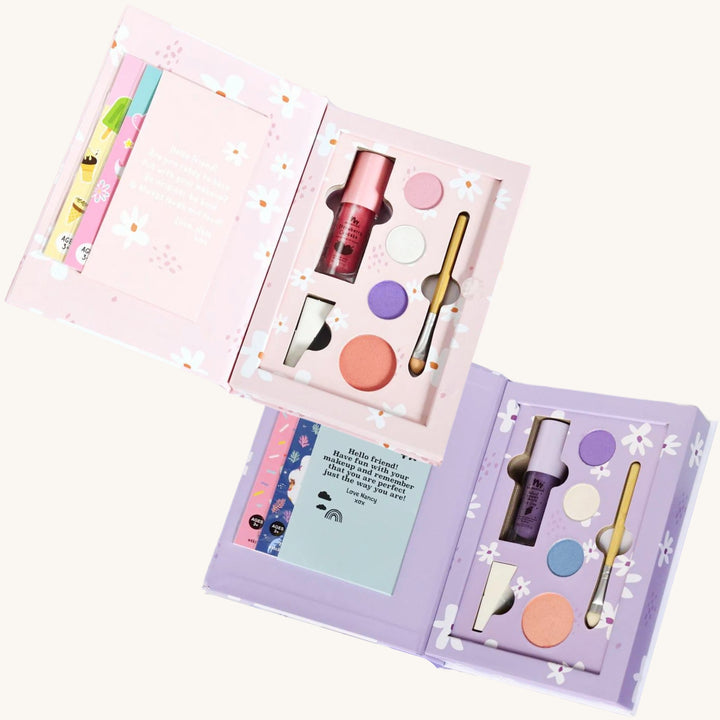
The 9-Piece Mermaid or Unicorn Makeup Set for Kids is the strongest creative-play recommendation.
Its pressed powders, compact format, and washable positioning make it a more manageable alternative to a large adult palette. It may work for supervised dress-up, birthday parties, costumes, performances, and occasional home play.
Keep the products away from the waterline, use clean applicators, and remove everything before bed.
9-Piece Mermaid or Unicorn Makeup Set for Kids
$49.99
Let her imagination sparkle—safely. This Natural Pressed Powder Makeup Set is made with vibrant mineral pigments and a non-toxic, skin-friendly formula trusted by parents since 2016. As the longest-standing clean beauty brand for kids, they've led the way in creating… read more
Heart-Shaped Makeup Remover Puff
The Heart-Shaped Makeup Remover Puff connects the two sides of clean kids makeup and skincare by making gentle cleanup part of the routine.
Use it with lukewarm water or a mild cleanser the child already tolerates. Press and wipe gently rather than scrubbing.
Wash the puff regularly and allow it to dry fully between uses.
Heart-Shaped Makeup Remover Puff
$9.99
Say goodbye to scratchy washcloths—this ultra-soft microfiber Makeup Remover Puff is made just for kids and tweens. Gentle on young skin, it makes washing up after beauty play a breeze. A handy hanging tag lets it dry between uses, and… read more

Product comparison
| Product | Role in the routine | Best suited to | Parent consideration |
|---|---|---|---|
| Fragrance-Free Kids Skincare Set | Everyday cleansing and moisturizing | Pre-teens or teens who need a basic routine | Do not add steps the child does not need |
| 9-Piece Mermaid or Unicorn Makeup Set | Occasional creative beauty play | Children who enjoy supervised color and dress-up | Review application areas and hygiene |
| Heart-Shaped Makeup Remover Puff | Gentle same-day removal | Children and tweens using washable makeup | Wash and dry it regularly |
How to build a simple combined routine
Families do not need a full makeup line and a full skincare line.
Start with the child’s actual need.
Step 1: Choose one everyday product
Possible starting points include:
A gentle cleanser
A basic moisturizer
A lip balm
A body lotion
A sunscreen
Do not purchase all five merely because they form a recognizable routine.
Step 2: Add one play category
Choose one:
Lip gloss
Nail color
Nail stickers
Face gems
Pressed eyeshadow
A small makeup kit
Step 3: Plan application boundaries
Agree on:
When it can be used
Where it can be applied
Whether an adult must help
Whether products can be shared
How tools will be cleaned
Step 4: Plan removal
Know which cleanser, cloth, puff, or water-based method will remove the product.
Step 5: Introduce one new formula at a time
This makes it easier to identify irritation or discomfort.
A careful clean kids makeup and skincare routine is usually smaller than the product collections promoted through social media.
How to compare brands that sell both categories
When evaluating a company’s complete range, choose one skincare product and one makeup product and compare them side by side.
Check:
Are both ingredient lists complete?
Is fragrance handled consistently?
Are allergens or sensitivities acknowledged?
Is age guidance available?
Are pigments explained?
Is removal discussed?
Does the makeup require several additional products?
Does the skincare promote adult actives?
Does the language remain age-appropriate?
Are customer questions answered clearly?
One excellent moisturizer does not prove that every makeup product meets the same standards.
One attractive makeup kit does not prove that the skincare line is simple or age-appropriate.
Consistency must be visible product by product.
Foundationless boundaries
A company may meet a family’s ingredient standards while still selling products the parent prefers to delay.
Ingredients and developmental fit are separate questions.
Popsicle Beauty Club recommends keeping childhood beauty focused on:
Lip care
Nails
Washable color
Hair care
Bath and body care
Face gems
Costume makeup
Occasional shimmer
Hygiene and comfort
Parents may choose to delay:
Foundation
Concealer
Contouring
Pore-blurring products
Anti-aging products
Strong exfoliating routines
Daily correction-focused makeup
Products marketed around looking older
The purpose of clean kids makeup and skincare should be to support care and creativity—not to make adult performance beauty available earlier.
Common mistakes to avoid
Even thoughtfully selected clean kids makeup and skincare can become overwhelming when families introduce too many products, skip removal planning, or allow clean claims to replace individual label checks.
1. Buying a complete routine before identifying a need
More products do not create healthier skin.
2. Assuming one clean claim covers the whole brand
Review each product separately.
3. Treating natural fragrance as automatically gentle
Essential oils and naturally derived scent can still bother an individual child.
4. Avoiding every preservative
Water-based products need effective preservation.
5. Choosing makeup without planning removal
Cleanup should be part of the purchase decision.
6. Using skincare to correct normal childhood skin
Ordinary pores, freckles, texture, and occasional dryness are not flaws.
7. Introducing complexion coverage as a confidence tool
When a child feels distressed about acne, redness, or another concern, prioritize emotional support, gentle care, and qualified clinical advice when needed.
8. Buying several new formulas at once
One-at-a-time introduction makes sensitivity troubleshooting easier.
Where Popsicle Beauty Club fits
Parents researching clean kids makeup and skincare may find separate stores for makeup, skincare, hair care, and removal products, each using a different definition of clean.
Popsicle Beauty Club offers a more focused starting point through:
A curated children’s marketplace
Makeup and skincare in one catalogue
Ingredient-forward product pages
Fragrance-free and scented options
Age-aware education
Gentle removal tools
Parent guidance
Foundationless positioning
Beauty as care and creative expression
For a direct guide to selecting makeup formulas, pigments, applicators, hygiene, and removal, read our clean kids makeup set guide.
For a broader approach to cleansers, moisturizers, skin type, fragrance, and simple routines, see our natural makeup and skin care for kids guide.
Bottom line
The best clean kids makeup and skincare choices do not come from one slogan or one viral product.
Look for consistent standards across both categories:
Full ingredient disclosure
Product-specific fragrance information
Appropriate preservation
Transparent pigments
Manageable formats
Age-appropriate purpose
Simple routines
Easy removal
Hygiene guidance
No correction-focused childhood messaging
Begin with one everyday product the child genuinely needs.
Add one makeup-for-play category when the family is ready.
Keep the routine small, supervise when appropriate, and remember that beauty can be joyful without becoming a daily requirement.
Want to understand the science and ethics behind clean beauty? Read The Science & Ethics Behind Non-Toxic Beauty to explore what makes a product truly non-toxic and how to navigate misleading labels.
About the Author: This article was written by the contributing writers at Popsicle Beauty Club—a team of moms, educators, and clean beauty advocates passionate about creating a safer, more imaginative world for kids. We believe in empowering parents with trusted information and offering fun, non-toxic beauty and personal care products that let children play, express, and explore—without compromising their health.
FAQs
What clean beauty brands specialize in products for children’s everyday self-care routines?
Which brands make the least irritating glitter or shimmer makeup for children’s delicate skin?
Which children’s brands sell both makeup and everyday skin care with consistent clean standards?
What does clean kids makeup and skincare mean?
It generally refers to children’s makeup and personal-care products selected according to ingredient transparency, fragrance, age fit, intended use, removal, and family standards. The term “clean” itself can vary among brands.
Are preservatives unsafe in kids skincare?
Not automatically. Water-based products need effective protection against microbial growth. Evaluate the complete formula and the child’s known sensitivities.
Should kids use foundation or concealer if the ingredients are clean?
Ingredient quality does not answer the developmental question. Popsicle recommends delaying routine complexion correction and keeping childhood makeup focused on expression and play.