
Table of Contents
- Introduction
- Quick answer: a parent-friendly way to vet clean beauty brands
- Popsicle safety snapshot
- What “clean” really means (and what it doesn’t)
- How to choose clean beauty brands for kids (and where the line is)
- Ingredient and label checklist (what to check before you buy)
- Foundationless guidance: what to buy instead of complexion coverage
- Common mistakes to avoid when shopping clean beauty brands
- How Popsicle Beauty Club helps parents shop clean beauty brands (without overwhelm)
- Bottom line
- Sources and further reading
- FAQs
Introduction
If you’re searching for clean beauty brands, the most useful thing to know is this: “clean” isn’t a regulated promise. The safest-feeling path for families is to choose brands that are transparent with ingredients, avoid unnecessary complexity (especially for kids), and make products that remove easily and fit age-appropriate routines. For children and many tweens, prioritize gentle hygiene and playful color over correction-focused products.
Below is a parent-friendly way to evaluate clean beauty brands without getting lost in marketing. We’ll cover what to look for on labels, how to decide what’s worth buying now vs. later, and how Popsicle Beauty Club fits as a practical clean kids’ beauty hub for vetted options in one place.
Quick answer: a parent-friendly way to vet clean beauty brands
- Look for full ingredient transparency (clear INCI lists; minimal “proprietary” vagueness).
- Prefer simpler formulas for kids: fewer actives, fewer layers, fewer potential irritants.
- Be careful with “fragrance” and “flavor” if your child is sensitive—these can be common triggers for some families.
- Check where the product goes: eye-area and lip products deserve stricter standards than a body lotion.
- Choose easy removal (especially for glitter and long-wear styles).
- Patch test when appropriate, especially for first-time use or if your child has reactive skin.
- Keep makeup age-appropriate: makeup as art, not armor; delay complexion coverage as a developmental milestone.
Popsicle safety snapshot
Popsicle Beauty Club isn’t a neutral “list everything” blog. We’re a curated clean kids’ beauty hub built for parents who want safer, vetted options in one place—without turning childhood into a performance.
- Medical-advisory-backed kids’ beauty education: We write with age-appropriate development in mind, not trend pressure.
- EWG Verified positioning/products where applicable: When a product is explicitly EWG Verified, we’ll say so. When it’s not, we won’t imply it is.
- Allergist review process where applicable: Some brands or products may go through extra review; we avoid blanket “hypoallergenic” promises unless a brand substantiates them.
- Curated marketplace standards: Popsicle carries vetted clean kids’ beauty brands and prioritizes transparent labels, age-appropriate positioning, and parent-friendly shopping filters.
Translation: we’re here to help you compare clean beauty brands with clearer criteria, and to keep the “why” centered on kids’ comfort, play, and healthy self-perception.
What “clean” really means (and what it doesn’t)
In beauty, “clean” usually signals that a brand is avoiding certain ingredients (often specific preservatives, fragrances, or petroleum-derived dyes) and/or following a published “no list.” But clean is not a single universal standard, and marketing terms like “non-toxic,” “natural,” or “hypoallergenic” can be used inconsistently across brands.
If you want a broader framework for comparing ingredients, claims, and product categories, our guide to clean beauty products for kids explains how to separate useful label information from broad clean-beauty marketing.
Also important: the “right” choice can differ by child. Skin sensitivity, eczema tendencies, scent tolerance, and sensory preferences vary a lot. That’s why patch testing and ingredient transparency matter more than buzzwords.
How to choose clean beauty brands for kids (and where the line is)
Here’s the decision path we use at Popsicle to keep shopping practical and age-appropriate.
Step 1: Start with the use case
- Everyday hygiene and care (body wash, lotion, deodorant for older kids, hair care): prioritize gentle, easy-to-rinse formulas and clear labeling.
- Play makeup (lip balm/gloss, nail color, temporary hair color, face gems): prioritize easy removal, comfortable wear, and age-appropriate marketing (no “fix your face” messaging).
- Special occasions (recitals, birthdays, spirit days): choose products designed for short wear and straightforward cleanup—especially around eyes.
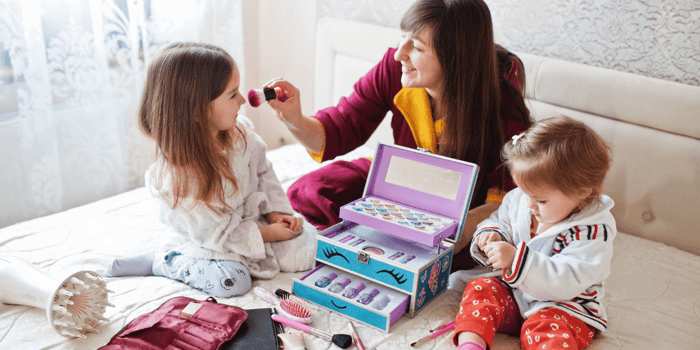
For families starting in the play-makeup lane, the Natural Kids Play Makeup Kit by Oh Flossy is a useful example of what this approach can look like in practice: colorful eyeshadow, blush, lip color, and child-sized applicators packaged around creative play rather than complexion correction. The formulas are also designed to wash off with water, making cleanup part of the buying decision rather than an afterthought.
Natural Kids Play Makeup Kit

$34.99
$40.99
Looking for a clean beauty gift that’s safe, fun, and worry-free? This natural play makeup kit lets little ones explore color and creativity with non-toxic, skin-friendly formulas parents trust. Each kit includes vibrant loose powder eyeshadows, soft blush, lipstick, and… read more
Step 2: Choose age-appropriate complexity
- Ages ~3–7: keep it simple—bath, body, detangling, sunscreen (as directed), and occasional playful extras (like nail color) if desired.
- Ages ~8–12: a gentle cleanse + moisturize can be enough. Add playful color if they’re curious (gloss, nail art), not correction-focused products.
- Teens: still keep it simple; if acne or irritation is persistent or distressing, consider guidance from a qualified clinician rather than building a complicated correction-focused routines.
Step 3: Use “placement rules” for stricter screening
When evaluating clean beauty brands, tighten standards when products are used:
- Near eyes (mascara, shadows, glitter): higher risk for irritation and migration—choose carefully and supervise younger users.
- On lips (balms/gloss): prioritize brands that list ingredients clearly and avoid unnecessary irritants for your child.
- On scalp (leave-ins, styling products): fragrance and sensitizers can matter more if a child is prone to itching or dryness.
Ingredient and label checklist (what to check before you buy)
This checklist is designed for real-life label reading. You don’t need a chemistry degree—just a consistent process.
1) “Fragrance” and “parfum” (and why parents flag it)
Fragrance can be a main reason products smell “fun,” but it’s also a common reason sensitive kids react. Another challenge: individual fragrance ingredients typically aren’t listed out.
FDA notes that individual fragrance ingredients do not have to be listed separately on cosmetic labels, which can make it harder to know what’s inside “fragrance.” That matters if your family is avoiding certain fragrance components or if you’re trying to troubleshoot irritation.
- If your child is sensitive: consider fragrance-free (when explicitly labeled) or very lightly scented products.
- If your child loves scent: pick one scented product category (like a body wash) rather than layering multiple scented steps.
2) Dyes and color additives
Color can be part of joyful, age-appropriate beauty play. But if you’re choosing between similarly effective options, many parents prefer brands that are transparent about pigments and that avoid unnecessary dyes in everyday care.
It’s also helpful context that FDA explains color additives have specific rules and that certified color additives are synthetically produced and batch-certified for certain impurities. (This isn’t a reason to panic—it’s a reason to treat color as a meaningful label-reading category.)
3) Preservatives: don’t fear them—understand them
Parents sometimes assume “no preservatives” is automatically better. In reality, preservatives can be important for preventing microbial growth in water-based products. The goal is not “preservative-free at all costs,” it’s choosing brands that balance preservation with skin comfort and that communicate clearly.
4) Glitter and sparkle
Sparkle is a big part of kids’ beauty—and it can be done thoughtfully. What to check:
- Where it’s used: loose glitter near eyes is higher-risk for migration.
- How it removes: choose sparkle that comes off without aggressive scrubbing.
- Mess management: consider gels or pressed formats over loose particles for younger kids.
5) “Active” skincare ingredients (a common tween trap)
If a product reads like adult skincare—strong exfoliants, intense “resurfacing,” or multi-step routines—pause. Many tweens don’t need that level of intervention. A simpler routine (cleanse, moisturize, SPF as directed) is often the more age-appropriate baseline.
Foundationless guidance: what to buy instead of complexion coverage
Popsicle Beauty Club is not anti-makeup. We’re against adultification, performance beauty, and correction-focused beauty for children, tweens, and teens. Foundation, concealer, simple skin care, simple moisturizers, and coverage-first routines are best treated as developmental milestones worth delaying—not routine childhood purchases.
If your child is asking for “makeup like TikTok,” try offering expressive alternatives that keep the message healthy: makeup as art, not armor.
- For “I want to look fancy”: a clear or softly tinted lip balm/gloss, a fun nail color, or hair accessories.
- For creativity: washable color (like playful eye-safe approaches where appropriate), face gems for special occasions, or costume face paint for events—used with supervision and removed gently.
- For skin confidence: a gentle moisturizer + sunscreen routine and a supportive script (“Your skin is something to care for, not fix.”).
When the actual need is basic skincare rather than makeup, a small routine can be more useful than another beauty set. The Fragrance-Free Kids Skincare Set by Natural Outcome pairs a foaming face wash with a lightweight moisturizer for pre-teens and teens, offering a simple two-step option for families who want everyday cleansing and hydration without building an adult-style routine.
Fragrance-Free Kids Skincare Set

$29.99
$32.98
The Natural Outcome fragrance-free Kids Skincare Set includes two everyday essentials—the Teen Skin Ultra Gentle Foaming Face Wash and the Teen Skin Calm Control non toxic face moisturizer. Designed for teens and pre-teens, this plant-based duo makes skincare simple and… read more
When parents shop clean beauty brands through this lens, the goal shifts from “coverage and correction” to “comfort, play, and self-care skills.”
Common mistakes to avoid when shopping clean beauty brands
- Buying a routine instead of a need: kids don’t need a 7-step regimen. Start with one product that solves a real problem (dry skin, tangles, chapped lips) or one playful item for self-expression.
- Assuming “clean” means allergy-proof: even gentle products can irritate. Patch test when appropriate, introduce one new product at a time, and stop if irritation shows up.
- Letting packaging choose for you: “cute” can distract from label gaps. Flip to the ingredient list and look for transparency.
- Over-indexing on “natural”: botanical extracts and essential oils can be irritating for some kids. “Plant-based” doesn’t automatically mean “better for my child.”
- Using adult performance makeup as the template: long-wear, waterproof, and heavy layering can require harsher removal and can normalize correction-focused beauty too early.
- Ignoring placement risk: eyes and lips deserve more caution than body products; sparkle requires extra thought.
How Popsicle Beauty Club helps parents shop clean beauty brands (without overwhelm)
Parents don’t just need information—they need a shopping filter. Popsicle Beauty Club is designed to be that filter: a curated marketplace where you can browse vetted clean kids’ beauty options without wading through thousands of adult products repackaged for kids.
- Shop by stage: starter self-care, play makeup, hair care, and special-occasion extras—without centering complexion correction.
- Shop by parent concerns: fragrance sensitivity, simpler routines, easy removal, and age-appropriate positioning.
- Shop with standards: ingredient transparency and kid-appropriate framing come before trend appeal.
If you’re specifically shopping for a birthday, holiday, or first beauty set, our guide to clean kids beauty brands and giftable sets shows how to compare age fit, ingredients, easy removal, and what is actually worth including in a set.
If you’re comparing clean beauty brands and you want a practical shortcut, start with Popsicle’s curated assortment and then use the checklist above to validate any brand you’re considering elsewhere, too.
Bottom line
The best clean beauty brands for families are the ones that make it easy to understand what you’re buying, keep formulas and routines appropriately simple for kids, and support beauty as expression—not correction. Use the ingredient and placement checklists, patch test when appropriate, and don’t feel pressured to “upgrade” your child into adult-style makeup milestones before they’re ready.
Sources and further reading
- NIEHS: Cosmetics and Your Health - Explains what counts as cosmetics and notes most cosmetics/ingredients aren’t FDA-preapproved (except color additives).
- FDA: Phthalates in Cosmetics - Notes how phthalates may be used and explains why “fragrance” on labels can limit ingredient visibility.
- FDA: Color Additives in Foods - Clear overview of certified color additives and batch certification concepts (helpful context for dye discussions).
- NIEHS: Endocrine Disruptors - Background on what endocrine disruptors are and common exposure routes in daily life.
Curious about which harmful ingredients to avoid in your child's beauty products? Read The Truth About Harmful Beauty Ingredients for Kids to uncover the hidden toxins in mainstream makeup, skincare, and hair care—and discover safer alternatives.
About the Author: This article was written by the contributing writers at Popsicle Beauty Club—a team of moms, educators, and clean beauty advocates passionate about creating a safer, more imaginative world for kids. We believe in empowering parents with trusted information and offering fun, non-toxic beauty and personal care products that let children play, express, and explore—without compromising their health.
FAQs
What are the best kids’ beauty brands if I care about both clean ingredients and cute, giftable sets?
Which kids’ beauty brands actually use non-toxic, clean ingredients and aren’t just greenwashing?
What clean beauty brands specialize in products for children’s everyday self-care routines?
How can I compare two clean beauty brands that use different ingredient standards?
Start with the specific product rather than the brand slogan. Compare the full ingredient lists, fragrance approach, colorants, product purpose, age guidance, and removal instructions. Two clean beauty brands may follow different “no lists” while both making reasonable choices, so the better option is the one that fits your child’s needs and your family’s priorities.
Are fragrance-free clean beauty products always better for kids?
Not automatically. Fragrance-free can be especially useful for children who have sensitive skin, scent sensitivities, or a history of irritation, but it does not guarantee that every other ingredient will suit every child. Read the complete formula, introduce one new product at a time, and patch test when appropriate.
Should I choose one clean beauty brand for my child’s entire routine?
Usually not. There is no need to stay with one brand if different products work better for different needs. You might prefer one company for hair care, another for fragrance-free skincare, and another for occasional play makeup. Compare products individually and keep the overall routine simple rather than trying to build a matching multi-step collection.