
Table of Contents
- Introduction
- 1) Why toddler lip gloss is different from adult gloss
- 2) How to read a kids lip gloss label without getting overwhelmed
- 3) Ingredients that are usually good “starter” choices for toddler lip gloss
- 4) Ingredients some parents prefer to avoid in toddler lip gloss
- 5) Red flags beyond ingredients: packaging, hygiene, and “too tasty” gloss
- 6) How to use toddler lip gloss safely in real life (including patch testing)
- 7) Bottom line: a parent-friendly checklist for toddler lip gloss
- FAQs
Introduction
Shopping for toddler lip gloss is less about chasing shine and more about choosing a simple, low-fuss formula that fits how toddlers actually use products: quick swipes, curious reapplications, and (often) a little licking. The goal isn’t perfection—it’s picking ingredients and packaging that make you feel comfortable, then using it in a way that keeps lips happy and reduces mess.
This guide is designed for parents and gift-givers who want practical label-reading help. We’ll walk through ingredients that generally make sense for toddler lip gloss, what some families prefer to avoid, and the everyday habits that matter just as much as the formula (like patch testing and not sharing tubes).
1) Why toddler lip gloss is different from adult gloss
A toddler’s “lip routine” is not a grown-up lip routine. Even if the product is marketed as lip gloss for kids, your criteria may be stricter for toddlers because:
- Accidental ingestion is more likely. Toddlers frequently lick their lips or chew applicators.
- Skin can be more reactive. Fragrance, flavor, and certain plant extracts can be more irritating on sensitive skin.
- Hygiene is harder. A wand applicator that touches lips (and then goes back into the tube) can get messy fast.
- They don’t need long wear. You’re typically looking for comfort and a little fun—not a long-lasting finish.
For most families, the “best” toddler lip gloss is the one with a short, understandable ingredient list, a comfortable texture, and packaging that helps you control how much goes on.
2) How to read a kids lip gloss label without getting overwhelmed
Ingredient lists can look intimidating, but you can get a lot of clarity quickly with a few checks:
- Start with the first 5–8 ingredients. These usually make up most of the formula. For toddler safe lip gloss, you’ll often see a base of oils, waxes, and/or emollients.
- Look for “flavor” and “fragrance.” These are common triggers for irritation around the mouth. If your child is sensitive, consider fragrance-free and unflavored options.
- Check the colorants. A sheer, clear gloss often needs fewer dyes. Tinted products can be fine, but if you’re unsure, starting with clear can simplify things.
- Watch for “plumping” language. Plumping effects are typically created with ingredients that tingle. That sensation is not ideal for toddlers.
- Ignore buzzwords alone. Phrases like “natural” or “clean” can mean different things across brands. The ingredient list is more useful than the front label.
If you’re aiming for toddler lip gloss non toxic, it helps to define what “non toxic” means for your family in practice: generally, it’s choosing a formula you’re comfortable with if a tiny amount ends up being licked off, while still using the product as directed and keeping it out of reach when not supervised.
Understanding what terms like "clean," "natural," and "non-toxic" actually mean can make ingredient labels much easier to evaluate. Our Parents Guide To Clean Beauty Products explains how to look beyond marketing claims and make more informed beauty choices for children.
3) Ingredients that are usually good “starter” choices for toddler lip gloss
Every child is different, and “safe” can depend on sensitivities, but many parents prefer a simple base that focuses on cushioning and slip. When you’re shopping for lip gloss for toddler girl or any toddler, these ingredient types are often the easiest place to start:
Simple emollients and oils
- Castor oil: a common gloss base that gives shine and grip.
- Mineral oil or hydrogenated polyisobutene: often used for smooth slip and shine (some families prefer to avoid mineral oil, others don’t mind it—this is a personal preference).
- Plant oils like sunflower seed oil: can add comfort, though any plant oil can be a sensitivity for some kids.
Waxes and texture builders
- Beeswax or candelilla wax: helps thicken and reduce dripping or migrating outside the lip line.
- Shea butter or cocoa butter: can feel comforting, though richer butters may be heavier or more likely to smear.
Soothing/supportive extras (kept simple)
- Vitamin E (tocopherol): commonly used as an antioxidant; can be fine for many, but any ingredient can irritate a specific child.
In general, for toddler lip gloss, a shorter list with familiar emollients is often a good sign—especially if the product is clear or lightly tinted and avoids “active” sensations.
4) Ingredients some parents prefer to avoid in toddler lip gloss
This isn’t a list of “danger ingredients.” It’s a practical list of things that may be unnecessary for toddlers, more likely to irritate, or more likely to encourage overuse. If you’re trying to choose toddler safe lip gloss, consider whether these show up on the label:
- Fragrance (parfum) and essential oils: They can smell great, but fragrance is a common source of irritation—especially around the mouth. Essential oils (like peppermint or citrus oils) can also be sensitizing for some kids.
- Flavor: Flavorings can encourage licking and repeated reapplication. For toddlers, unflavored or very mildly flavored is often easier.
- “Plumping” ingredients: Menthol, peppermint components, or warming/cooling agents can tingle. Tingling can be unpleasant and may lead to rubbing or wiping.
- Strong exfoliants: Anything positioned as a “lip scrub” or containing gritty particles is usually a no for toddlers (messy, and can irritate).
- High-shimmer or glitter particles: Aside from mess, particles can migrate. If you choose shimmer, look for very fine shimmer and a controlled applicator.
If your child has known sensitivities, consider choosing a very basic kids lip gloss formula first, then branching out later if it goes well. Learning which ingredients commonly trigger irritation can help simplify the shopping process. The Truth About Harmful Beauty Ingredients for Kids breaks down the additives, fragrances, and preservatives many families choose to avoid in children's beauty products.
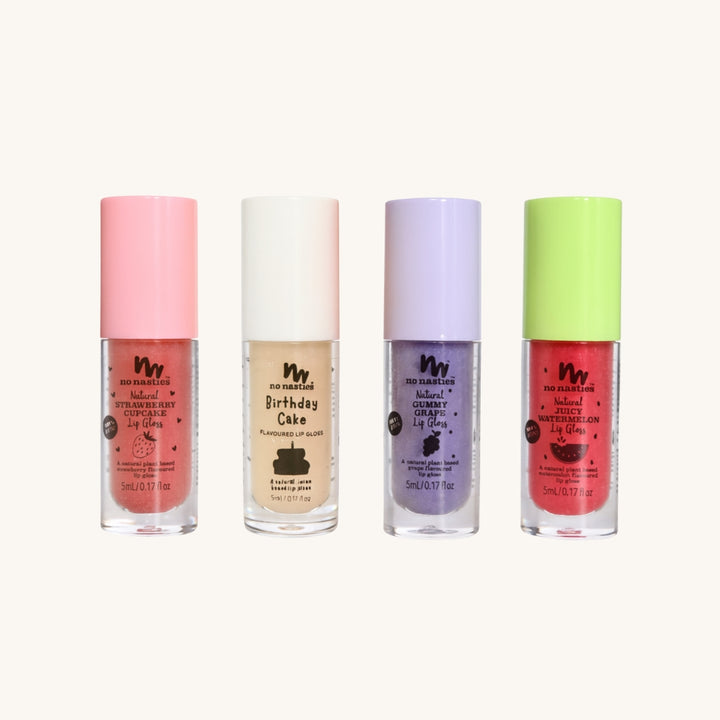
We highly recommend this natural flavor lip gloss by No Nasties. Formulated for even the most sensitive skin, it’s nut-free, gluten-free, dairy-free, and made without wheat derivatives or almond oil—making it our most allergy-friendly lip gloss yet.
Natural Flavor Lip Gloss for Kids
$7.99
A yummy, all-natural treat for little lips, this natural flavor lip gloss for kids adds a whisper of color while keeping lips soft and nourished with sunflower, olive, coconut, and jojoba oils. Formulated for even the most sensitive skin, it’s… read more
5) Red flags beyond ingredients: packaging, hygiene, and “too tasty” gloss
The formula matters, but how the product is packaged and used can be just as important for a toddler lip gloss purchase.
Packaging that helps you control the amount
- Squeeze tube: You can dispense a tiny dot onto a clean fingertip, which is often easier and more hygienic than a wand.
- Large doe-foot wand: Tends to pick up more product than you want for toddlers and can turn into a “paintbrush” for faces and furniture.
- Pot/jar: Cute, but double-dipping can get messy quickly. If you use a pot, use a clean spatula or a dedicated clean fingertip.
Hygiene considerations
- Sharing is a no. Even within a family, don’t share gloss between kids.
- Cap security matters. A cap that clicks shut reduces spills inside bags or cars.
- Watch applicators. If the applicator touches the floor (or gets chewed), it’s time to clean or replace.
Be cautious with “dessert” marketing
Many lip gloss for kids products lean into candy scents and flavors. If you’re specifically shopping for toddler lip gloss non toxic, consider whether an intense “treat” vibe will lead to licking, overeating the product, or constant reapplication. Sometimes the simplest clear gloss wins.
6) How to use toddler lip gloss safely in real life (including patch testing)
Even the gentlest-looking product can cause irritation for an individual child. Usage habits can reduce problems and keep the experience fun.
Do a patch test first
Before the first full use, apply a tiny amount to a small area of skin (many parents choose the outer arm). Wait to see if any redness or irritation appears. If you’re unsure or your child has a history of reactions, it’s okay to skip the product altogether and talk to a qualified professional for personalized guidance.
Keep application minimal
- Start with clean, dry lips.
- Dispense a rice-grain amount (seriously small) onto a clean fingertip.
- Tap onto the center of the lips and press lips together.
- Wipe any gloss that migrates onto surrounding skin to reduce irritation around the mouth.
Use it as an occasional, supervised item
- Supervise use. Toddlers are more likely to smear gloss beyond the lips or chew packaging.
- Set a “one swipe” rule. One small application is usually enough.
- Remove at the end of the day. A soft cloth with gentle cleanser can help prevent residue from lingering around the mouth.
If lips look dry or irritated, pause use and focus on basic comfort measures. In many cases, what a toddler needs most is simply less product and fewer potential irritants.
7) Bottom line: a parent-friendly checklist for toddler lip gloss
When you’re choosing toddler lip gloss, you don’t need a perfect product—you need a sensible one with a label you understand and a routine you can manage. Here’s a quick shopping checklist you can use in-store or while scrolling:
- Choose simple bases (oils/waxes/emollients) and avoid “active” sensations like plumping or tingling.
- Prefer fragrance-free and unflavored if your toddler has sensitive skin or tends to lick.
- Start with clear or lightly tinted to minimize dyes and reduce staining/mess.
- Pick controlled packaging (often a squeeze tube) so you can apply a tiny amount with a clean fingertip.
- Check labels every time (formulas change), and keep an eye out for ingredients you know your child reacts to.
- Patch test before regular use and keep application supervised.
For most families, the best toddler lip gloss is the one that’s comfortable, lightly applied, and easy to say “yes” to without turning into an all-day sticky situation.
For a complete guide on non-toxic play makeup, check out our in-depth resource: The Ultimate Guide to Non-Toxic Play Makeup for Kids for expert tips, product recommendations, and everything you need to know about choosing safe beauty play products for your child.
About the Author: This article was written by the contributing writers at Popsicle Beauty Club—a team of moms, educators, and clean beauty advocates passionate about creating a safer, more imaginative world for kids. We believe in empowering parents with trusted information and offering fun, non-toxic beauty and personal care products that let children play, express, and explore—without compromising their health.