
Table of Contents
- 1) Why ingredients matter more for lip gloss on toddlers
- 2) How to read a kids lip gloss label like a parent (not a chemist)
- 3) Ingredient “green flags” for toddler lip gloss
- 4) Ingredients to pause on (and why they can be tricky)
- 5) Shopping criteria beyond ingredients: packaging, applicators, and mess control
- 6) How to use lip gloss with toddlers: patch testing, supervision, and a realistic routine
- 7) Bottom line: a parent checklist for lip gloss for toddlers
- FAQs
Lip Gloss for Toddlers: Ingredients Parents Should Check (and What to Skip)
Shopping for lip gloss for toddlers is a little different than shopping for your own: toddlers lick their lips, smear product outside the lip line, and may treat a tube like a toy. That means the best choice is usually the simplest one—minimal ingredients, gentle texture, and packaging that helps you control how much goes on.
This guide walks through what to look for on labels (and what to think twice about) when choosing lip gloss for toddlers, plus practical tips for patch testing and day-to-day use. It’s not about fear—just smart, realistic shopping and routines that fit toddler behavior.
1) Why ingredients matter more for lip gloss on toddlers
Any lip product can end up in the mouth—especially with kids. With lip gloss for toddlers, ingredient choices matter because:
- Higher “incidental ingestion”: Gloss sits on the surface and transfers easily to snacks, cups, and fingers.
- More contact with surrounding skin: Toddler application often drifts onto the skin around the lips, where irritation can show up as redness or dryness.
- Sensory sensitivity: Strong flavors, intense minty/cooling ingredients, and heavy fragrances can be unpleasant and may encourage licking (which can make lips feel drier).
None of this means you can’t use lip gloss for toddlers. It just means the “best” one is usually gentle, boring, and easy to apply in a thin layer.
2) How to read a kids lip gloss label like a parent (not a chemist)
You don’t need to memorize every ingredient, but you do want a quick system. When evaluating lip gloss for toddlers, scan for these label clues:
- Ingredient list length: Shorter isn’t automatically better, but fewer moving parts can make troubleshooting easier if irritation happens.
- Fragrance and flavor: Look for “fragrance,” “parfum,” or “flavor/aroma.” If your child is sensitive, fragrance-free (and ideally flavor-free) is often a safer starting point.
- “Cooling” or “plumping” language: These typically rely on tingly ingredients and are usually better reserved for adults.
- Colorants: Tints are fine, but brighter shades may use more dyes. If you’re unsure, start with a clear or lightly tinted option.
- Allergen hints: If your toddler has known sensitivities (for example, to certain botanical oils or nut-derived ingredients), treat lip products like you would food labels—double-check every time, even within the same brand.
Marketing terms like “clean,” “natural,” or “non toxic” aren’t standardized across the industry. For lip gloss for toddlers, the label (ingredients + directions) is more useful than the front-of-package claims.
3) Ingredient “green flags” for toddler lip gloss
When parents ask what to look for in lip gloss for toddlers, these are common ingredient types that tend to be well-tolerated for many families. (Every child is different—always check the full label.)
Simple, protective bases
- Petrolatum (often very effective at reducing moisture loss and protecting the surface)
- Mineral oil (a stable, low-scent option commonly used in lip products)
- Hydrogenated polyisobutene (a common gloss base that gives slip and shine)
- Polybutene (another widely used, stable gloss ingredient)
Gentle emollients and texture helpers
- Castor seed oil (common in lip products for shine and cushion; note: still an individual-sensitivity possibility)
- Beeswax, candelilla wax, or carnauba wax (for structure, especially in balmy-gloss textures)
- Squalane (lightweight, usually low-odor, helps reduce tight feeling)
- Shea butter (comfortable feel; can be great in balmy formulas)
Low-drama humectants (in the right formula)
- Glycerin can be helpful, especially when paired with occlusives (like petrolatum) to help keep moisture from evaporating.
Tip: For lip gloss for toddlers, a balmy gloss (more like a glossy balm) is often easier than a super-slippery, high-shine formula because it stays put better and feels less “wet.”
4) Ingredients to pause on (and why they can be tricky)
These ingredients aren’t “bad” across the board, and many people use them without issue. But for lip gloss for toddlers, they’re worth a closer look—especially if your child has sensitive skin, eczema-prone areas around the mouth, or a history of reactions.
Fragrance, flavor, and essential oils
- Fragrance/parfum and flavor/aroma can be irritating for some kids and may encourage licking because they taste sweet or smell strong.
- Essential oils (peppermint, citrus, cinnamon, etc.) are common “natural” add-ins that can still be sensitizing on lips.
Tingly or “plumping” agents
- Ingredients that create a cooling/tingling sensation (often used in adult plumping glosses) can feel uncomfortable for toddlers and may lead to rubbing or licking.
Strong actives and exfoliants
- Menthol, camphor, and similar sensation-focused ingredients can be harsh for little lips.
- Chemical exfoliants (like certain acids) aren’t typical for kids lip gloss, but if you see them, that’s a sign it’s not designed for toddlers.
Sticky, high-transfer formulas (a practical “ingredient-adjacent” concern)
- Super-sticky gloss tends to migrate, collect hair/crumbs, and end up on cheeks, toys, and sleeves—raising the chance of irritation simply from friction and frequent wiping.
If you’re aiming for clean lip gloss for kids or non toxic lip gloss for kids, focus less on buzzwords and more on whether the formula avoids strong fragrance/flavor and sensation boosters, and whether the ingredient list is easy for you to recognize and re-check.
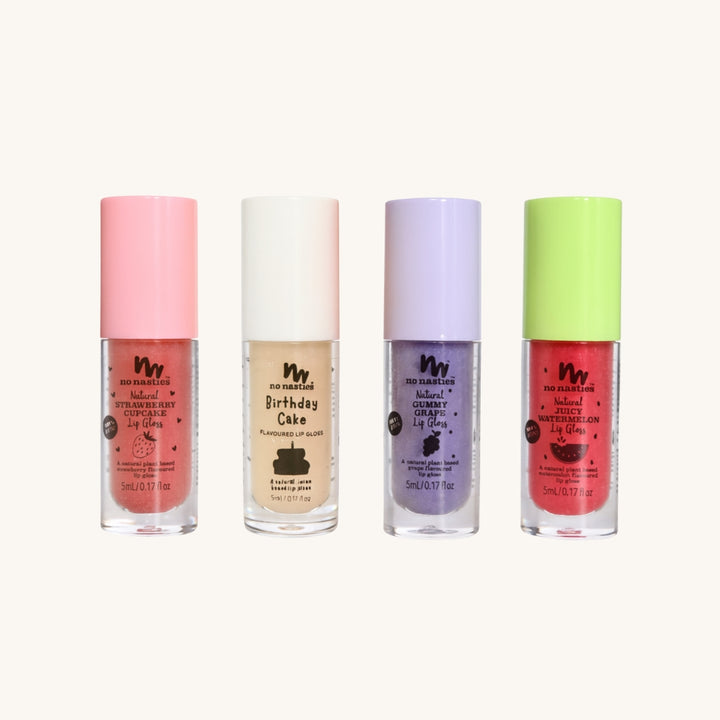
If you are in the market for all natural lip gloss, we highly recommend this option by No Nasties. A yummy, all-natural treat for little lips, this natural flavor lip gloss for kids adds a whisper of color while keeping lips soft and nourished with sunflower, olive, coconut, and jojoba oils.
Formulated for even the most sensitive skin, it’s nut-free, gluten-free, dairy-free, and made without wheat derivatives or almond oil—making it our most allergy-friendly lip gloss yet.
Natural Flavor Lip Gloss for Kids
$7.99
A yummy, all-natural treat for little lips, this natural flavor lip gloss for kids adds a whisper of color while keeping lips soft and nourished with sunflower, olive, coconut, and jojoba oils. Formulated for even the most sensitive skin, it’s… read more
5) Shopping criteria beyond ingredients: packaging, applicators, and mess control
With lip gloss for toddlers, packaging can matter as much as the ingredient list. A great formula in a hard-to-control tube can turn into a sticky face in seconds.
- Choose a controlled dispenser: A squeeze tube with a small opening can help you apply a tiny amount. Wide-doe-foot wands can overload product quickly.
- Consider a balm-gloss hybrid: These usually apply more predictably, especially if you’re doing quick touch-ups.
- Look for a secure cap: Toddlers love twisting and pulling. A sturdy closure helps prevent spills in bags and reduces the chance of a child opening it unsupervised.
- Avoid glass for little hands: Dropped gloss happens. Plastic packaging is often the lower-stress option.
- Pick a shade you can live with on cheeks: Clear or very light tint is easiest for accidental face application.
Also consider your household’s “mess tolerance.” If you want toddler lip gloss for play, choose a formula that wipes off easily with a damp cloth. If you want it for protection during dry weather, pick a more balmy, clingy texture that stays in place. If your primary goal is moisture protection rather than shine, a simple lip balm for toddlers may be an easier starting point because balms tend to stay in place better and require less frequent reapplication.
6) How to use lip gloss with toddlers: patch testing, supervision, and a realistic routine
Even the gentlest lip gloss for toddlers can cause irritation for an individual child. That’s why checking labels and doing a patch test is a smart habit—especially with a new brand, a new scent, or a more colorful formula.
A simple patch test approach
- Start small: Apply a tiny amount to the outside of the lip area (or a small spot on the inner forearm) rather than full lips on day one.
- Wait and watch: Check for redness, bumps, dryness, or complaints of burning/tingling over the next day.
- Try again before committing: If there’s no reaction, use a thin layer on lips the next time.
For day-to-day use, the goal is thin, supervised application:
- Use a clean finger or cotton swab: This gives you control and keeps the applicator cleaner.
- Apply a rice-grain amount: Enough for comfort and shine, not so much that it slides off the lips.
- Set expectations: “One swipe, then cap goes back on.” Treat it like lotion—parent-led, not free play.
- Reapply only as needed: If you’re using it for dryness, consider starting with a simple balm and saving gloss for special moments.
If your child repeatedly licks after application, switch to a fragrance-free, flavor-free option or a plainer balm. Licking can make lips feel drier over time, and it often turns into a cycle.
7) Bottom line: a parent checklist for lip gloss for toddlers
The best lip gloss for toddlers is the one you can use sparingly, comfortably, and consistently—without turning into a sticky face situation or a mystery-ingredient guessing game.
- Check the label every time, especially for fragrance/flavor, essential oils, and “plumping/cooling” cues.
- Favor simple bases and balmy-gloss textures that stay put and are easy to apply in a thin layer.
- Choose controlled packaging (small opening, secure cap) to prevent over-application and mess.
- Patch test new products and stop use if irritation shows up.
- Keep it supervised; treat lip gloss for toddlers like a personal-care step, not a toy.
If you’re comparing kids lip gloss options and feeling overwhelmed, start with a clear, fragrance-free, minimal-ingredient formula in a squeeze tube. Once you know your child tolerates it well, you can decide whether a lightly tinted lip gloss for kids makes sense for dress-up or special occasions.
Bottom line: Choose lip gloss for toddlers with a simple ingredient list, low scent/flavor, and packaging that helps you control the amount—then patch test and keep application calm, quick, and supervised.
Curious about which harmful ingredients to avoid in your child's beauty products? Read The Truth About Harmful Beauty Ingredients for Kids to uncover the hidden toxins in mainstream makeup, skincare, and hair care—and discover safer alternatives.
About the Author: This article was written by the contributing writers at Popsicle Beauty Club—a team of moms, educators, and clean beauty advocates passionate about creating a safer, more imaginative world for kids. We believe in empowering parents with trusted information and offering fun, non-toxic beauty and personal care products that let children play, express, and explore—without compromising their health.