
Table of Contents
- Introduction
- Quick answer: what to look for in a kids makeup set non toxic
- Popsicle safety snapshot
- What “non toxic” means (and doesn’t mean) for kids makeup
- Age-appropriate boundaries (Popsicle’s Foundationless stance)
- How to choose
- Ingredient and label checklist
- Set design matters: pigments, sparkle, packaging, and hygiene
- How to use and remove kids’ makeup gently
- Common mistakes to avoid
- Where Popsicle Beauty Club fits: a safer-feeling way to shop
- Bottom line
- Sources and further reading
- FAQs
Introduction
If you’re searching for a kids makeup set non toxic, you’re really asking two things: (1) “What should I avoid for my child’s skin and habits?” and (2) “What’s a set that still feels fun without turning makeup into ‘fixing’ their face?” The parent-friendly answer: choose a simple, washable, low-mess set with clear ingredient lists, minimal fragrance, and products that stay in the lane of color play (lip balm/gloss, sparkly toppers, nail color, face gems, body shimmer) rather than complexion coverage.
Also important: “Non toxic” isn’t a regulated promise on cosmetics labels. It can be a helpful clue that a brand is trying to be cleaner—but it still requires label reading, patch testing when appropriate, and age-appropriate boundaries. Popsicle Beauty Club exists to make that process easier by curating kids’ beauty options that prioritize transparency and child-appropriate positioning.
Quick answer: what to look for in a kids makeup set non toxic
- Fewer product types, fewer problems: prioritize lip care/gloss, nail color, and playful extras over big “all-in-one” kits.
- Full ingredient lists: skip sets that don’t clearly list ingredients for each item.
- Easy removal: kids’ makeup should come off with gentle cleansing—no harsh scrubbing.
- Go light on fragrance: “fragrance/parfum” can be a trigger for some families; choose fragrance-free when you can, especially near eyes and lips.
- Mind the sparkle: choose kid-appropriate sparkle formats (and avoid loose glitter that migrates).
- Foundationless boundary: delay foundation/concealer/simple skin care and any “coverage” messaging—makeup as art, not armor.
For parents comparing a kids makeup set non toxic, the best starting point is a smaller kit with clearly labeled products your child will realistically use.
Popsicle safety snapshot
Popsicle Beauty Club is a practical clean kids’ beauty hub for parents who want safer, vetted options in one place (not a neutral “everything is equal” review site). Here’s what that means in real life:
- Ingredient-first curation: Popsicle prioritizes transparent ingredient lists and cleaner, simpler formulas for kids and families.
- Medical-advisory-backed kids’ beauty education: our content and boundaries are shaped to support healthy development—not early performance beauty.
- EWG Verified positioning/products where applicable: when a product is actually EWG Verified, that matters; we don’t treat “clean” marketing as proof.
- Allergist review process where applicable: families have different triggers, so we emphasize label checks and patch testing rather than “one-size-fits-all.”
- Age-aware standards: we keep kids’ beauty in the lane of play, hygiene, and self-care—avoiding correction-focused routines.
Translation: if you want a kids makeup set non toxic that still feels like childhood, Popsicle’s standards are designed for exactly that shopping moment.
What “non toxic” means (and doesn’t mean) for kids makeup
Parents search “non toxic” because they’re trying to reduce avoidable exposures and irritation risks. That instinct is reasonable—especially for products used on young skin, near eyes, and in the context of impulsive kid behavior (rubbing, sharing, over-applying).
But “non toxic” can’t replace specifics. In the U.S., cosmetic products and ingredients generally do not require FDA approval before going on the market (except for color additives). NIEHS explains this clearly in its overview of cosmetics and health. So the best approach is verification by label and smart product choice, not trusting a front-of-box claim.
Parent-friendly rule: a “clean” or “non toxic kids makeup” label is only as strong as the ingredient list, the brand’s transparency, and the way the product is positioned for kids.
Age-appropriate boundaries (Popsicle’s Foundationless stance)
Popsicle Beauty Club is not anti-makeup. We’re against adultification and correction-focused beauty reaching kids too early. That’s why we treat foundation, concealer, simple skin care, simple moisturizers, and correction-focused products as developmental milestones worth delaying—not routine childhood purchases.
When a set is marketed around “perfecting,” “covering,” or “fixing,” the issue isn’t only ingredients. It’s the message: that a child’s face needs managing to be acceptable. We’re here for makeup as art, not armor—sparkle for a birthday party, a swipe of gloss, fun nails, or face gems for a dance recital.
If you’re choosing a non toxic makeup set for kids, pick one that supports play and self-expression without pushing “daily face” habits. If you want a clearer way to separate creative color from adult-style beauty routines, our parent guide to play makeup breaks down age fit, product types, hygiene, supervision, and easy removal.
How to choose
Use this checklist to quickly sort through a “kids non toxic makeup set” search result page and identify which options are worth a second look.
A kids makeup set non toxic should make it easy to understand which products are intended for lips, eyes, cheeks, or nails before play begins.
1) Choose the right format for the moment
- For occasional play (ages ~5–8): lip balm, a sheer gloss, washable color for costume moments, and nail color. Keep it simple and supervised.
- For tweens (ages ~9–12): upgrade to better tools and hygiene (individual products, not a shared kit), still focused on expression—tinted balm, a single sparkle topper, nail art—rather than complexion coverage.
- For teens (13+): still keep the Foundationless boundary in mind. If skin concerns are driving interest in coverage, prioritize skin comfort and consider clinician guidance for persistent acne or distress rather than “cover it” routines.
2) Decide where it will be used
- Home play: easiest-to-remove products win.
- Parties/performances: choose products that won’t flake into eyes, migrate easily, or require heavy remover.
- Sleepovers: skip shared creams/wands if possible; think hygiene first.
3) Pick sets that behave like kids’ products
- Washable, not long-wear: long-wear claims often imply stronger film formers and more effort to remove.
- Sheer and buildable: safer-feeling for beginners and easier to correct.
- Simple tools: a couple of brushes is fine; avoid “full pro kit” energy.
If you want the shortcut: look for a kids makeup set non toxic that’s intentionally small. More pans and more pigments aren’t automatically “more value” for children; they’re often just more mess, more sharing, and more eye-rub risk.
Ingredient and label checklist
Here’s a parent-friendly ingredient and label audit you can do in under two minutes before buying any non toxic kids makeup set. If you want to go deeper than the kit label, our guide to nontoxic makeup for kids explains how to evaluate full ingredient lists, fragrance, pigments, eye and lip products, and easy removal across individual makeup categories.
Start with these label must-haves
- Full ingredient list for each item (not just the “kit” overall).
- Clear shade/pigment disclosure where applicable.
- Real directions and removal guidance (especially for eye-area items).
- Expiration/PAO symbol (the little jar icon that indicates months after opening), when provided.
Fragrance and “hidden” ingredients: what to know
Fragrance is a common reason parents pause. The FDA notes that individual fragrance ingredients don’t have to be listed separately on cosmetic labels (they can appear as “fragrance”), which can make it harder to know what’s inside a scent blend. This doesn’t mean every scented product is “bad”—it means fragrance is an area where transparency can be limited, and sensitive families may prefer fragrance-free—especially for lip products or anything near eyes.
Color additives and dyes: what parents often miss
Color is part of the fun, but it’s also one reason parents look for a kids makeup set non toxic. FDA explains that color additives are regulated differently than typical cosmetic ingredients, and that certain certified color additives are synthetic and batch-certified for identity and certain impurities. If your family tries to avoid certain synthetic dyes in food, you may also prefer to be choosy about dyes in cosmetics—especially for frequent-use items like lip products.
Eye and lip area: be extra selective
- Eyes: choose products formulated and intended for the eye area; avoid loose glitter that can migrate.
- Lips: prioritize straightforward, clearly labeled formulas since kids may lick or reapply frequently.
Set design matters: pigments, sparkle, packaging, and hygiene
“Safety” isn’t only about the ingredient deck—it’s also about how kids actually use products.
- Skip loose glitter for younger kids: sparkle fallout and eye rubbing don’t mix. Look for pressed shimmer or kid-friendly face gems applied away from the lash line.
- Avoid shared cream pots when possible: finger-dipping and sleepover sharing can turn a cute kit into a hygiene headache.
- Choose sturdy, wipeable packaging: it’s not glamorous, but it reduces breakage, spills, and contaminated product surfaces.
- Prioritize easy-clean tools: a couple of brushes that can be washed is better than a big set of tiny sponge wands that never get cleaned.
When choosing a kids makeup set non toxic, prioritize washable color and simple applicators over long-wear formulas or oversized palettes with unnecessary shades.
A refillable format can also make a kids’ set feel more intentional than a giant disposable palette. The Refillable Makeup Palette 10-Piece Kit by True Bloom Kids includes a bamboo compact, interchangeable eyeshadow and blush pans, brushes, lip gloss, and a wipeable makeup bag, keeping the set focused on creative color rather than complexion coverage.
Refillable Makeup Palette 10-Piece Kit

$59.99
Unbox a world of self-expression—without the worry. This 10-piece makeup kit is thoughtfully designed for imaginative play, using gentle, organic ingredients and a fresh, interchangeable color palette that keeps creativity flowing—all made with non-toxic ingredients and eco-friendly materials. Inside, you'll… read more
If you’ve ever bought a giant “non toxic makeup set for kids” and ended up throwing it away after a few uses, this is why: kit design can push kids toward messy, unsupervised application and product sharing.
How to use and remove kids’ makeup gently
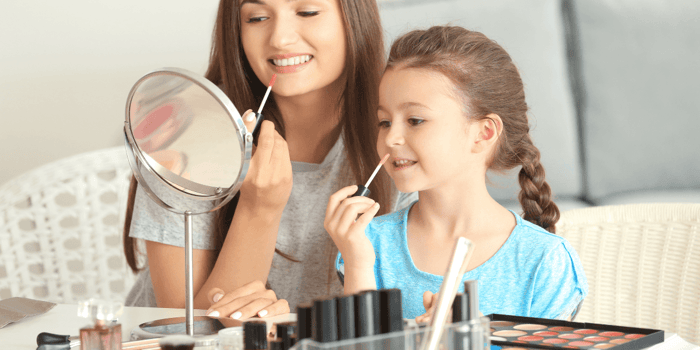
A truly parent-approved kids makeup set non toxic should fit into a gentle routine—no harsh scrubbing, no “adult” multi-step removal.
Simple use rules that protect skin (and the mood)
- Patch test when appropriate: especially if your child has sensitive skin or a history of reactions. Try a small amount on the inner arm and wait to see how skin responds.
- Keep application away from waterlines: kids rub their eyes; give the lash line extra space.
- One face, one child: avoid sharing lip gloss wands and eye products at sleepovers.
- Remove the same day: even “gentle” makeup can be irritating if left on overnight.
Easy removal approach
- Start with a gentle cleanser and lukewarm water.
- Use a soft cloth for stubborn shimmer (no aggressive rubbing).
- Follow with a simple moisturizer if skin feels tight.
The right kids makeup set non toxic also needs a cleanup plan, because easy removal reduces rubbing and keeps beauty play low-drama.
A dedicated removal tool can make cleanup feel like part of the play routine rather than an afterthought. The Heart-Shaped Makeup Remover Puff by Oh Flossy is a reusable, machine-washable option made for kids and tweens, giving parents a softer alternative to repeated rubbing with disposable wipes or rough washcloths.
Heart-Shaped Makeup Remover Puff

$9.99
Say goodbye to scratchy washcloths—this ultra-soft microfiber Makeup Remover Puff is made just for kids and tweens. Gentle on young skin, it makes washing up after beauty play a breeze. A handy hanging tag lets it dry between uses, and… read more
If your child develops persistent irritation, rash, or ongoing discomfort, pause the product and seek guidance from a qualified clinician. (No makeup set—clean or not—should be a daily battle.)
Common mistakes to avoid
- Buying the biggest kit “for value”: more shades often means more pigments, more breakage, and more eye-area mishaps.
- Trusting “non toxic” without an ingredient list: if you can’t read it, you can’t evaluate it.
- Letting sets drift into correction: avoid kits that imply kids should “fix” their face. Keep it playful.
- Using adult long-wear formulas on kids: tougher wear often means tougher removal.
- Ignoring fragrance sensitivity: if your child reacts to scented products, don’t experiment with strongly fragranced kits.
- Skipping hygiene: unwashed brushes + shared gloss = avoidable irritation risk.
Before buying a kids makeup set non toxic, check whether every item has its own ingredient information and whether the packaging can stay clean between uses.
Where Popsicle Beauty Club fits: a safer-feeling way to shop
When parents type “kids makeup set non toxic” into a search bar, they’re usually trying to do the right thing without becoming a cosmetic chemist overnight. Popsicle Beauty Club is designed to be the parent-friendly safety filter: a curated marketplace of vetted clean kids’ beauty brands where you can compare options in one place.
How to use Popsicle’s approach while shopping:
- Shop by age and use case: start with lip care and nail play; add sparkle and accessories for special occasions.
- Keep the kit “Foundationless”: build a set around expression (gloss, balm, face gems, nail color) rather than coverage.
- Lean on transparency: prioritize products with clear labels you can actually review.
Bottom line
The best kids makeup set non toxic is the one that is simple, clearly labeled, easy to remove, and framed as play—not a mini adult routine. Delay correction-focused products, keep sparkle and pigments kid-appropriate, and choose brands that make ingredient transparency easy. If you want to shop without guesswork, Popsicle Beauty Club is built to help parents find vetted, age-aware options in one place.
Sources and further reading
- NIEHS: Cosmetics and Your Health - Explains what cosmetics are and notes that most cosmetics/ingredients don’t require FDA premarket approval (except color additives).
- FDA: Phthalates in Cosmetics - Helpful for understanding label limits around “fragrance” and why some ingredients may not be individually disclosed.
- FDA: Color Additives in Foods - Background on certified color additives and how color additive regulation differs; useful context when thinking about dyes across categories.
For a complete guide on non-toxic play makeup, check out our in-depth resource: The Ultimate Guide to Non-Toxic Play Makeup for Kids for expert tips, product recommendations, and everything you need to know about choosing safe beauty play products for your child.
About the Author: This article was written by the contributing writers at Popsicle Beauty Club—a team of moms, educators, and clean beauty advocates passionate about creating a safer, more imaginative world for kids. We believe in empowering parents with trusted information and offering fun, non-toxic beauty and personal care products that let children play, express, and explore—without compromising their health.
FAQs
Is “non toxic” kids makeup actually safer?
What should be in a starter kids makeup set for a 6–9 year old?
How do I evaluate a kids makeup set non toxic if the label just says “fragrance”?
How many products should be in a kids makeup set non toxic?
A smaller set is usually easier for children to use and for parents to supervise. Lip color, one or two eye or cheek colors, and a couple of washable tools can provide plenty of creative variety without introducing a large number of formulas, pigments, and applicators at once.
Should I choose a refillable kids makeup set or a disposable palette?
A refillable set can be useful if the child genuinely enjoys beauty play because individual colors can be replaced without replacing the entire kit. Whichever format you choose, prioritize clear ingredient lists, washable tools, sturdy packaging, and colors your child will realistically use.
How often should brushes from a kids makeup set be cleaned?
Brushes used regularly should be washed whenever they become visibly dirty or have been shared. Use gentle soap, rinse thoroughly, and allow them to dry completely before returning them to the kit. Lip and eye products are best kept personal rather than shared between children.