
Table of Contents
- Introduction
- Answer-ready summary
- Popsicle Beauty Club’s parent-first approach
- Why eye-area products deserve extra attention
- Kids eyeshadow ingredients parents may want to avoid or limit
- 1. Fragrance and parfum
- 2. Heavy essential-oil blends
- 3. Loose glitter and gritty sparkle
- 4. Poorly disclosed pigments and color blends
- 5. Strong film formers and adult long-wear systems
- 6. Unnecessary flavor-like or scented additives
- 7. Preservative concerns in creams and liquids
- 8. Talc when the family prefers talc-free products
- Ingredients that are not automatically a problem
- A quick comparison table
- How to choose a kids eyeshadow palette
- Product recommendations from Popsicle Beauty Club
- How to apply kids eyeshadow more safely
- Patch testing and sensitivity
- Common mistakes to avoid
- 1. Buying an adult palette because it offers more shades
- 2. Assuming “clean” means irritation-proof
- 3. Sharing palettes and brushes
- 4. Using craft glitter near the eyes
- 5. Applying too close to the lash line
- 6. Sleeping in eyeshadow
- 7. Scrubbing during removal
- 8. Turning eyeshadow into appearance correction
- Where Popsicle Beauty Club fits
- Bottom line
- FAQs
Introduction
Understanding kids eyeshadow ingredients can feel intimidating because eye products combine pigments, binders, shimmer, preservatives, and marketing terms that are not always easy for parents to interpret.
Most families are not searching for a perfectly “pure” palette. They want to know which formula features are more likely to cause stinging or irritation, which label terms provide limited information, and which adult-performance features are unnecessary for occasional childhood beauty play.
The most practical approach is to evaluate the full ingredient list alongside the product format, shimmer type, fallout, intended application area, hygiene, and removal instructions.
For many families, the main pause points include added fragrance, heavy essential-oil blends, poorly disclosed pigments, loose or gritty glitter, strong long-wear systems, and formulas that require aggressive rubbing to remove.
This parent-friendly guide explains how to evaluate kids eyeshadow ingredients without turning beauty play into fear—or turning childhood color play into adult performance beauty.
Answer-ready summary
When reviewing kids eyeshadow ingredients, parents may want to pause and investigate:
Fragrance or parfum, especially for sensitive eyelids
Natural fragrance and essential oils used primarily for scent
Chunky or loose glitter that can migrate toward the eyes
Poorly disclosed pigments or color blends
Strong adhesive or long-wear systems that are difficult to remove
Cream and liquid formulas without clear preservation information
Talc when the family prefers talc-free powders
Adult-style waterproof or budge-proof formulas
Products without a complete ingredient list
Palettes marketed for children but positioned around looking older or needing a “complete face”
This does not mean every unfamiliar ingredient is harmful or that every child will react to the same formula.
It means parents can use these categories as practical pause points when comparing products used close to the eyes.
Popsicle Beauty Club’s parent-first approach
Popsicle Beauty Club is designed to help families compare cleaner, age-appropriate beauty options without importing adult beauty pressure into childhood.
For eyeshadow, the goal should be:
Creative color play
Dress-up
Dance or theater looks
Birthday and holiday sparkle
Costume makeup
Growing application and hygiene skills
Supervised self-expression
The goal should not be:
Creating a daily “must-wear” face
Teaching a child that she looks tired or plain without makeup
Introducing heavy adult-performance routines
Applying products directly inside the lash line
Turning color play into complexion correction
Encouraging a child to look older
This reflects Popsicle Beauty Club’s Foundationless philosophy: makeup can be art, imagination, and self-expression, but it should not become armor.
No eyeshadow can be guaranteed to suit every child. Parents should review the current label, introduce one product at a time, supervise use, and stop immediately if the child experiences stinging, swelling, redness, pain, or persistent irritation.
Why eye-area products deserve extra attention
The eyelid is delicate, and products applied there are used close to the eyes.
Children also tend to:
Rub their eyes
Touch their faces
Apply too much product
Drop brushes
Share palettes
Forget they are wearing makeup
Sleep in products unless reminded
Scrub when removal feels difficult
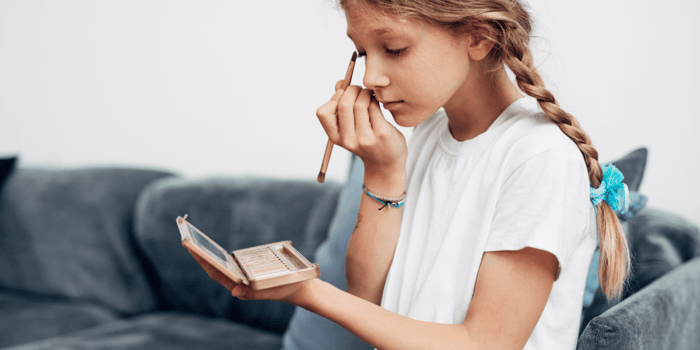
That means a formula should be assessed by more than its front-label claims. Because eye products sit close to delicate skin and the eye itself, reviewing kids eyeshadow ingredients should always include particle behavior, placement, and removal—not only the ingredient names.
Reviewing kids eyeshadow ingredients should go hand in hand with questions about particle size, fallout, hygiene, placement, wear time, and removal.
A simple formula can still become uncomfortable if it sheds into the eyes or is applied with dirty tools. Likewise, a carefully chosen pigment can still create problems if the product requires heavy rubbing at bedtime.
Kids eyeshadow ingredients parents may want to avoid or limit
1. Fragrance and parfum
Added fragrance is one of the first features many parents choose to avoid around the eye area.
On a label, scent may appear as:
Fragrance
Parfum
Aroma
Natural fragrance
Botanical fragrance
Essential-oil blend
A fragrance blend may contain several components without listing each one separately.
That can make it difficult for families to identify which component caused stinging, watery eyes, redness, or eyelid irritation.
Fragrance-free eyeshadow may be a practical starting point when the child has:
Sensitive skin
Eczema
Fragrance-triggered headaches
Watery eyes
Previous eyelid reactions
Sensory discomfort with scent
When comparing kids eyeshadow ingredients, parents should treat natural fragrance as fragrance rather than assuming it is automatically gentler.
2. Heavy essential-oil blends
Essential oils are sometimes included for fragrance or botanical positioning.
Natural ingredients are not automatically irritating, but eyelids are thin and can be more reactive than other areas of the body.
A child who tolerates a botanical body wash may still find the same aromatic ingredient uncomfortable near the eyes.
Parents may prefer to avoid strongly scented essential-oil blends in eyeshadow, especially when the oils do not provide a clear functional benefit beyond aroma.
3. Loose glitter and gritty sparkle
Loose glitter is one of the most important practical avoid categories for children’s eye makeup.
The issue is not only the ingredient name. In this part of a kids eyeshadow ingredients review, the finished texture and amount of fallout may matter as much as the glitter or shimmer listed on the label.
It is also:
Particle size
Sharp or irregular edges
Fallout
Migration
Eye rubbing
Removal friction
A product may use words such as:
Glitter
Sparkle
Shimmer
Pearl
Metallic
Luminous
These finishes can behave very differently.
Fine shimmer pressed securely into a powder may create a soft glow with less migration. Chunky glitter or loose pigment is more likely to fall onto the cheeks, hands, lashes, and potentially into the eyes.
If a product feels gritty or releases visible particles during a light swipe, it may be better suited to nail art, hair play, or another area away from the eyelids.
4. Poorly disclosed pigments and color blends
Eyeshadow needs colorants to create its shades.
The useful parent question is not whether a palette contains pigments. It is whether the brand clearly identifies what creates the color and whether the shades are intended for the stated application area.
Look for:
A complete ingredient list
Shade-specific pigment information
Clear application guidance
Eye-area suitability
Transparent colorant disclosure
Be cautious with palettes that use broad phrases such as “color blend” without explaining the actual pigments.
When evaluating kids eyeshadow ingredients, transparency is more useful than a vague claim that the palette is “safe,” “clean,” or “natural.”
5. Strong film formers and adult long-wear systems
Adult eyeshadows may be designed to resist:
Sweat
Oil
Creasing
Transfer
Water
All-day wear
Those features can be useful for adult performance makeup, but children rarely need sixteen-hour wear or waterproof color.
More adhesive formulas may require:
Cleansing balm
Oil remover
Several passes with a cotton pad
More rubbing
Longer cleanup
For children, easy removal is an important product feature.
If the palette requires aggressive rubbing to remove, it may not be a good match for occasional beauty play—even when the front label uses cleaner-positioned language.
6. Unnecessary flavor-like or scented additives
Some children’s cosmetics are designed to smell like candy, fruit, cupcakes, or other treats.
That sensory element may feel fun, but it does not improve the eyeshadow’s performance.
Parents may prefer a low-scent or fragrance-free eye product and reserve stronger sensory products for categories used farther away from the eyes.
A child does not need an eyeshadow palette to smell edible in order for the colors to feel playful.
7. Preservative concerns in creams and liquids
Cream and liquid eye products require appropriate preservation when the formula contains water or is repeatedly exposed to fingers and applicators.
The goal should not be “no preservatives.”
Without suitable preservation, a product may become contaminated by bacteria, yeast, or mold.
Parents should look for:
A complete formula
Storage guidance
Period-after-opening information
Clean applicator instructions
Clear replacement recommendations
A wet product with no visible preservation or shelf-life guidance may deserve closer scrutiny than a responsibly preserved formula.
8. Talc when the family prefers talc-free products
Some powder eyeshadows use talc to improve texture, spreadability, and softness.
Some families prefer talc-free formulas for children.
A talc-free claim alone does not guarantee that a product is suitable. Parents should still evaluate:
Fragrance
Pigments
Fallout
Glitter
Removal
Hygiene
Age positioning
Talc is one consideration, not the complete decision.
Ingredients that are not automatically a problem
A balanced guide should explain both what parents may want to limit and what they do not need to fear automatically. A balanced assessment of kids eyeshadow ingredients should distinguish between functional formula components and features that add avoidable irritation, fallout, or removal difficulty.
1. Preservatives
Water-based products require preservation.
A properly preserved cream eyeshadow can be more responsible than a product claiming to be preservative-free without explaining how contamination is controlled.
2. Mineral pigments
Mineral pigments are commonly used to create color and shimmer.
A mineral origin does not automatically make a formula irritation-proof, but mineral pigments are not automatically a red flag either.
3. Mica
Mica can create a fine shimmer or luminous finish.
The practical concern is how the finished product behaves. Fine, well-bound shimmer is different from chunky, loose sparkle that falls toward the eyes.
4. Silicones
Some formulas use silicones to improve glide and reduce creasing.
Silicones are not automatically harmful. The relevant questions are whether the formula is comfortable, age-appropriate, and easy to remove.
5. Technical ingredient names
A long or unfamiliar name does not automatically signal danger.
Many ingredients serve useful functions such as:
Binding powder
Improving texture
Preventing contamination
Helping pigment spread evenly
Stabilizing the formula
Reducing dustiness
Evaluate ingredients by function rather than rejecting them because they sound technical.
A quick comparison table
This table summarizes the kids eyeshadow ingredients and product features that commonly deserve a closer look rather than an automatic yes-or-no judgment.
| Ingredient or feature | Why parents may pause | What to consider |
|---|---|---|
| Fragrance or parfum | May cause stinging or limit transparency | Prefer fragrance-free for sensitive eyes |
| Natural fragrance | Natural does not guarantee non-irritating | Review essential oils and scent tolerance |
| Loose glitter | Can migrate toward the eye | Choose pressed fine shimmer instead |
| Poorly disclosed pigments | Makes informed comparison difficult | Look for complete shade-specific labels |
| Waterproof or budge-proof claims | May require aggressive removal | Prioritize easy-off formulas |
| Cream formulas without preservation details | May raise hygiene concerns | Check shelf life and storage directions |
| Talc | Some families prefer talc-free | Evaluate the whole formula |
| “Hypoallergenic” | Does not guarantee no reaction | Patch test when appropriate |
| Very large palettes | More shades, fallout, and sharing temptation | Start with a smaller edit |
How to choose a kids eyeshadow palette
Reviewing kids eyeshadow ingredients is only one part of choosing a suitable palette.
The product should also match the child’s age, application skills, intended occasion, and ability to follow hygiene rules. The best kids eyeshadow ingredients will not make a poorly designed, dusty, or difficult-to-remove palette suitable for a young beginner.
1. Start with the format
Pressed powder
Pressed powder may work well because it is:
Easier to control than loose pigment
Less messy
Simple to apply lightly
Easy to store
Available in sheer, buildable colors
Choose a formula that is not excessively dusty.
Cream or balm
Cream formulas may offer:
Lower powder fallout
Faster application
Easy fingertip use
A soft wash of color
Parents should check fragrance, preservation, and whether the formula stains or becomes difficult to remove.
Loose powder or glitter
Loose formats are usually higher-maintenance for children.
They are easier to spill, inhale, over-apply, and transfer into the eyes.
For most families, pressed powder or a well-contained cream is the simpler choice.
2. Choose fine shimmer over chunky glitter
Sparkle does not need to be eliminated completely.
A soft satin or fine shimmer can create a playful effect while reducing the problems associated with large glitter particles.
The goal is controlled sparkle rather than maximum sparkle.
3. Prefer sheer, buildable color
Children rarely need intense pigment in one swipe.
Sheer color:
Is easier to control
Looks more playful
Reduces overapplication
Is easier to blend
Often removes more easily
Supports makeup as art rather than performance
4. Choose a smaller palette
A palette with three or four useful shades may be more practical than a large adult-style collection.
A smaller palette can reduce:
Clutter
Unused colors
Product sharing
Application overwhelm
Pressure to create a full adult eye look
5. Plan removal before purchasing
Before buying, ask:
Will this come off with gentle cleansing?
Does the child already tolerate the required cleanser?
Does the shimmer remain after washing?
Will a parent supervise removal?
Does the product recommend a strong adult remover?
A formula that cannot be removed gently is not the best beginner option.
Product recommendations from Popsicle Beauty Club
The following products illustrate different approaches to pressed eyeshadow, compact palettes, creative kits, and gentle removal.
Parents should review the current listing, full ingredients, shade information, intended use, and the child’s sensitivities before purchasing.
These current products were verified on the official Popsicle Beauty Club catalogue. The examples show how kids eyeshadow ingredients should be considered alongside palette size, pressed-powder format, refillability, application tools, and gentle removal.
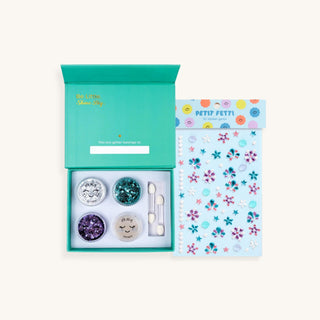
Eco Natural Kids Makeup Pressed Powder Eyeshadow & Blush
Eco Natural Kids Makeup Pressed Powder Eyeshadow & Blush is the strongest direct recommendation for families who want to choose individual pressed colors rather than buying a large adult-style palette.
The official product listing describes child-focused pressed mineral color made for age-appropriate beauty play. A single shade or small selection can help families keep application simple while reducing clutter and unnecessary duplicates.
Parents should still check each selected color, watch for fallout, use a clean brush, and keep application on the eyelid rather than the waterline.
Eco Natural Kids Makeup Pressed Powder Eyeshadow & Blush

$39.99
$44.49
Give her the gift of safe, worry-free beauty play with Eco Natural Kids Makeup Pressed Powder Eyeshadow—crafted in Australia with her delicate skin in mind. These allergy-friendly pressed powders are nut-free, gluten-free, soy-free, and dairy-free. While they do contain coconut-based… read more
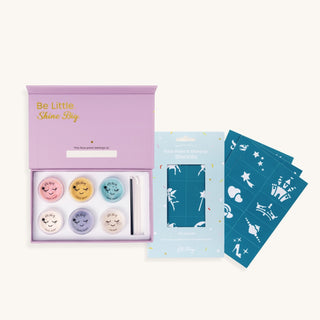
Refillable Makeup Palette 10-Piece Kit
The Refillable Makeup Palette 10-Piece Kit may suit an older child who enjoys organizing colors and using a complete creative set with supervision.
The current listing includes a bamboo compact, interchangeable colors, soft brushes, and plant- and mineral-based makeup products. Its refillable format can also support conversations about using products intentionally rather than continually buying new palettes.
Because the kit contains several products, parents should agree on application areas, hygiene rules, and a removal routine before use.
Refillable Makeup Palette 10-Piece Kit

$59.99
Unbox a world of self-expression—without the worry. This 10-piece makeup kit is thoughtfully designed for imaginative play, using gentle, organic ingredients and a fresh, interchangeable color palette that keeps creativity flowing—all made with non-toxic ingredients and eco-friendly materials. Inside, you'll… read more
Heart-Shaped Makeup Remover Puff
The Heart-Shaped Makeup Remover Puff is the strongest companion product because this article prioritizes gentle removal.
The official listing describes a reusable, machine-washable microfiber puff made for kids and tweens. It can be used with lukewarm water or a gentle cleanser the child already tolerates.
Press the damp puff lightly against the closed eyelid before wiping. Avoid scrubbing, and wash the puff regularly.
Heart-Shaped Makeup Remover Puff

$9.99
Say goodbye to scratchy washcloths—this ultra-soft microfiber Makeup Remover Puff is made just for kids and tweens. Gentle on young skin, it makes washing up after beauty play a breeze. A handy hanging tag lets it dry between uses, and… read more
How to apply kids eyeshadow more safely
Even carefully chosen kids eyeshadow ingredients cannot compensate for poor hygiene or unsafe placement.
A simple routine keeps beauty play more comfortable.
Before application
Wash hands
Start with clean, dry eyelids
Tie back hair
Use a clean dedicated brush
Check that the product has not changed smell or texture
Agree on where the color will be placed
During application
Keep color on the eyelid
Avoid the waterline
Avoid tightlining
Tap excess powder from the brush
Use one light layer first
Stop immediately if the child feels stinging
Remind the child not to rub her eyes
After application
Remove the product the same day
Use lukewarm water and a gentle cleanser
Press a damp pad or puff against the closed lid
Wipe lightly rather than scrubbing
Wash brushes
Close the palette securely
Store it somewhere dry
For a broader guide to choosing formats, finishes, pigments, placement, and removal, read our eyeshadow makeup for kids guide.
For more detail on shimmer, particle size, fallout, and avoiding craft glitter, review our glitter eyeshadow for kids guide.
Patch testing and sensitivity
Patch testing may be appropriate when a child has sensitive skin or is trying a new eyeshadow brand. Patch testing can help families introduce unfamiliar kids eyeshadow ingredients cautiously, although it cannot guarantee that delicate eyelid skin will respond in the same way.
A cautious process is:
Apply a small amount to the inner arm.
Leave it for the time recommended by the product.
Remove it gently.
Observe for redness, bumps, burning, or itching.
Stop use if irritation develops.
Patch testing cannot diagnose an allergy or guarantee that the eyelids will react the same way.
Eye pain, significant swelling, persistent redness, discharge, or vision changes require prompt professional guidance.
Common mistakes to avoid
Even after reviewing kids eyeshadow ingredients, families can run into problems when they choose the wrong format, ignore hygiene, or treat makeup like a daily requirement.
1. Buying an adult palette because it offers more shades
More shades do not automatically create better value for a child.
Adult palettes may prioritize stronger pigment, complex finishes, long wear, and intense glitter.
2. Assuming “clean” means irritation-proof
Any product can bother an individual child.
Review the full label and patch test when appropriate.
3. Sharing palettes and brushes
Eye products should not be casually shared between siblings or friends.
Sharing increases hygiene risks and makes it difficult to know whose skin or tools introduced contamination.
4. Using craft glitter near the eyes
Craft glitter is not a substitute for an eye-area cosmetic.
Move glitter play to nails, hair accessories, crafts, or another safer zone.
5. Applying too close to the lash line
Younger children do not need tightlining, waterline color, or product pressed into the lash roots.
Keep the look lid-focused.
6. Sleeping in eyeshadow
Overnight wear can increase dryness, transfer, rubbing, and irritation.
Remove it before bed.
7. Scrubbing during removal
If a product requires scrubbing, change either the formula or the removal method.
8. Turning eyeshadow into appearance correction
Avoid statements such as:
“This makes your eyes prettier.”
“You look tired without it.”
“You need this for photos.”
“This makes you look more grown-up.”
Try:
“These colors are fun.”
“You created a beautiful design.”
“Makeup is optional.”
“Your face is already enough.”
Where Popsicle Beauty Club fits
Parents researching kids eyeshadow ingredients may find hundreds of adult palettes, character-themed sets, loose glitter products, and broad “clean” claims with limited explanation.
Popsicle Beauty Club provides a more focused starting point through:
Curated children’s makeup
Pressed eyeshadow options
Smaller age-appropriate kits
Ingredient-forward product pages
Gentle removal tools
Parent-friendly education
Foundationless beauty positioning
A beauty-as-expression approach
A curated marketplace does not replace reading the individual product label.
It helps families narrow the selection and avoid sorting through adult products designed around intense pigmentation, long wear, and performance beauty.
Bottom line
The most important kids eyeshadow ingredients and formula features to pause and evaluate are those connected to fragrance, poorly disclosed pigments, loose glitter, strong long-wear systems, preservation transparency, and difficult removal.
Parents may choose to limit:
Fragrance or parfum
Heavy essential-oil blends
Loose or gritty glitter
Poorly disclosed color blends
Adult waterproof formulas
Strong adhesive wear systems
Cream products without clear preservation guidance
At the same time, avoid assuming that every preservative, mineral pigment, mica-based shimmer, silicone, or technical ingredient is automatically harmful.
Choose a formula that is clearly labeled, low-fallout, easy to apply lightly, and simple to remove without rubbing.
The goal is not a perfect eye look.
The goal is occasional, comfortable color play that keeps makeup in the category of art—not armor.
Curious about which harmful ingredients to avoid in your child's beauty products? Read The Truth About Harmful Beauty Ingredients for Kids to uncover the hidden toxins in mainstream makeup, skincare, and hair care—and discover safer alternatives.

About the Author: This article was written by the contributing writers at Popsicle Beauty Club—a team of moms, educators, and clean beauty advocates passionate about creating a safer, more imaginative world for kids. We believe in empowering parents with trusted information and offering fun, non-toxic beauty and personal care products that let children play, express, and explore—without compromising their health.