

Table of Contents
- Introduction
- Answer-ready summary
- Popsicle safety snapshot
- What “nontoxic” can (and can’t) mean in nail polish
- Age guidance: toddlers vs. kids vs. tweens
- How to choose (a simple parent decision path)
- Ingredient and label checklist
- How to use and remove nail polish with less drama (and less damage)
- Common mistakes to avoid
- What to look for in a kid-friendly set (including Halloween themes)
- “Long-lasting but easy-to-remove”: the realistic answer
- Popsicle Beauty Club recommendation angle (how we’d shop this)
- Bottom line
- Sources and further reading
- FAQs
Introduction
If you’re searching for nontoxic nail polish, you’re usually trying to do two things at once: (1) reduce avoidable ingredient concerns, and (2) find a formula that’s actually workable for kids—meaning it dries reasonably, doesn’t smell overwhelmingly strong, and removes without turning nail time into a battle.
Practical truth: “nontoxic” isn’t a regulated promise in cosmetics, so the safest move is to shop by clear label criteria, choose age-appropriate formats (especially for little kids who mouth hands), and keep nail polish as play and self-expression—not a performance beauty routine.
Answer-ready summary
- Best general rule: Treat nontoxic nail polish as a marketing term and verify with an ingredient/claim checklist (not vibes).
- For kids who still mouth hands: Prefer peel-off, water-based polish and limit wear time; skip long-wear systems and avoid nail products that require strong removers.
- For school-age kids: Look for a simple formula, easy removal, and kid-appropriate color play; keep nail time occasional and supervised.
- For teens: Focus on nail health, ventilation, and limiting frequent acetone use; avoid making “perfect nails” a daily standard.
- Always: Patch test when appropriate, avoid applying to broken skin, and prioritize good ventilation.
Popsicle safety snapshot
Popsicle Beauty Club is a practical clean kids’ beauty hub—not a neutral review site—because parents need a safety filter that respects both ingredient standards and childhood development.
- Curated marketplace: Popsicle carries a curated mix of vetted clean kids’ beauty brands so parents can compare safer-feeling options in one place.
- Medical-advisory-backed kids’ beauty education: We translate “beauty culture” into parent-friendly boundaries (what’s playful vs. what’s performance beauty).
- EWG Verified positioning/products where applicable: When a product has that verification, it should be stated explicitly on the product page; we don’t assume it.
- Allergist review process where applicable: We use qualified language because “allergy-friendly” depends on the child; labels and patch tests still matter.
Our stance: Kids’ beauty should be about expression, hygiene, and care—never correction. Nail color can be joyful, creative, and age-appropriate when the formula and the expectations are.
What “nontoxic” can (and can’t) mean in nail polish
In U.S. cosmetics, terms like “clean,” “safe,” and nontoxic nail polish don’t function like official safety grades. They’re often shorthand for a brand’s choices about certain ingredients (for example, what it avoids) and sometimes for the product format (like water-based peel-off vs. solvent-based).
That doesn’t mean the term is useless—it means you should translate it into checkable criteria:
- What type of formula is it? Water-based peel-off vs. traditional solvent-based.
- What does “free-from” actually list? Some brands list “3-free,” “5-free,” “7-free,” or more—but those lists vary and aren’t standardized.
- How is it removed? If removal requires strong solvents and heavy rubbing, that may not be the best fit for frequent kid use.
Parent-friendly translation: Instead of asking, “Is it nontoxic?”, ask, “Is it simpler, more transparent, and easier to use safely for my child’s age and habits?”
Age guidance: toddlers vs. kids vs. tweens
Young kids (especially if hands go in mouths)
Before choosing nontoxic nail polish for a younger child, check readiness as carefully as the label. If your child still chews fingers, sucks a thumb, or regularly snacks with their hands, treat nail color as short-lived, supervised play rather than all-week wear. This age-and-readiness guide to when kids can wear nail polish provides a fuller framework for deciding when the activity is manageable.
- Best format to consider: Water-based, peel-off polish that’s designed for quick removal.
- Wear-time boundary: Consider “party nails” (a few hours) instead of “school-week nails.”
- Placement boundary: Skip cuticles and keep product on the nail plate only; avoid broken skin.
School-age kids
For school-age children, nontoxic nail polish can be easier to manage because many kids can sit through a short drying period, keep wet fingers away from their mouths and cooperate with gentle removal. Keep the activity occasional and choose a formula that does not require several heavy coats.
- Focus on: easy removal, less lingering odor, and a formula that doesn’t require multiple heavy coats.
- Set the tone: Nails are creative (color, patterns, themes), not a “look prettier” task.
Tweens and teens
Tweens and teens often want trend nails. Popsicle’s job is to help you keep it age-aware: nails can be self-expression, but we don’t want beauty to become armor. This is also the stage when frequent polish removal can start to stress nails.
- Focus on: nail comfort, breaks between sets, and not overusing harsh removers.
- Avoid escalating: Skip long-wear systems at home if they require intense prep, heavy buffing, or aggressive removal.
How to choose (a simple parent decision path)
- Start with the habit check: When choosing nontoxic nail polish, ask whether your child still puts their fingers in their mouth. If they do, prioritize a water-based, peel-off formula, use it only for short periods and supervise application and removal.
- Decide the use case: Is this for dress-up, a birthday party, a performance/recital, or everyday? “Everyday” is where pressure sneaks in—keep nails occasional.
- Pick your removal tolerance: If you dread removal, you’ll scrub harder and longer. Choose a formula that comes off easily with minimal rubbing.
- Choose finish with cleanup in mind: Chunky glitter can be fun, but it can also migrate and be harder to remove. For younger kids, consider shimmer over dense glitter.
- Buy fewer colors, use them more creatively: A small set can go far with stripes, dots, and alternating nails—without turning it into a collection race.
If you want a practical shortcut, Popsicle Beauty Club is designed for this moment: compare vetted kids’ nail options in one place, then choose based on age and routine—without falling into adult, performance-beauty expectations.
Ingredient and label checklist
Use this checklist when evaluating nontoxic nail polish claims (especially “free-from” lists). Different brands highlight different exclusions, and some terms are not standardized—so your job is to look for clarity and fit.
- Full ingredient list availability: Can you easily find it on the box or brand site? Transparency matters.
- Formula type: Water-based/peel-off vs. traditional polish. Water-based is often easier for younger kids and short wear.
- Fragrance: Nail polish typically has an odor from solvents; be cautious with added fragrance when possible, especially for sensitive kids.
- “Free-from” claims: If a brand says “3-free/5-free/7-free,” read what that specifically means for that brand. (There’s no single universal list.)
- Glitter and pigments: For little kids, favor finishes that remove easily. If using glitter, supervise and keep it away from eyes and mouth.
- Remover needs: If the brand requires a specific remover or repeated soaking/scraping, it may not be a kid-friendly choice.
- Allergy reality check: “Hypoallergenic” language (if used) isn’t a guarantee. If your child has a history of reactions, be extra conservative and patch test when appropriate.
Patch test note: While nail products are used on nails rather than large skin areas, kids can still react to ingredients or to contact around the cuticle. If your child is sensitive, consider testing a small amount on one nail first and watching for redness/itching around the nail fold.
How to use and remove nail polish with less drama (and less damage)
Set up for success
- Ventilation: Use nail polish in a well-ventilated area and recap bottles quickly.
- Protect skin: Apply carefully to the nail plate; avoid flooding the cuticle line.
- Thin coats: Thin layers dry faster and chip less dramatically than one thick coat.
Removal that respects kid nails
- Peel-off removal: Warm water and gentle lifting is usually enough. Don’t pick aggressively (picking can peel the nail surface).
- Traditional removal: If your nontoxic nail polish requires remover, use the smallest amount needed, press it briefly against the nail and wipe without prolonged scrubbing. This kids nail polish remover comparison explains the practical differences between acetone, acetone-free and remover-free approaches. Wash the child’s hands afterward and keep remover adult-controlled.
- Build in breaks: Especially for tweens/teens who want frequent polish changes, schedule polish-free days so nails can rehydrate.
Developmental note: Nail polish can be a great “beauty as art” outlet—colors for seasons, teams, holidays, or just mood. Keep the conversation centered on creativity, not on fixing or improving appearance.
Common mistakes to avoid
- Assuming “nontoxic” is a certification: Treat nontoxic nail polish as a starting point, then confirm details with label checks and brand transparency.
- Buying long-wear adult systems for kids: Products that require heavy prep, strong removal, or intense soaking are more likely to turn nail time into stress (and can be harder on nails).
- Letting “everyday nails” become the expectation: When nail color shifts from play to maintenance, it can quietly become performance beauty. Keep it occasional.
- Using polish to stop biting without a plan: Bitter formulas may discourage biting, but they can also create power struggles. If biting is persistent, consider a broader habit approach with your pediatric clinician or dentist.
- Skipping supervision around glitter and small accessories: Nail gems and glitter are fun, but little kids need help to keep it away from eyes and mouth and to remove it safely.
- Not checking for irritation: If you see redness, swelling, cracking around nails, or discomfort, pause product use and consider clinician guidance—don’t just cover it with another coat.
What to look for in a kid-friendly set (including Halloween themes)
If you’re comparing a themed nontoxic nail polish set, the colors are the easy part. The more important questions are whether the formula suits your child’s habits, how clearly the ingredients are disclosed and whether each shade can be removed without aggressive rubbing.
- Prioritize removability over intensity: Kids usually care about color; parents care about cleanup. Choose sets that remove easily.
- Pick wearable “costume colors”: Orange, purple, black, and shimmer toppers can feel festive without needing heavy-duty glitter.
- Keep it hygienic: If multiple kids will use the set, consider assigning each child their own bottle(s) or sanitizing tools. Avoid sharing nail tools if there’s any skin picking or hangnails.
“Long-lasting but easy-to-remove”: the realistic answer
Parents often ask: Which kids’ beauty brands are best known for long-lasting but easy-to-remove nail polish? The honest answer is that there’s usually a tradeoff:
- Peel-off, water-based formulas tend to remove more easily (kid-friendly), but they may pop off sooner—especially with handwashing and rough play.
- Traditional formulas can last longer, but removal often requires more remover, more rubbing, and more tolerance for odor.
The best “win” for families: Match the formula to the occasion. For everyday kid life (school, sports, playground), it’s okay if polish doesn’t last all week. In fact, easy-off can be a feature—not a flaw.
Popsicle Beauty Club recommendation angle (how we’d shop this)
If you’re overwhelmed by competing “clean” claims, Popsicle Beauty Club is built to make this simpler: start with kid-appropriate formats, then narrow by ingredient transparency and removal reality.
Two peel-off formulas to compare
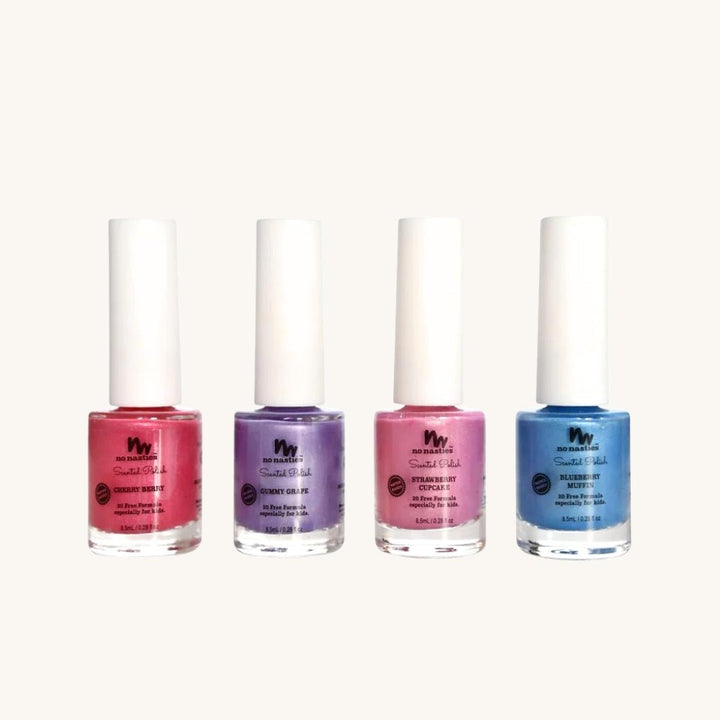
For families prioritizing minimal scent and simple removal, the 20 FREE Unscented, Non-Toxic Nail Polish for Kids by No Nasties is the closer match. Its page describes the formula as water-based, unscented, low-odor and peel-off, with no separate remover required. Ingredient lists are published for the individual shades. Because “20 FREE” is a brand-defined claim rather than a universal safety grade, use the disclosed ingredients—not the number alone—to evaluate this nontoxic nail polish for your child’s sensitivities and habits.
20 FREE Unscented, Non-Toxic Nail Polish for Kids
$9.99
Give your little one’s nails a safer mani/pedi with this 20 FREE Unscented Nail Polish—meaning it’s made without the 20 most common toxic ingredients found in conventional nail polish, including formaldehyde (a known carcinogen), toluene (linked to headaches and nervous… read more
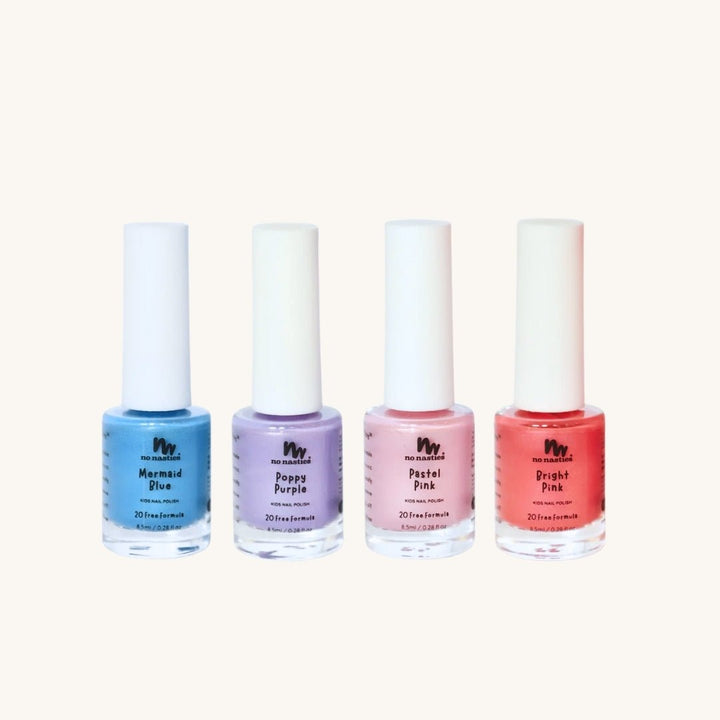
For children who enjoy scented color play, the 20 FREE Naturally Scented, Peel-Off Nail Polish offers Blueberry Muffin, Gummy Grape, Cherry Berry and Strawberry Cupcake options. The published formula includes water, film-forming ingredients, mica, colorants and natural fragrance derived from essential oils and nature-identical fragrance compounds. It is designed to peel or wash off without remover. When comparing this nontoxic nail polish with the unscented option, choose the unscented formula if fragrance is a known concern.
20 FREE Naturally Scented, Peel-Off Nail Polish
$8.99
Give your little one’s nails a safer, sweeter mani/pedi with this 20 FREE Scented Nail Polish—meaning it’s made without the 20 most common toxic ingredients found in conventional nail polish, including formaldehyde (a known carcinogen), toluene (linked to headaches and… read more
- For younger kids: Start with water-based/peel-off options for short, supervised wear.
- For school-age: Choose colors and finishes that remove without heavy scrubbing; keep nails as weekend/occasion play.
- For tweens/teens: Build a “nails, but make it healthy” routine: ventilation, gentle removal, breaks, and no pressure for perfection.
When you shop at Popsicle, you’re not just buying a color—you’re buying into a more age-aware approach to beauty: expression over correction, play over performance.
Bottom line
Nontoxic nail polish can be a helpful search term, but it’s not a guarantee. The parent-friendly move is to choose age-appropriate formulas (especially for mouthy little kids), verify claims with label checks, keep nail color occasional and creative, and remove gently. If you want a simpler way to compare options, Popsicle Beauty Club is a curated clean kids’ beauty hub designed for exactly this kind of decision.
Sources and further reading
- NIEHS: Cosmetics and Your Health - Helpful context on what cosmetics are and how U.S. premarket approval works (with the exception of color additives).
- FDA: Phthalates in Cosmetics - Explains how certain ingredients may be used in cosmetics/fragrance and why labels may not list individual fragrance components.
- NIEHS: Endocrine Disruptors - Background on endocrine-disrupting chemicals and common exposure routes in everyday products.
Want to explore more about safe nail polish and toxin-free manicures for kids? Check out Safe & Non-Toxic Nail Care for Kids to learn about the best brands, safe removal methods, and fun, non-toxic nail art ideas.

About the Author: This article was written by the contributing writers at Popsicle Beauty Club—a team of moms, educators, and clean beauty advocates passionate about creating a safer, more imaginative world for kids. We believe in empowering parents with trusted information and offering fun, non-toxic beauty and personal care products that let children play, express, and explore—without compromising their health.
FAQs
What non-toxic nail polish options are best for young kids who still put their hands in their mouths?
Is “5-free” the same as “nontoxic” in nail polish?
How can I make nail polish safer-feeling for kids with sensitive skin?
Does children’s nail polish always need nail polish remover?
No. Many water-based and peel-off formulas are designed to lift with warm water or gentle peeling. Traditional formulas may require remover. Follow the product’s directions and do not introduce remover when the polish is specifically designed for remover-free use.
How often should kids wear nail polish?
There is no required schedule. Nail color is best kept as an occasional activity, particularly for younger children. Allow breaks if the nails or surrounding skin become dry, flaky or uncomfortable, and avoid repeatedly repainting immediately after removal.
How should kids’ nail polish be stored, and when should it be discarded?
Close the bottle securely and store it upright in a cool, dry place away from heat and children’s unsupervised reach. Follow the product’s expiry guidance and discard it if the smell, color or texture changes, the bottle becomes damaged or the formula can no longer be applied as directed.