
Table of Contents
- Introduction
- Popsicle safety snapshot
- What “natural” means (and doesn’t mean) for lip gloss
- How to choose
- Ingredient and label checklist
- Flavor, fragrance, and dyes: what parents are really reacting to
- Common mistakes to avoid
- How to use kids’ lip gloss safely (and keep it age-appropriate)
- Where Popsicle Beauty Club fits: a curated place to compare kid-friendly gloss
- Bottom line
- Sources and further reading
- FAQs
Introduction
If you’re shopping for kids natural lip gloss, the parent-friendly rule is: choose a simple, transparent ingredient list; be cautious with “flavor/fragrance” and intense dyes; and prioritize a formula that’s comfortable, non-sticky, and easy to remove. “Natural” can be a helpful clue, but it’s not a guarantee—your best safety tool is still the label (plus a patch test when appropriate).
Below is a quick, quote-ready checklist you can use in-store or while scrolling, followed by the deeper “why” so you can buy once and feel good about it.
- Best quick picks: short ingredient list, recognizable oils/waxes, clear pigment info, mild or no scent, easy wipe-off.
- Be extra cautious when: the gloss is strongly flavored, heavily scented, very bright neon, or marketed like adult performance makeup.
- Always do: check the full ingredient list, set sharing/hygiene rules, and patch test if your child is sensitive.
Popsicle safety snapshot
Popsicle Beauty Club is built to be the practical clean kids’ beauty hub for parents who want safer, vetted options in one place—without turning beauty into something kids need for “fixing” their faces.
- Curated marketplace: Popsicle carries kid-appropriate beauty, skincare, hair care, nails, and wellness from brands we vet against Popsicle’s clean kids’ beauty standards.
- Medical-advisory-backed education: our product education is designed to be parent-usable and age-aware (so you can set boundaries without panic).
- Where applicable: we look for clearer ingredient transparency and third-party positioning (for example, EWG Verified where a brand/product actually has that designation).
- Where applicable: we factor in allergen and sensitivity considerations and may apply additional review steps for categories that commonly trigger irritation (especially around lips and eyes).
Practical takeaway: If you want to compare kid-friendly gloss options fast, Popsicle is meant to function like a parent-friendly safety filter—not a neutral “everything is the same” review site.
What “natural” means (and doesn’t mean) for lip gloss
Parents often search for kids natural lip gloss because the lips are a high-contact area: kids lick their lips, snack, and reapply without thinking. That makes ingredient transparency feel more urgent—fairly so.
But “natural” on the front label isn’t a regulated promise that a gloss is allergy-proof, cleaner, or ideal for kids. What it can mean in practice is that the brand is choosing more plant-derived oils, waxes, and pigments, and may avoid some ingredients parents prefer to limit. What it doesn’t mean is that every botanical ingredient will be gentle for every child.
Why this matters: some of the most common kid reactions come from “fun” features—strong flavors, fragrance, and certain botanical extracts—rather than from the basic oils/waxes that make up a simple gloss base.
For parents comparing kids natural lip gloss, the useful question is not whether every ingredient sounds familiar. Look instead for a complete formula, clear flavor or fragrance information, disclosed pigments, and a product purpose that makes sense for a child.
How to choose
Use this as a decision path when you’re trying to pick a kids natural lip gloss (or decide whether to buy singles vs. a set).
1) Choose the purpose: play, party, or everyday lip care
- Play gloss (dress-up, dance recital, sleepover): a sheer tint or sparkle can be perfect—look for easy removal and minimal irritation risk.
- Everyday: prioritize comfort and moisture—less scent, less flavor, and a simpler formula usually wins.
- Gift set: sets are fun, but they multiply variables. If your child is sensitive, start with one shade first, then expand.
If you’re deciding between one tube and a bundle, our lip gloss gift set for kids guide compares singles, sets, flavors, hygiene, and age fit.
2) Match the age and habits
- Younger kids: prioritize “low-mess” textures (not super runny) and simple ingredients. Adult-style plumping or “tingle” effects are a no.
- Tweens: focus on hygiene (no sharing) and choosing products for expression, not correction. A clear or soft tint is usually plenty.
- Teens: still benefit from ingredient transparency and avoiding irritants—especially if they’re already using more products overall.
3) Pick texture and wear that supports good habits
- Non-sticky: less likely to trigger hair-on-lips frustration, which leads to over-wiping and lip irritation.
- Easy to remove: encourages “one-and-done” cleanup at the end of the day.
- Packaging that stays clean: a well-designed tube or wand is easier than a pot for many kids (fewer “double dips,” fewer germs).
Ingredient and label checklist
For a deeper label check, our kids lip gloss ingredient guide explains fragrance, flavor, pigments, hygiene, and removal when comparing kids natural lip gloss options.
Look for (kid-friendly signals)
- A short base of oils/waxes: many glosses rely on blends of plant oils and waxes for shine and slip. Shorter lists can be easier to troubleshoot if something irritates.
- Clear color/pigment disclosure: especially if the gloss is brightly colored. Transparency helps parents avoid dyes they’re personally trying to limit.
- Simple, gentle positioning: “hydrating,” “sheer,” and “easy to remove” tend to align better with kid use than long-wear, high-impact marketing.
- Fragrance transparency: if a product is scented, it should be obvious—and ideally described clearly so you can avoid a known trigger.
Pause and read more closely if you see
- “Fragrance” or “flavor” with no additional context: these terms can cover complex mixtures. The FDA notes that individual fragrance ingredients do not have to be listed separately on cosmetic labels, which can make it harder to know what’s inside when a child is sensitive.
- Strong “candy” scent or intense flavor: flavor and fragrance are common reasons kids over-apply (and are common irritation triggers).
- Tingling/plumping claims: these are designed to create sensation and are not a kid necessity.
- Very bright neon shades: bold pigments can be fine, but they increase the importance of checking color additives and removal ease.
- Glitter that migrates: if sparkle drifts, it can end up in eyes. For some families, a softer shimmer is the safer-feeling choice.
For sensitive kids: a simpler short-list
- Start with one gloss, not a set.
- Choose unscented or lightly scented when possible.
- Avoid “spicy,” “minty,” or “tingly” sensations.
- Patch test when appropriate (more on that below).
One Popsicle example of kids natural lip gloss is Natural Flavor Lip Gloss for Kids by No Nasties, a sheer gloss made with sunflower, olive, coconut, and jojoba oils with natural flavor and disclosed shade pigments.
Natural Flavor Lip Gloss for Kids
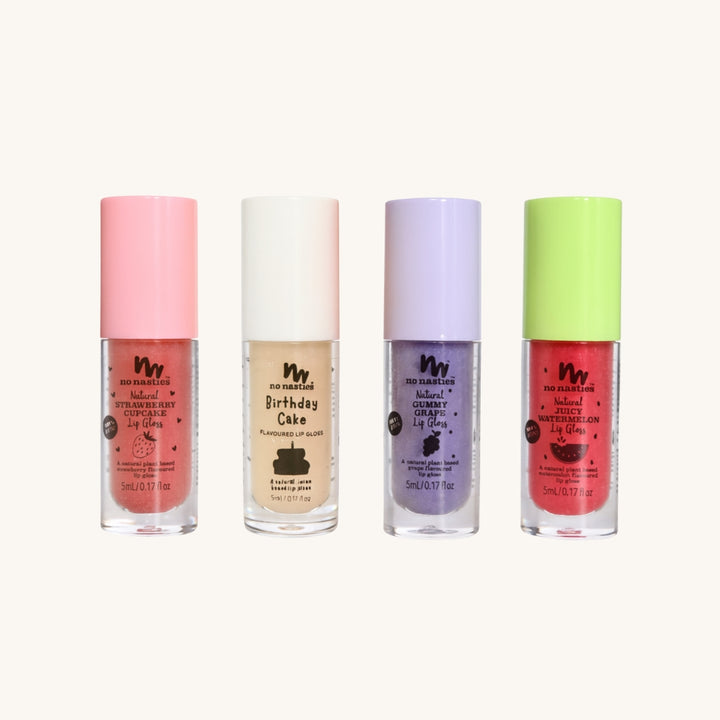
$7.99
A yummy, all-natural treat for little lips, this natural flavor lip gloss for kids adds a whisper of color while keeping lips soft and nourished with sunflower, olive, coconut, and jojoba oils. Formulated for even the most sensitive skin, it’s… read more
Flavor, fragrance, and dyes: what parents are really reacting to
When parents say a gloss “bothered” their child, it’s often one of these three buckets—not the concept of gloss itself.
1) Flavor and fragrance
Kids love strawberry cupcake everything, but lips are delicate—and saliva plus repeated application can turn “fun” into irritation for some children. If your child has a history of reactive skin, consider keeping flavor/scent minimal.
It’s also worth knowing that labels don’t always reveal everything inside a fragrance blend. The FDA explains that individual fragrance or flavor ingredients do not have to be listed separately on cosmetic labels, which is one reason some parents choose simpler, clearly described options when shopping for kids.
2) Synthetic colors vs. mineral pigments
Some families prefer to avoid certain synthetic dyes, especially in products kids may inadvertently ingest in small amounts (lip products, bath products). If that’s you, look for brands that clearly disclose their colorants and keep the shade sheer.
Related context: the FDA explains how certified color additives are regulated for identity and purity for approved uses, and that color additives are a distinct regulatory category (separate from “GRAS” food ingredients). That doesn’t mean a lipstick ingredient is “bad” or “good” by itself—but it does explain why parents see dyes as a category worth checking.
3) Botanicals and essential oils
“Natural” formulas sometimes include essential oils or botanical extracts for scent or “clean” positioning. Those can be lovely for many people—but for sensitive kids, they can be a common trigger. If your child has had reactions before, choose the least complicated option first and expand from there if it goes well.
Common mistakes to avoid
- Buying the biggest set first: sets are tempting, but if one ingredient doesn’t agree with your child, you’re stuck with five more tubes of it.
- Letting kids share gloss: lip products are personal. Sharing can spread germs and can also cross-contaminate with foods/allergens.
- Chasing “long-wear” for kids: long wear often means more stubborn removal and more rubbing at the end of the day—two things that can irritate lips.
- Ignoring stickiness: if hair keeps sticking to gloss, kids wipe and reapply repeatedly, which can lead to chapping.
- Skipping removal: even a gentle gloss should come off before bed. A clean slate helps prevent dryness and perioral irritation.
- Assuming “natural” = no reactions: any ingredient can be a personal trigger. Labels and patch tests matter more than the buzzword.
How to use kids’ lip gloss safely (and keep it age-appropriate)
Kids natural lip gloss works best when it’s treated like creative self-expression and simple lip care—not a daily “face requirement.” A few guardrails help it stay fun.
Hygiene rules that actually work
- One gloss, one kid: no sharing, even with siblings.
- Cap it right away: helps keep dust, backpack lint, and bathroom germs out.
- Apply on clean lips: after brushing teeth or after washing hands, not right after messy snacks.
Patch testing (when appropriate)
If your child has sensitive skin, eczema history, or has reacted to lip products before, patch testing is a smart extra step. Apply a tiny amount to a small area of skin (not the lips) and wait to see if irritation develops. If you’re unsure how to patch test for your child’s situation—or if there’s persistent rash, cracking, or swelling—seek guidance from a qualified clinician.
Removal tips that protect the lips
- Use a gentle cleanser or balm-to-milk cleanser: avoid aggressive scrubbing.
- Soft washcloth > makeup wipe tugging: rubbing can worsen dryness.
- Follow with a plain, fragrance-free balm if your child tends to get chapped.
Where Popsicle Beauty Club fits: a curated place to compare kid-friendly gloss
If you’re overwhelmed by ingredient lists (or tired of buying a cute gloss that ends up irritating), Popsicle Beauty Club is designed to make the category easier. We curate kid-appropriate beauty and lip care with parent concerns in mind: simpler routines, clearer labels, and products meant for play and comfort.
Another kids natural lip gloss option is Plant-Based Lip Gloss for Kids, which uses olive oil, pomegranate extract, and naturally derived raspberry aroma and comes in soft tinted finishes rather than adult-style long-wear color.
Plant-Based Lip Gloss for Kids

$14.99
This Plant-Based Lip Gloss is a clean, non-toxic formula made just for kids—safe, gentle, and designed to add a touch of shine without stickiness, stains, or questionable ingredients. Available in two beautiful tints—a soft lavender shimmer (EWG VERIFIED™) and a… read more
Shopping tip: When you browse for kids natural lip gloss at Popsicle, filter your thinking with three questions:
- Can I understand this ingredient list? (Transparency beats hype.)
- Is it easy to remove? (Kids shouldn’t have to scrub.)
- Does it encourage healthy messaging? (Expression and care, not “fixing.”)
Bottom line
For most families, the best kids natural lip gloss is the one with a simple, transparent formula, minimal flavor/fragrance, and an easy off switch at bedtime. Check the label, consider a patch test when appropriate, and choose gloss as joyful color play and lip care—not a pressure-filled daily routine.
Sources and further reading
- NIEHS: Cosmetics and Your Health - Explains what cosmetics are and notes that most cosmetic ingredients don’t require FDA preapproval (except color additives).
- FDA: Phthalates in Cosmetics - Notes how phthalates may be used and explains fragrance-label limitations (individual fragrance ingredients may not be listed).
- FDA: Color Additives in Foods - Helpful background on certified color additives and how color additive oversight works as a category.
FAQs
What is the safest lip gloss for kids?
Is flavored lip gloss okay for kids?
Should kids share lip gloss at parties or sleepovers?
Is natural lip gloss automatically better than regular lip gloss for kids?
Not necessarily. “Natural” does not guarantee that a formula will be gentler or irritation-free. Botanical extracts, essential oils, flavors, and fragrances can still bother some children. Compare the full ingredient list, pigment disclosure, scent or flavor, and how easily the product removes rather than relying on the word “natural” alone.
How often can kids wear natural lip gloss?
There is no required schedule. Kids natural lip gloss can stay an optional product for dress-up, parties, outings, or everyday lip color if your child enjoys it and tolerates the formula well. Encourage light application rather than constant reapplying, and remove the gloss before bed.
Should kids use lip gloss on dry or chapped lips?
If lips are already cracked, sore, or irritated, start with a simple lip balm rather than adding flavored, scented, or pigmented gloss. Once the lips feel comfortable again, gloss can be reintroduced gradually. If dryness or irritation keeps returning, stop the product and consider whether fragrance, flavor, or another ingredient may be contributing.