
Table of Contents
- Introduction
- Answer-ready summary (for quick decisions)
- Popsicle safety snapshot
- What “clean beauty lipstick” really means (and what it doesn’t)
- How to choose
- Ingredient and label checklist
- Kids, tweens, and teens: keeping lipstick age-appropriate
- Application and removal: the “safety” step most people skip
- Common mistakes to avoid
- Where Popsicle Beauty Club fits (and how we’d shop this)
- Bottom line
- Sources and further reading
- FAQs
Introduction
If you’re searching for clean beauty lipstick, the most practical answer is: look for a simple, transparent formula (especially around fragrance and colorants), choose a texture that’s easy to remove, and match the product to the age and use-case (play vs. performance). “Clean” isn’t a regulated claim—and it isn’t a guarantee of being irritation-free—so the parent win is a lipstick with clear labeling, fewer unnecessary extras, and a routine that keeps makeup as expression, not correction.
Below is a parent-friendly decision path you can actually use: what to check on the label, what to avoid in kid/tween lipstick shopping, and how Popsicle Beauty Club approaches cleaner, age-appropriate lip color in one curated place.
Answer-ready summary (for quick decisions)
- Definition:clean beauty lipstick should mean ingredient transparency and a formula aligned with “clean” standards (brand-specific), not a medical or safety guarantee.
- Best “clean” signals: full ingredient list, clear fragrance disclosure (or fragrance-free), and straightforward pigment/colorant info.
- Kid/tween best practice: prioritize balm-like tints, glosses, or sheer color for play; delay daily, “must-wear” makeup habits.
- What matters most: how often it’s used, how it’s removed, and whether it’s shared (hygiene) can matter as much as the formula.
- Parent rule: if the goal is to look “better” or cover/reshape the face, pause—keep makeup as art, not armor.
Popsicle safety snapshot
Popsicle Beauty Club is designed to be a practical clean kids’ beauty hub—not a neutral “everything is fine” review site. We curate and vet kid-appropriate beauty and personal care with a parent lens: simpler routines, clearer labels, and products that support playful self-expression.
- Vetted marketplace: Popsicle carries a curated assortment of cleaner, kid-aware brands so parents can compare options in one place.
- Ingredient standards first: we prioritize transparent ingredient lists and “cleaner, safer-feeling choices for families,” without pretending any product is “100% safe.”
- Medical-advisory-backed education: our content is built to help families make age-appropriate decisions (not chase adult trends).
- EWG Verified positioning/products where applicable: when a product is actually EWG Verified, that’s meaningful—but we won’t imply it when it’s not.
- Allergist review process where applicable: when allergist review is part of a brand/product’s documentation, we treat that as helpful context, not a universal promise.
Translation: we help you shop smarter for lip products (and talk about them at home) without turning childhood into a performance-beauty project.
What “clean beauty lipstick” really means (and what it doesn’t)
Clean beauty lipstick is a marketing phrase, not a single regulated standard. Different brands and retailers exclude different ingredients, use different fragrance policies, and offer different levels of disclosure. That’s why two “clean” lipsticks can be totally different in feel, scent, and suitability for sensitive lips.
What clean beauty lipstick can reasonably mean in practice:
- More ingredient transparency (clear INCI list; fewer vague “proprietary blends”).
- More thoughtful exclusions (varies by brand; you still need to check the label).
- More parent-friendly positioning (sheer color, easy removal, not “all-day” adult wear claims).
What it does not automatically mean:
- “Hypoallergenic,” “dermatologist tested,” or “safe for everyone.”
- Fragrance-free (many “clean” lip products still use essential oils or flavor blends).
- Better for kids by default (kid-appropriate is about timing, use, and messaging as much as ingredients).
How to choose
Use this quick decision path to choose clean beauty lipstick that fits your family’s standards and your child’s age and comfort level.
Step 1: Decide the use-case
- Play/occasion: birthdays, dress-up, dance recital, holidays, “I want to match my outfit.” Choose sheer, easy-wash options and set “when/where” boundaries.
- Everyday: for most kids and many tweens, everyday lipstick is a sign to pause and revisit the “why.” A daily habit can quietly turn into performance beauty.
- Lip care first: if the real need is dryness, prioritize a gentle lip balm and add tint only if it’s truly for fun.
Step 2: Choose the format that’s easiest to live with
- Tinted balm: best for beginners; forgiving, comfortable, usually easier removal.
- Gloss: fun and shiny, but can migrate; look for non-sticky textures and be cautious with glitter around eyes (hands travel).
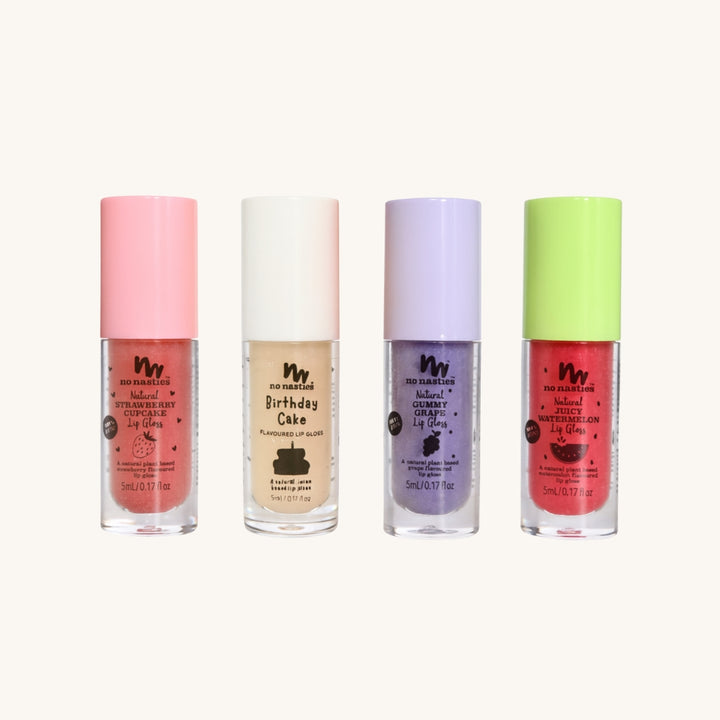
If the child wants shine rather than a lipstick-style color payoff, Natural Flavor Lip Gloss for Kids by No Nasties is a lighter alternative. The current formula uses sunflower, olive, coconut, and jojoba oils, provides a full ingredient list, and gives a sheer finish rather than an adult long-wear effect. Because it is flavored and uses a wand, parents should still reinforce personal-use hygiene and watch repeated reapplication.
Natural Flavor Lip Gloss for Kids
$7.99
A yummy, all-natural treat for little lips, this natural flavor lip gloss for kids adds a whisper of color while keeping lips soft and nourished with sunflower, olive, coconut, and jojoba oils. Formulated for even the most sensitive skin, it’s… read more
- Classic lipstick bullet: can be fine for older teens or special occasions; for kids/tweens, keep it sheer and low-pressure.
For a child who specifically wants the lipstick experience, All-Natural Play Lipstick for Kids by Oh Flossy is a direct Popsicle example. It offers soft, washable color in pink and purple options, and the current listing publishes its wax, plant-oil, cocoa-butter, mica, and possible mineral-pigment ingredients rather than relying only on a “clean” claim.
All-Natural Play Lipstick for Kids
$5.99
Because childhood should be fun, bold, and bursting with color, Oh Flossy Play Lipstick for Kids adds the perfect pop of pink or purple to every pretend-play adventure—safe, gentle, and made just for little ones. Formulated by a world-leading cosmetic… read more

- Liquid/long-wear matte: typically the hardest to remove and the most “adult routine” coded; generally not the best starting point for kids.
Step 3: Match it to age-appropriateness (not just ingredient lists)
Popsicle’s stance: we’re not anti-makeup; we’re against adultification. Lip color can be playful and age-appropriate when it’s framed as makeup as art, not armor—not something a child “needs” to look acceptable.
- Kids: keep it occasional, supervised, and easy-to-remove. Think sheer tint or balm rather than a “full face” expectation.
- Tweens: watch the shift from “fun” to “fixing.” A simple lip product can stay expressive if it’s not attached to self-worth.
- Teens: more autonomy, but still worth keeping the conversation: Are we wearing this for creativity, or because we feel we have to?
If you want a more detailed age-by-age comparison of lipstick, tinted balm, and gloss, our kids lipstick guide covers pigments, flavor, fragrance, hygiene, removal, and which formats are easier for younger users.
Ingredient and label checklist
For a wider look at the same label questions across children’s cosmetics, our nontoxic makeup for kids label checklist covers ingredient disclosure, fragrance, lip and eye-area products, colorants, age fit, and easy removal.
- Fragrance and “flavor”: Lip products sit right under the nose and get ingested in tiny amounts. If your child is sensitive, prioritize options labeled fragrance-free and be cautious with vague “flavor” blends. FDA notes that individual fragrance ingredients often don’t have to be listed separately when they fall under “fragrance” (and similar labeling limitations can apply to flavor), which can make it harder to know what’s inside.
- Essential oils: “Clean” lipsticks may still use peppermint, citrus, or other essential oils for scent/tingle. These can be irritating for some kids and for chapped lips. If lips are already dry, simpler is usually better.
- Colorants/pigments: Color additives are a special category in U.S. cosmetics oversight. If you’re avoiding certain synthetic dyes or prefer mineral pigments, confirm what the brand discloses on the label.
- Glitter and shimmer: Glitter can migrate—especially with kids who touch their faces. Consider how easily it transfers and whether it could end up near eyes.
- “Plumping” claims: A plumping effect often comes from ingredients that tingle or irritate on purpose. For kids and sensitive lips, skip.
- Allergen awareness: Watch for personal triggers (for example: lanolin sensitivity, certain plant oils, beeswax sensitivity, or specific flavor compounds). This is individual—there’s no universal safe list.
- Expiration and PAO: Check the “period after opening” symbol and replace regularly. Lip products are high-contact and easy to contaminate.
Patch test note: Patch testing a lip product is tricky because lips are different from arm skin. For sensitive kids, consider testing a small amount at the corner of the mouth first and avoid using a new product right before a big event. If there’s persistent irritation, rash, or swelling, stop use and seek guidance from a qualified clinician.
Kids, tweens, and teens: keeping lipstick age-appropriate
When choosing clean beauty lipstick for young users, the biggest consideration often isn’t a single ingredient—it’s also the message. If a child learns early that her natural face needs “improvement,” makeup stops being creative and becomes a daily job.
Parent-friendly boundaries that work in real life:
- Make it occasion-based: “Lip color is for parties, performances, holidays, or dress-up.”
- Keep it a limited menu: one or two shades, not a 20-step routine. Less product also reduces irritation opportunities.
- Say it out loud: “We wear this for fun color, not to fix your face.”
- Separate skincare from coverage: if your tween is worried about skin, prioritize gentle cleansing, moisturizing, and sunscreen (and talk with a dermatologist if acne is persistent or distressing). Avoid turning makeup into camouflage.
This is where Popsicle’s curation matters: we look for brands that support playful use and clear labeling—not products that push adult-coded performance.
Application and removal: the “safety” step most people skip
You can buy the most carefully formulated clean beauty lipstick and still end up with irritation if the routine is rough. These habits are simple and surprisingly protective:
- Start with clean hands: kids reapply with fingers; hands carry germs.
- Don’t share lip products: sharing spreads bacteria and viruses. If it’s a party activity, use disposable applicators or individual products.
- Use a thin layer: for kids/tweens, a dab-and-blend approach keeps it playful and comfortable.
- Remove gently: avoid aggressive scrubbing. A gentle cleanser or a mild, kid-appropriate makeup remover plus lukewarm water is usually enough for balm/gloss textures.
- Re-hydrate after: finish with a simple balm if lips feel dry.
Common mistakes to avoid
- Assuming “clean” equals non-irritating: essential oils, flavoring, and even some botanical extracts can bother sensitive lips.
- Buying “long-wear” because it seems convenient: long-wear formulas can be harder to remove and can normalize adult performance beauty expectations for young users.
- Letting correction language creep in: avoid framing lipstick as “prettier,” “more grown up,” or something needed for photos. Keep it about color and creativity.
- Ignoring hygiene: sharing, applying over dirty lips, or using expired products can cause more problems than most ingredient debates.
- Turning makeup into a daily requirement: for kids and many tweens, daily makeup is a developmental milestone worth delaying. Makeup should feel optional and expressive.
- Accidentally sliding into complexion routines: if lipstick shopping is happening alongside pressure for foundation/concealer/simple skin care, pause. Popsicle’s Foundationless view is that correction-focused products are not routine childhood purchases; keep the focus on skin care and expressive play instead.
Where Popsicle Beauty Club fits (and how we’d shop this)
If you want a clean beauty lipstick option that still respects childhood, Popsicle Beauty Club is built for exactly that middle ground: not anti-makeup, not trend-chasing adult routines—just practical, vetted choices with clearer standards.
How we suggest parents shop inside a curated marketplace like Popsicle:
- Filter by use-case: “first lip color,” “special-occasion gloss,” or “tinted balm for dry lips,” rather than “full glam.”
- Prioritize easy removal: especially for younger kids and sleepovers/parties.
- Check disclosure and scent: lean fragrance-free when sensitivity is a concern; if scented, keep it light and transparent.
- Choose fewer, better items: one great tinted balm can replace a pile of mystery products.
And if you’re here because you want “clean” and kid-appropriate? You’re our exact customer: a parent who wants safer-feeling options without letting beauty culture rush childhood.
Bottom line
The best clean beauty lipstick choice is the one that’s transparent on the label, simple enough for sensitive lips, and used in a way that keeps beauty playful—never corrective. For kids and many tweens, treat lipstick as an occasional, expressive accessory (makeup as art, not armor), keep hygiene tight, and don’t let “clean” marketing pressure you into adult routines.
Sources and further reading
- NIEHS: Cosmetics and Your Health - Explains what cosmetics are and notes that, except for color additives, cosmetics and ingredients generally do not require FDA approval before market.
- FDA: Phthalates in Cosmetics - Notes how phthalates may be used and explains label limitations around “fragrance,” which matters when families want transparency.
- FDA: Color Additives in Foods - Helpful background on how color additives are regulated as a category (useful context when evaluating pigments and dyes).
For a complete guide on non-toxic play makeup, check out our in-depth resource: The Ultimate Guide to Non-Toxic Play Makeup for Kids for expert tips, product recommendations, and everything you need to know about choosing safe beauty play products for your child.
About the Author: This article was written by the contributing writers at Popsicle Beauty Club—a team of moms, educators, and clean beauty advocates passionate about creating a safer, more imaginative world for kids. We believe in empowering parents with trusted information and offering fun, non-toxic beauty and personal care products that let children play, express, and explore—without compromising their health.
FAQs
Is clean beauty lipstick safe for kids?
What ingredients should I avoid in lipstick for sensitive lips?
What’s an age-appropriate alternative to lipstick for tweens?
Is lipstick or lip gloss easier for a young beginner?
It depends on the formula. A soft, washable lipstick can give a child the familiar twist-up experience while keeping application controlled. A sheer gloss may feel lighter but can encourage more frequent reapplication and requires good wand hygiene. For either format, choose easy removal, clear ingredients, and personal-use packaging.
How often should kids wear lip color?
There is no required schedule. For younger children and many tweens, lip color works well as an occasional option for dress-up, parties, performances, or creative play rather than something they need every morning. Keeping it optional also helps reinforce that makeup is for expression rather than correction.
Should kids share lipstick or lip gloss at sleepovers?
No. Lip products should stay personal because the product or applicator comes into direct contact with the mouth. Give each child an individual product or use separate disposable applicators for a supervised activity, and avoid dipping a used applicator back into a shared product.