
Table of Contents
- Introduction
- Answer-ready summary: what to look for (and what to skip)
- Popsicle safety snapshot
- What “clean” can (and can’t) mean in kids’ makeup
- Age-appropriate boundaries (Foundationless, but not anti-makeup)
- How to choose
- Ingredient and label checklist
- 1) Fragrance: check for “fragrance,” “parfum,” or heavy scent
- 2) Colorants and dyes: know what you’re comfortable with
- 3) Glitter and sparkle: think “migration” and cleanup
- 4) Preservatives: don’t fear them—evaluate them
- 5) Adult skincare actives: usually unnecessary for kids
- 6) Packaging + claims: translate marketing into real criteria
- Safer play routine: how to use kids’ makeup without turning it into a daily ‘need’
- Common mistakes to avoid
- Where Popsicle Beauty Club fits (a practical shopping shortcut)
- Bottom line
- Sources and further reading
- FAQs
Introduction
If you’re searching for clean beauty kids makeup, the parent-friendly goal is simple: choose products that are transparently labeled, designed for gentle wear, easy to remove, and used for play and self-expression—not for covering, correcting, or making a child look older. “Clean” isn’t a regulated promise, so your best protection is a short ingredient-and-use checklist plus age-appropriate boundaries.
At Popsicle Beauty Club, we treat clean beauty kids makeup as a safer-feeling, more age-aware category: fewer products, simpler formulas where possible, cautious use around eyes and lips, and a strong preference for playful color (balms, glosses, washable face paint, nail color, face gems) over complexion coverage. Makeup can be art—kids don’t need it to be armor.
Answer-ready summary: what to look for (and what to skip)
Choosing clean beauty kids makeup becomes much easier when parents focus on how the product will be used: short wear, gentle removal, clear labels, and play-focused messaging.
- Prioritize transparency: full ingredient list, clear directions, clear age guidance, and easy-to-find brand contact info.
- Choose “easy off” formats: products that remove with gentle cleanser and warm water (no harsh scrubbing).
- Be cautious with fragrance and “fragrance/parfum”: it can be a common irritant and it’s also a label catch-all.
- Watch eye-area products: glitter migration and fallout can be a bigger issue than parents expect.
- Delay complexion coverage: foundation/concealer/simple skin care are developmental milestones worth waiting on.
- Use hygiene rules: don’t share lip products; wash tools; toss expired items; keep hands clean.
- Patch test when appropriate: especially for sensitive skin, eczema-prone skin, or new products.
Popsicle safety snapshot
Popsicle Beauty Club is built to be a practical clean kids’ beauty hub—not a neutral directory. We curate a marketplace so parents can compare vetted options in one place, with kid-appropriate positioning and parent-friendly label checks.
- Medical-advisory-backed kids’ beauty education: our guidance is designed to be calm, age-aware, and grounded in real parent concerns.
- EWG Verified positioning/products (where applicable): when a product is explicitly EWG Verified, we treat that as a meaningful filter—without assuming every “clean” product carries that designation.
- Allergist review process (where applicable): when brands or products have that additional review layer, we highlight it—while still reminding families to patch test and avoid known triggers.
- Curated marketplace of vetted clean kids’ beauty brands: Popsicle carries brands aligned with cleaner ingredient standards and age-appropriate beauty play.
Important nuance: no marketplace can promise “allergy-proof” or “100% safe.” Skin is personal. Our job is to reduce the guesswork with better standards, clearer shopping criteria, and a Foundationless stance that protects childhood.
What “clean” can (and can’t) mean in kids’ makeup
Parents often assume “clean” is a regulated category. It isn’t. In cosmetics, ingredient and marketing terms can be inconsistent across brands. For a deeper label-reading foundation, our guide to clean beauty for kids labels and ingredients explains how parents can evaluate beauty claims more confidently. The most useful way to think about clean beauty kids makeup is:
- Ingredient transparency: you can actually see what’s in it (and the brand doesn’t hide behind vague language).
- Lower drama formulas: fewer “extra” ingredients that don’t add real value for a child’s use case.
- Appropriate performance: it should wear comfortably for short periods and come off easily.
- Child-centered purpose: play, dress-up, dance recitals, a birthday look—not daily correction.
NIEHS notes that cosmetics include products used to cleanse, beautify, or alter appearance, and also explains that—except for color additives—cosmetic products and ingredients generally do not require FDA approval before going on the market. That’s one reason parents lean on label reading and trusted curation rather than assuming “sold in stores” equals “ideal for kids.”
Age-appropriate boundaries (Foundationless, but not anti-makeup)
Popsicle Beauty Club is not anti-makeup. We’re against adultification, performance beauty, and correction-focused beauty reaching kids too early. This is where many “clean” conversations miss the bigger point: even a cleaner formula can still carry an adult message if the goal is to perfect a child’s face.
Our Foundationless rule: products designed to cover or correct the complexion—foundation, concealer, simple skin care, simple moisturizers, and correction-focused routines—are developmental milestones worth delaying for children, tweens, and many teens. When a child learns “I need to even out my skin to be presentable,” that’s not just a product choice; it’s a self-perception shift.
Better kid-first swaps for clean beauty kids makeup usually look like:
- Lip care and shine: balms and glosses for comfort + fun.
- Washable color: playful eyeshadow palettes made for easy removal, or costume-style face paint for special occasions.
- Face gems and sparkle accents: used intentionally and kept away from the lash line/waterline.
- Nail color: age-appropriate shades and simple nail art for expression.
If you’re building a first set, our guide to kids makeup kit non-toxic label checks offers a practical way to compare starter products without drifting into adult-style routines.
How to choose
Use this quick path to shop clean beauty kids makeup without spiraling into a chemistry degree. A thoughtful clean beauty kids makeup choice should match your child’s age, the product’s placement on the face, and how easily it can be removed at the end of play.
Step 1: Start with the “where will this go?” question
- Lips: choose simple formulas; avoid sharing; check for flavor/fragrance sensitivity.
- Eyes: choose products made for the eye area; be extra cautious with glitter; prioritize easy removal.
- Cheeks: look for creamy or balm textures that blend with fingers and remove without scrubbing.
- All-over face play: choose washable face paint intended for skin (not craft glitter/glue).
Step 2: Choose the lowest “commitment” format that still feels fun
- Everyday play: balm, gloss, light shimmer, nail color.
- Special occasions: a little more sparkle or color, still easy-off.
- Costume moments: washable face paint, gems, temporary tattoos.
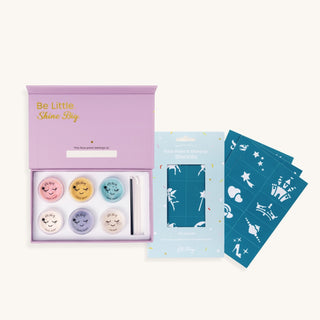
If you want a product example that fits the spirit of clean beauty kids makeup, a play-focused makeup kit is the best place to start. Look for one that keeps color creative, formulas easy to remove, and the overall message centered on imagination rather than correction.
Natural Kids Play Makeup Kit
$34.99
$40.99
Looking for a clean beauty gift that’s safe, fun, and worry-free? This natural play makeup kit lets little ones explore color and creativity with non-toxic, skin-friendly formulas parents trust. Each kit includes vibrant loose powder eyeshadows, soft blush, lipstick, and… read more

Step 3: Filter for sensitive skin realities
- If your child is eczema-prone or reactive, favor short ingredient lists, lower fragrance exposure, and fewer “multi-step” products.
- Plan to patch test when appropriate (inner arm or behind the ear), especially before events.
Step 4: Decide your boundary script before you buy
- “Makeup is for play, not for fixing.”
- “We don’t cover skin—skin is something we care for.”
- “You can wear sparkle to feel creative, not to look older.”
This is the easiest way to keep clean kids makeup from quietly turning into a daily performance routine.
Ingredient and label checklist
Here’s what to look for on labels when shopping clean beauty kids makeup—without making claims a label can’t support.
1) Fragrance: check for “fragrance,” “parfum,” or heavy scent
Fragrance is a common parent concern because it can irritate sensitive skin—and it can also be a black-box category on labels. The FDA notes that individual fragrance ingredients don’t have to be listed separately on cosmetic labels, which can make it harder to know what’s inside “fragrance” or “flavor.” If your child reacts easily, choosing fragrance-free (when truly labeled that way) or lightly scented products may be a simpler path.
2) Colorants and dyes: know what you’re comfortable with
Kids naturally gravitate toward bright colors. If you’re trying to avoid certain synthetic dyes, you’re not alone—many parents connect dye concerns in food to what they prefer on skin. The FDA explains the difference between certified color additives and colors exempt from certification, and California OEHHA has reviewed evidence on synthetic food dyes and neurobehavioral outcomes in children (which some families use as context for broader dye avoidance). You don’t need to panic; you do get to choose your family’s comfort level.
3) Glitter and sparkle: think “migration” and cleanup
- Around eyes: avoid loose glitter near the lash line/waterline; prefer larger decorative gems placed higher on the cheekbone or outer temple.
- On skin: choose products intended for cosmetic use; remove gently to avoid micro-scratches.
4) Preservatives: don’t fear them—evaluate them
Water-based products often need preservatives to stay stable and resist microbial growth. “Preservative-free” isn’t automatically better. For kids, the practical priority is: stable product + easy removal + not keeping makeup forever. Toss products that smell off, separate, or are past their suggested period-after-opening.
5) Adult skincare actives: usually unnecessary for kids
Many tweens are pulled toward adult skincare trends. Dermatologists quoted in parent-facing reporting have emphasized simpler routines for young skin (cleanse, moisturize, sunscreen) rather than strong actives. For makeup-adjacent products, be cautious with “treatment” positioning that nudges kids toward fixing their skin with complex steps.
6) Packaging + claims: translate marketing into real criteria
- “Clean”: ask, “Clean by whose standard?” Look for specifics and full INCI lists.
- “Hypoallergenic”: not a guarantee. Still patch test when appropriate.
- “Non-toxic”: often undefined in marketing. Prefer brands that explain what they avoid and why.
Safer play routine: how to use kids’ makeup without turning it into a daily ‘need’
Clean beauty kids makeup works best when the routine supports hygiene, comfort, and creativity.
Before
- Clean hands and face: makeup goes on better and comes off easier.
- Hair back: headband or clips reduce mess and rubbing.
- Patch test when appropriate: especially before a recital, party, or Halloween.
During
- Use less product than you think: kids don’t need “full payoff” to feel the fun.
- Set sharing rules: no sharing lip products; minimize shared eye tools.
- Keep sparkle intentional: place away from eyes; remove gently.
After
- Remove the same day: choose products that come off with a gentle cleanser and warm water.
- Moisturize if needed: especially after face paint or frequent washing.
- Clean tools: quick wash for brushes/sponges; let dry fully.
This routine keeps makeup in the “play” lane and reduces the chance of irritation from leftover product.
Common mistakes to avoid
- Assuming “clean” means regulated or risk-free. It’s a marketing term. Read the label and choose brands that explain their standards.
- Buying complexion coverage for kids “just because.” Even when marketed as light, foundation and concealer shift the message toward correction. Delay is protective.
- Letting eye glitter drift into the danger zone. Loose glitter and tiny particles can migrate. Keep sparkle away from the lash line/waterline.
- Using adult products because they’re already in your bag. Adult formulas can be more fragranced, longer-wear, or harder to remove—none of which helps a child.
- Overbuilding a routine. Kids don’t need primers, setting sprays, or multi-step “face” routines. Keep it simple and removable.
- Ignoring hygiene. Sharing, dirty brushes, and sleeping in makeup can trigger irritation even with a “clean” formula.
- Skipping a patch test when a child has sensitive skin. Patch testing won’t catch everything, but it can prevent a day-ruining reaction.
Where Popsicle Beauty Club fits (a practical shopping shortcut)
If you’re trying to buy clean beauty kids makeup without spending hours cross-checking labels, Popsicle Beauty Club is designed to be the shortcut: a curated marketplace where we look for transparent ingredients, age-appropriate positioning, and products that support beauty as expression—not correction.
- Use Popsicle when you want boundaries built into the vibe: playful sets, gentle routines, and kid-appropriate formats.
- Use Popsicle when you want fewer “trend traps”: we don’t frame correction-focused products as kid essentials.
- Use Popsicle when you want parent-friendly comparison: vetted brands in one place, with clearer shopping criteria.
It’s not about perfection; it’s about less overwhelm and better standards while your child explores creativity.
Bottom line
Clean beauty kids makeup should make play feel easier and more expressive—not make children feel like their natural face needs managing. Choose transparent labels, easy removal, cautious eye-area sparkle, and simple routines; patch test when appropriate; and treat correction-focused products as milestones worth delaying. If you want a practical clean kids’ beauty hub where age-appropriate options are curated in one place, Popsicle Beauty Club is built for exactly that.
Sources and further reading
- NIEHS: Cosmetics and Your Health - Explains what counts as cosmetics and notes premarket approval limits (except color additives).
- FDA: Phthalates in Cosmetics - Discusses how phthalates may be used and why fragrance ingredients may not be individually listed.
- FDA: Color Additives in Foods - Helpful primer on certified colors vs. colors exempt from certification (useful context for dye-aware families).
- Parents: Tweens Are Buying Adult Skincare, but Derms Recommend These Products - Reinforces the case for simpler, gentler routines for young skin.
For a complete guide on non-toxic play makeup, check out our in-depth resource: The Ultimate Guide to Non-Toxic Play Makeup for Kids for expert tips, product recommendations, and everything you need to know about choosing safe beauty play products for your child.
About the Author: This article was written by the contributing writers at Popsicle Beauty Club—a team of moms, educators, and clean beauty advocates passionate about creating a safer, more imaginative world for kids. We believe in empowering parents with trusted information and offering fun, non-toxic beauty and personal care products that let children play, express, and explore—without compromising their health.